
Waitman Wade Beorn is an associate professor of history at the University of Northumbria in Newcastle, UK. He is the author of Marching into Darkness: The Wehrmacht and the Holocaust in Belarus and The Holocaust in Eastern Europe: At the Epicenter of the Final Solution. His latest book Between the Wires: The Janowska Camp and the Holocaust in Lviv (Nebraska, 2024) was published in August.
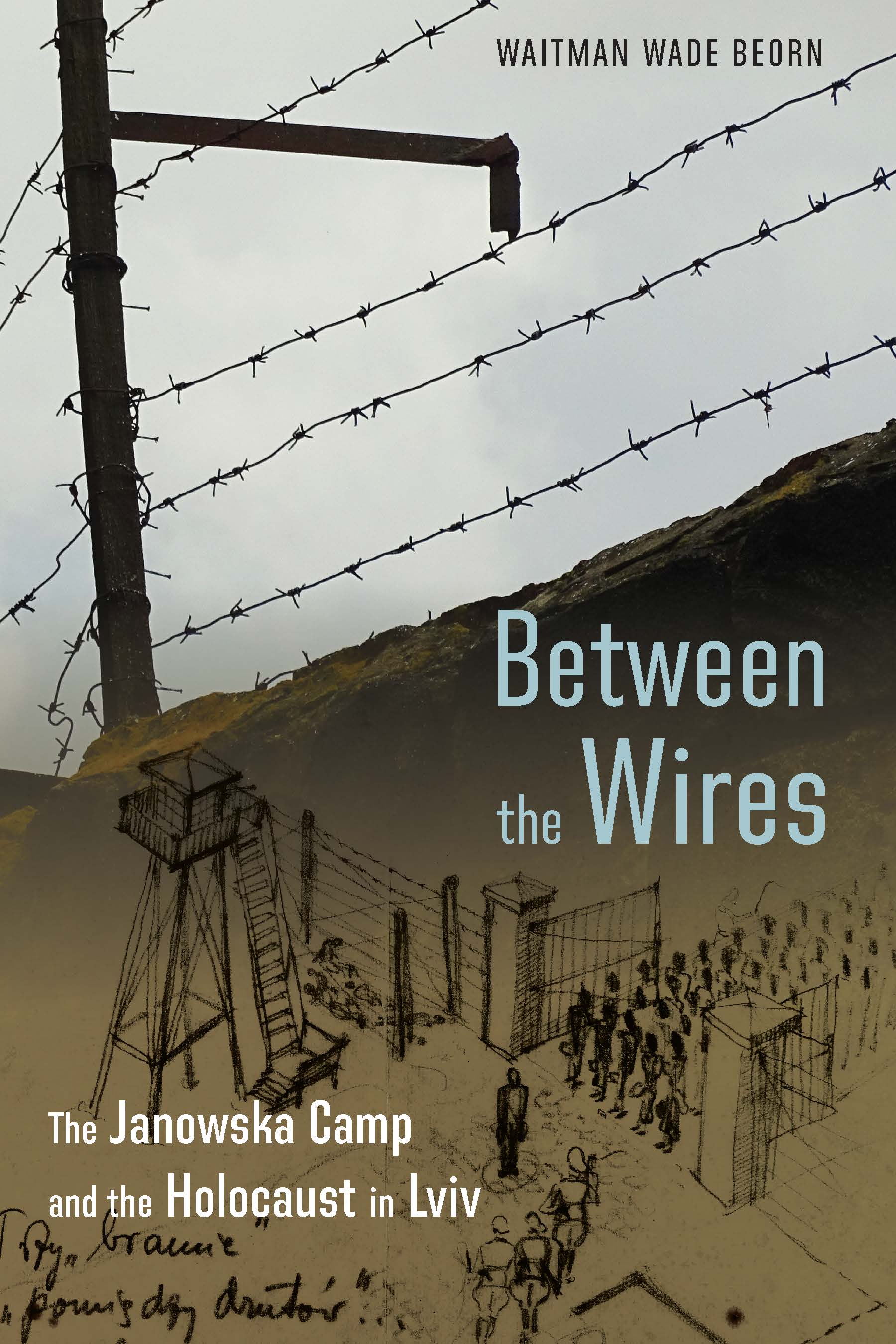
Between the Wires tells for the first time the history of the Janowska camp in Lviv, Ukraine. Located in a city with the third-largest ghetto in Nazi-occupied Europe, Janowska remains one of the least-known sites of the Holocaust, despite being one of the deadliest. Simultaneously a prison, a slave labor camp, a transit camp to the gas chambers, and an extermination site, this hybrid camp played a complex role in the Holocaust.
Prologue
How doth the city sit solitary, that was full of people!
—Book of Eicha (Lam. 1:1)
How is she become as a widow!
If you step onto tram number 7 in front of the grand yellow neoclassical Maria Zankovetska Theatre in downtown Lviv, it will take you to the end of the line on the western outskirts of the city along Shevchenka Street in about twenty minutes. And if you get off one stop before the terminus, you arrive at the Yanivski cemetery. Walking through this forested necropolis laid out on a neat grid, you are also entering the former “New” Jewish cemetery, founded in 1855. An art nouveau–style funereal building (Beth Tahara) was built in 1912 but it was destroyed along with almost all of the Jewish cemetery complex under the shadow of the swastika. The distinctive neo-Romanesque fence still stands, but now marks the border of a Christian cemetery. Only a few Jewish tombstones (matzevot) from the postwar period remain, distinctive in their rounded shape, Stars of David, and Hebrew lettering. Protective fencing surrounds them, as if guarding them against their neighbors. The oldest Jewish tombstones found in the city date to 1348. Citizens of Lviv often bring the fragments of old matzevot to the cemetery when they are found in the city where the Nazis used them as building materials.
Two such fragments laid at the entrance to the cemetery when I visited in 2017. One belonged to Izak Kroch, “an enlightened and educated man” who died on January 10 or 11, 1919. A blessing could be seen on the stone: “May his soul be bound in the bond of life.” The other tombstone was fragmented, violently ripped in half, leaving only a jagged diagonal top portion. The surviving inscription reads: “Here lies an esteemed woman,” who died on September 14 or 15, 1893. Beneath a three-armed candelabra, the rest of the matzevah is gone, leaving only the fragment and the words “and upright.” The place of her burial and even her name have been erased forever.
Deeper into the now almost entirely Christian cemetery, the path leads up a hill into the newest section, where unfinished mausoleums rather haphazardly populate either side of a muddy road. Breaking through the trees into the tall grass at the top of the ridge, the terrain of the former Zwangsarbeitslager-Lemberg (ZAL-L) or Forced Labor Camp-Lviv comes into view. This was the Janowska camp, a place where perhaps eighty thousand Jews were murdered. Below, in the shadow of the curving cliffs, is what remains of this sinister place. Perhaps fittingly, it is still a prison: the Lychakivska Penal Colony Number 30. Often shrouded in fog and smoke, the complex still occupies almost precisely the footprint of the old Nazi camp. Though many new buildings have been added, the place still evokes a palpable feeling of desolation and despair. The icy wind through the barren trees and the snow heavy on the ground only reinforces an almost visceral feeling that this is defiled ground, a truly cursed place.
And the very ground is defiled. Walking west down a narrow forest trail, one can still clearly see the natural draws and ravines known as “the Sands,” a name once whispered with terror by the Jews of the city, where thousands of men, women, and children were shot to death and later burned. Just north of the prison’s walls lies a small field where the Jews of Lviv and other surrounding communities awaited their turn to be murdered in these hills. This circuit ends at approximately where the monumental entrance to the Janowska camp once stood. Indeed, the former camp headquarters building remains, lying just outside of the modern prison; it is now a multifamily home. Guard dogs bark from within the prison yard. More recent guard towers and wire blend with rusted wartime wire and long-dark drooping lights from the Nazi era. A simple sign in this neighborhood (which also used to be part of the camp complex) explains that this is the grounds of the Janowska concentration camp. It says, “This is a site of memory of the Holocaust.” Yet, few have heard of this camp and fewer still remember it. Like the tombstones at the cemetery’s entrance and those buried throughout the city, the terrible history of the Janowska is fragmented, scattered, and unexcavated.
 UNP blog