
Elise Franklin is an assistant professor of history at the University of Louisville. Her latest book Disintegrating Empire: Algerian Family Migration and the Limits of the Welfare State in France (Nebraska, 2024) was published this month.
The latest title in the France Overseas: Studies in Empire and Decolonization series, Disintegrating Empire examines the entangled histories of three threads of decolonization: the French welfare state, family migration from Algeria, and the French social workers who mediated between the state and their Algerian clients.


Chapter 5 of my new book, Disintegrating Empire, begins with the story of Madame A., a woman from Algeria living in France nearly a decade after Algerian independence. According to the details kept in a case file by her French social worker, Madame A. petitioned the French government for a Medal of the French Family in 1971. This medal was created in the wake of the First World War as an initiative to promote the birth rate and reward mothers of large families for repopulating the nation. While she was born in Algeria, Madame A., her husband, and their children had moved to France after the conclusion of the Algerian War (1954-1962). They had petitioned for and received French citizenship in recognition of Monsieur A.’s service to the French army. A mother of nine, Madame A. was an excellent candidate for the gold medal, which was awarded to families with eight or more children. Despite her social worker’s insistence that Madame A. had scrupulous “moral character,” paid dutiful attention to her children’s education and health, and kept a well-ordered house, the regional committee rejected Madame A.’s application. They wrote that Madame A. did not fulfill the necessary criteria. When the social worker appealed, she did not receive a reply.
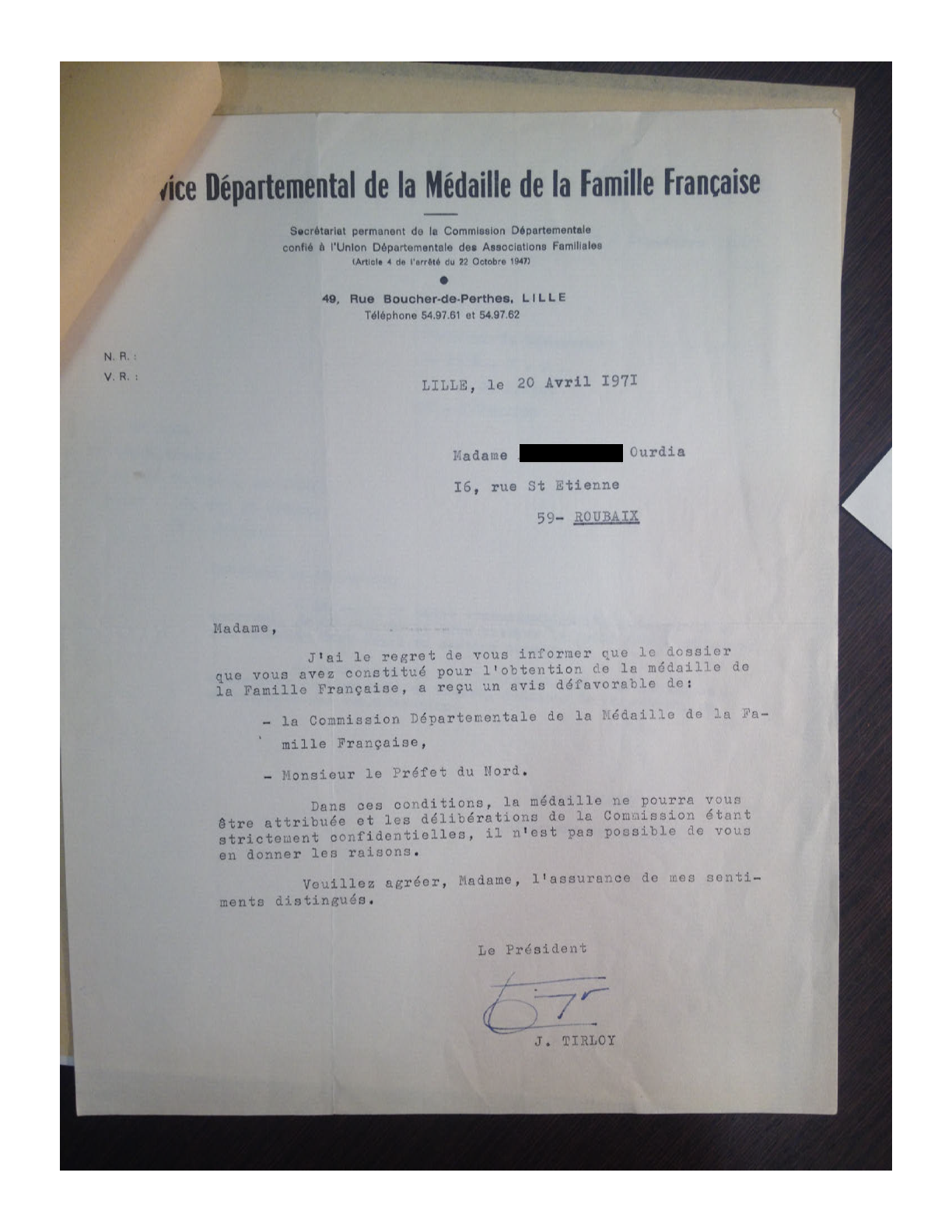
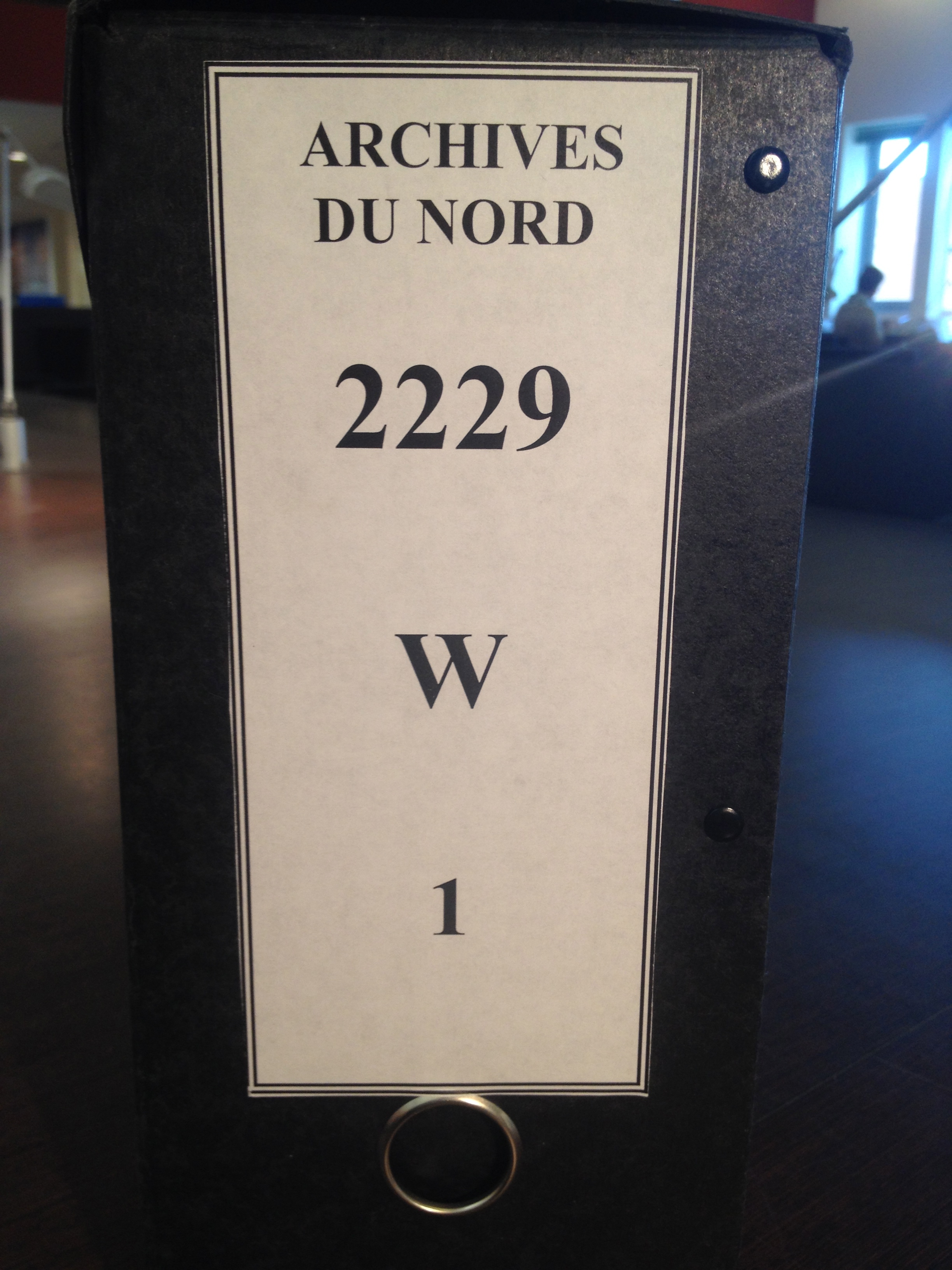
I first came across Madame A.’s case as I sifted through files conserved by the thousands by the Departmental Archives of the Nord in Lille, France while I conducted dissertation research in 2014. I was overwhelmed by the mountains of paperwork testifying to years of interventions conducted by a French specialized social aid association called the Social Service for North African Families (SSFNA), an organization founded in the early 1950s. The social workers were specifically trained to provide remedial social services to families from Algeria, who were at the time colonial citizens of France’s largest colonial territory in Algeria. I looked through 25 boxes containing over 2,700 families’ case files and recorded information about the families, their stays in France, the length of their relationship with the SSFNA, and summaries of their requests, bureaucratic travails, and case notes. As I pored over families’ case histories, I was struck by the enormous, but decentralized and disorganized, capacity of the midcentury French welfare state to engage everyday French and non-French inhabitants of villages, cities, departments, and regions. Most files engaged offices at every level of the French administrative apparatus, from the specialized social worker at the welcome desk of a regional office to the departmental prefectures to the offices of the central administration tasked with migration. The web of communication and activities that emerged painted a vibrant picture of how relationships between social workers and their Algerian clients spiraled in messy and unpredictable ways from the interpersonal to the structural.
This was also a portrait of a social welfare state confronted with a critical question: to what extent should the French state administer care to both laboring and non-laboring members of migrant families from France’s former colonies? The volume of information I was accumulating was so overwhelming, the tiny data points in a much larger picture, in fact, that I initially scarcely processed the relevance of Madame A.’s file to this essential question. Madame A.’s file—her desire for recognition from the French administration for her maternal service, her social worker’s many letters to pursue this award, and her ultimate rejection—provided a case-in-point of the pointed concerns of the decolonizing French welfare administration that in no way wished to encourage the birth rate of families from Algeria (whether they held French citizenship or not). The French welfare state was known for its largesse, but it was also increasingly interested in only providing benefits to white French citizens.
This had not always been the case, for Madame A. was not the first or only woman from Algeria to apply for the Medal of the French Family. Other historians have uncovered cases of successful applications during the Algerian War as well as concerted efforts to promote Algerian family migration as a tempering factor against nationalism. As I thought more about her file, however, there was another aspect that seemed to bear consideration: what was the nature of the connection between Madame A. and her social worker? How could I use social worker’s case files, a notoriously problematic source, to think differently about the long-term relationship that families established with social workers and the French social services over the course of decolonization? This case became the heart of a methodological problem that I wanted my book to engage. When I began to think about case files as “family stories,” I realized they reflected a dynamic, iterative rapport between families and their chroniclers, social workers, often over the course of many years. As Arlette Farge and Michel Foucault famously suggested, historians only encounter these family stories as “incomplete translations.” In my story: conversations between social workers and clients are recorded from the social worker’s perspective. They are also an opening for analysis about the ways Algerian families and social workers negotiated the midcentury French welfare state as it sought to restrict services to Algerians who were no longer citizens of greater France.
In this book, I use the stories of these relationships as one “thread” of disintegrating empire to understand the slow social historical process of decolonization over the course of the Algerian War and in the decades following Algerian independence. I use this thread alongside two others—the French midcentury welfare state and family migration from Algeria—to demonstrate the tangled relationship between the institutional and structural elements of the French administration and its empire in Algeria even as both countries worked to disentangle in the 1960s and 1970s. The stories of the relationships between families and their social workers are where the interpersonal and the institutional collide. Using these case files as well as the archives of private social aid associations and the central French administration, I argue that families from Algeria were not only auxiliary to the French welfare state; they were evidence of its power and its limits.
 UNP blog