
Jacob Flaws is an assistant professor of history at Kean University. His latest book Spaces of Treblinka: Retracing a Death Camp (Nebraska, 2024) was published this month.
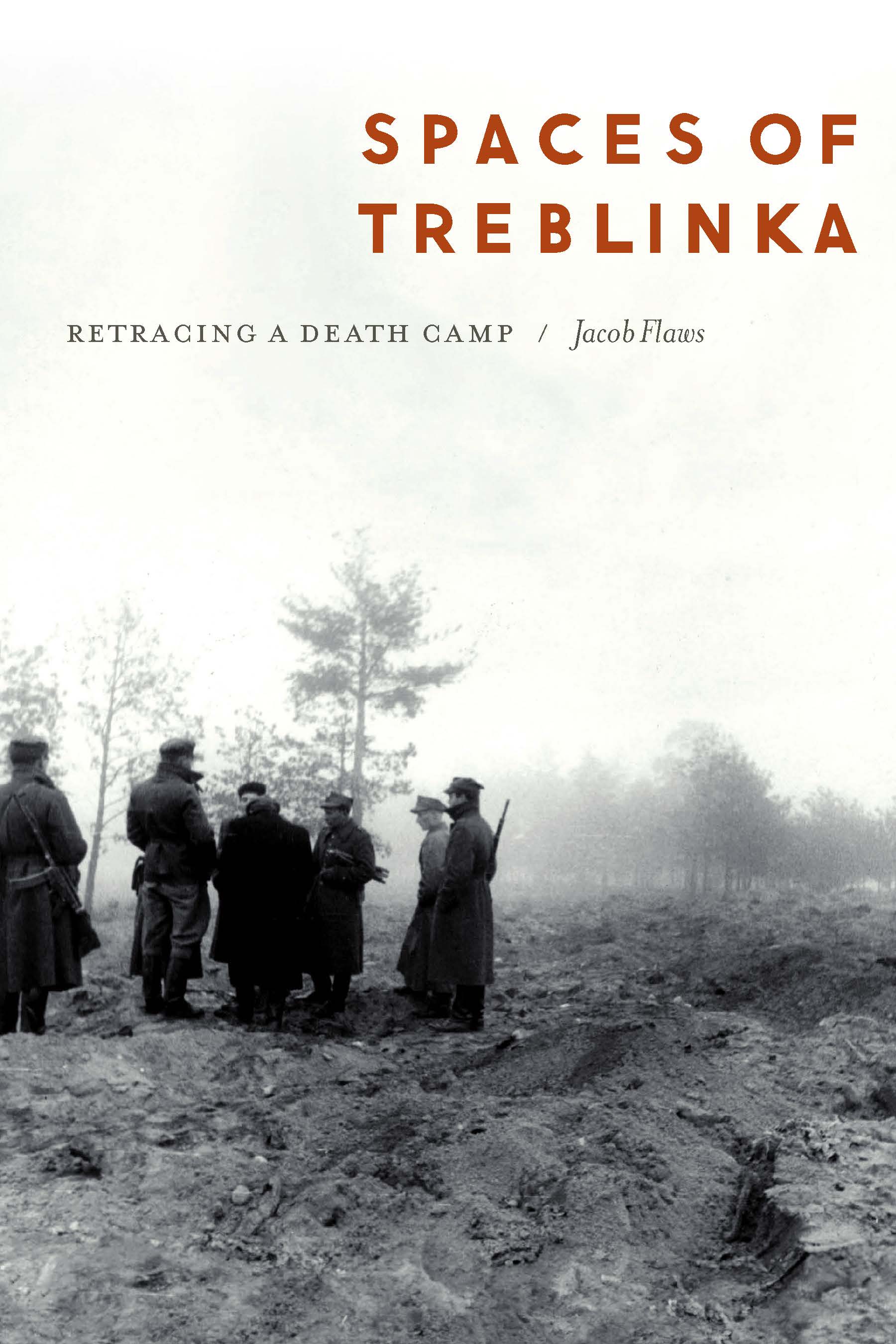
Have you ever visited a place that you felt was haunted? That basic idea was what drove me to write a book about Treblinka. While visiting sites of the Holocaust, I have often felt the tug of the past through the spatial landscape—walking through the once-electrified fences at Auschwitz; seeing the blue stains left from Zyklon B inside the gas chambers at Majdanek; smelling the musty, damp odor of the morgue room at the T4 killing site at Hartheim.
It is fairly easy to connect a dark history when immersed in the very same spaces where it happened. But Treblinka presented me with something different. Spread across an open field in a rural part of Poland jutted thousands of jagged memorial stones next to a large monument with a menorah clearly visible on its face. The place was quiet, serene, and poignant. Yet, nowhere were the crude wooden barracks, or the crematorium with its ovens, or the imposing gate with the “Arbeit Macht Frei (work makes you free)” sign that I’d come to associate with spaces of the Holocaust.
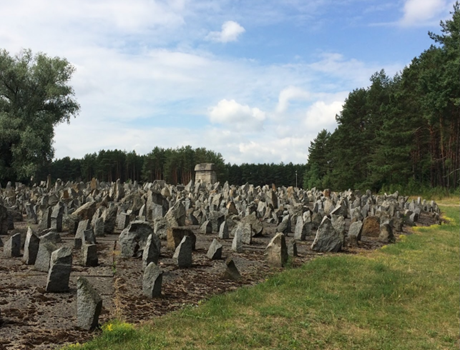
At Treblinka, I was confronted instead with a gaping absence—the lack of what once was in this very spot. I felt haunted but had no structures or remnants of buildings on which to attach that feeling.
Over the next decade, I embarked on a journey to try to reconceptualize what was there; to try to understand how such a horrible place might have actually looked, sounded, smelled, and felt like when it was operational. I needed to give myself, more than anybody else, an idea of the spatial legacy of place that no longer existed.
Spaces of Treblinka: Retracing a Death Camp is the result of that study, and I believe it gives the best portal into understanding what Treblinka was actually like. Along the way, I discovered that when it comes to reconceiving of no-longer-existent historical spaces, one has to rely on the memories of all of those who were impacted by the site when it was around. That meant putting the voices of German perpetrators alongside those of Jewish victims (and survivors) and local Polish witnesses. Contrasting their varying vantage points and relationships to the camp itself reconstituted the power dynamics at play wherein a global war is ongoing while one group (Germans) is occupying and suppressing another (Poles), and simultaneously aiming to completely eradicate a third (Jews). Wrapped up in these intense, violent, and unpredictable human landscapes were moments of death, survival, escape, separation, despair, brutality, and, in often small flickers, kindness, hope, and humanity.
The stories of these varied human interactions play out on the pages of Spaces of Treblinka, while simultaneously challenging us to rethink our own lived experiences. All too often we ascribe agency in history to humans alone, but at all times and places, the natural environment and its rhythms and whims played major roles in determining historical outcomes. Whether it was the wind spreading the smoke of burning bodies for miles for all to see or giving a fleeing Jewish escapee a bush to hide behind to avoid recapture, we humans don’t enact our lives outside of the landscapes in which we find ourselves.
For me, it was these subtle, often fundamental observations that carried the greatest power when considering how Treblinka once existed because they made it real. The death camp, those associated with it, the natural world it was within, and the larger world beyond, all of a sudden no longer appeared as black and white images of what once was. Instead, with the perspective I took (and I hope you will too in reading the book), I confronted a space consisting, as is true of all spaces that exist, have ever existed, and will exist, of vivid, multi-sensorial, and three-dimensional reality. Of all the observations I make in Spaces of Treblinka, this one is perhaps the most powerful because it helps remove some of the barriers that often arise when trying to truly put ourselves in the past. By trying to visualize what they saw, listen to what they heard, consider what they smelled, wonder about whose otherwise disparate paths may have crossed in the dead of night, and understand just how connected we are in the modern world, we begin to close the gap between then and now. And in so doing, we realize that haunted spaces of today retain that feeling because when we stand inside of them, it is really only time that separates us from what they once were; and that if we were there 80 years ago, we wouldn’t want to be standing there at all.
 UNP blog