
Rebecca Romo is an associate professor of sociology at Santa Monica College. G. Reginald Daniel (1949–2022) was a professor of sociology at the University of California, Santa Barbara. He was the cofounding editor and editor in chief of the Journal of Critical Mixed Race Studies and author or editor of numerous books, including More Than Black? Multiracial Identity and the New Racial Order. J Sterphone is a visiting assistant professor of sociology at Wheaton College. Their most recent book Between Black and Brown: Blaxicans and Multiraciality in Comparative Historical Perspective (Nebraska, 2024) was published in October.
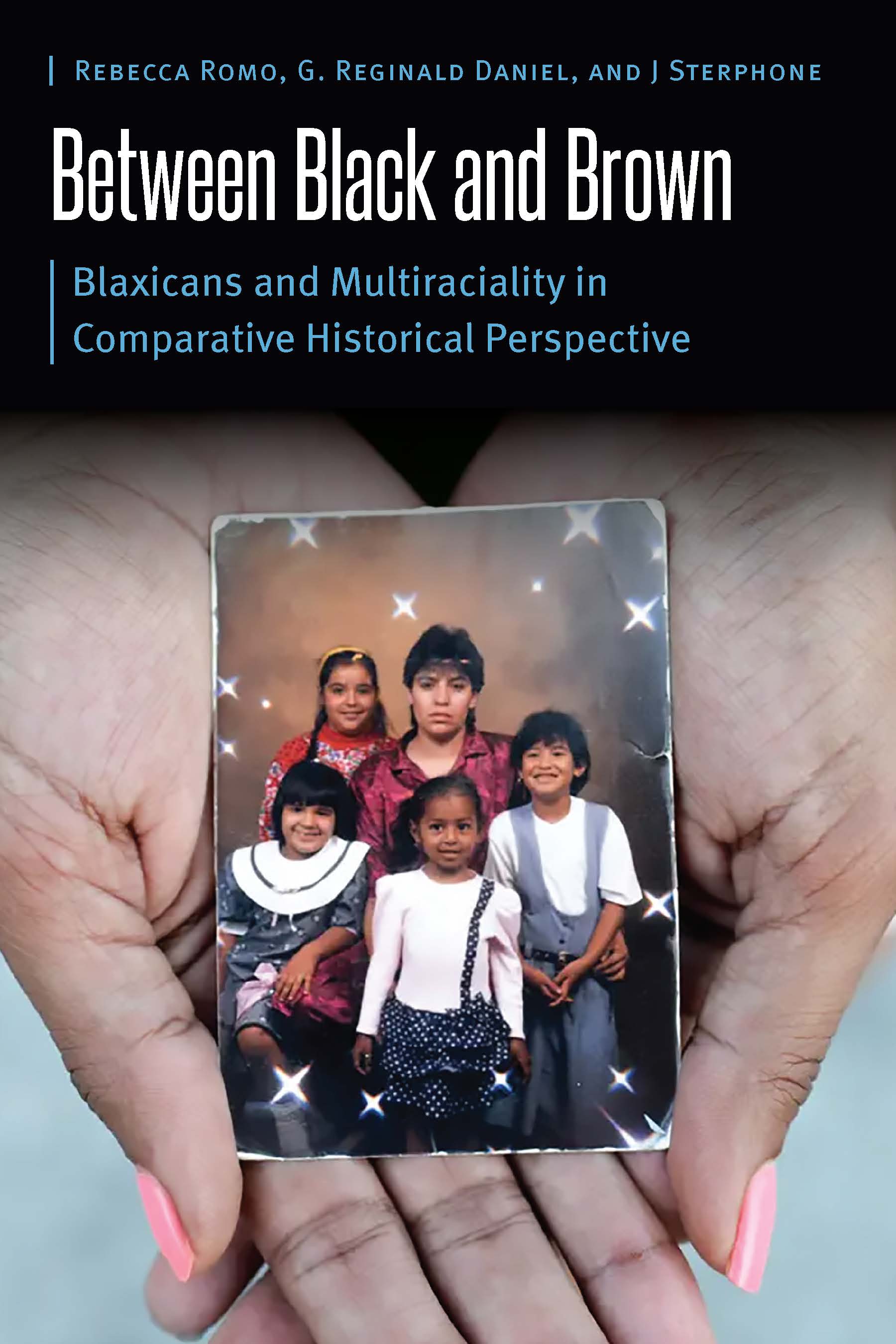
Between Black and Brown begins with a question: How do individuals with one African American parent and one Mexican American parent identify racially and ethnically? In answer, the authors explore the experiences of Blaxicans, individuals with African American and Mexican American heritage, as they navigate American culture, which often clings to monoracial categorizations.
Introduction
Bringing Blaxicans to the Forefront
“Aren’t we all multiracial?” is a common challenge directed at the topic of multiraciality. The confusion lies in the difference between being multiracial in ancestry and being multiracial in identity. Although we recognize certain physical traits as distinguishing populations from one another, a “mixed” lineage is thought to be the norm, rather than the exception, regardless of identity. If you trace a person’s lineage back twenty generations, you will find that each individual has over 1 million ancestors that span the globe. The possibilities of their geographical and “racial” composition are staggering. Indeed, racial intermingling has characterized human history. But that intermingling has been ignored, obscured, and erased by several hundred years of Eurocentric thought about racial (and cultural) purity. This phenomenon was shaped by new ideologies and practices accompanying the colonial expansion of Western Europe beginning in the fifteenth century. While expansion, conquest, exploitation, and enslavement are aspects of human history, they were not supported by ideologies or social systems based on race until the beginning of European colonialism.
Racial Formation and the Concept of Race
Increased competitiveness among European nation-states; the cultural and phenotypic differences between Europeans and the populations of the Americas, Asia, the Pacific Islands, and Africa; and the relative ease with which Europeans were able to dominate those populations influenced European perceptions of all non-Europeans. Over the following centuries, this in turn laid the foundation for the full development of the concept of “race,” which classified human populations as discrete, mutually exclusive biological groups. This conceptualization also included notions that these biological characteristics reflected behavioral, intellectual, temperamental, moral, and other qualities, which were inheritable. “Scientific” inquiry based on biological determinism confirmed inequalities between the races in a way that supported Europeans’ conviction of their own superiority. White racism and white supremacy were institutionalized by the state as systematic components of social structure. This justified the conquest and colonization of the Americas and the enslavement of Africans there. Moreover, the Americas became the site of an unprecedented blending of Indigenous, European, and African peoples and immigrant diasporas across the globe.
That said, all humans descend from a much earlier diaspora after the first modern humans evolved in Africa as early as 200,000 years ago. These first modern humans moved outside of Africa in several waves between 90,000 and 180,000 years ago. The people of this African diaspora adapted to various environments and evolved into geographical populations displaying differences in various bodily features. Some externally visible ones—skin color, hair, and facial morphology—are commonly referred to as “racial traits.” These physical differences (phenotypes) reflect some of the differences in genetic information (genotypes) transmitted through one’s ancestors. Yet all humans share 99.9 percent of their genes. Consequently, phenotypical differences among humans reflect only 0.1 percent of the genetic information transmitted through ancestors. Notwithstanding the fact that some phenotypical traits are quite noticeable (e.g., skin color, hair form), they are based on practically “nothing,” meaning a miniscule part of the total human genome. Still, they are composed of millions of bits of genetic information and are thus composed of “something.”
It should not be assumed, therefore, that people have taken leave of their senses when they make assumptions based on observation about the continental origins of an individual’s recent ancestors. Indeed, the concept of “race” is used in an attempt to explain, however fraught with contradictions, observable geno-phenotypical differentiations. There are populations that, taken as aggregates, exhibit higher incidences of genetic and physical traits than others. But while geno-phenotypical diversity of racial traits is a biological fact, the boundaries delineating subgroupings are not discrete or fixed entities and have always eroded through human contact and interaction.
The smaller the proportion of any given ancestry the more probable it is that the number of genes inherited from that ancestry is also proportionately smaller. Yet genes are randomly distributed in individuals. Having one or more ancestors from the West African diaspora associated with the Atlantic slave trade from the sixteenth to nineteenth centuries, for example, does not guarantee that individuals will inherit genetic information from those ancestors or exhibit discernible West African phenotypical traits. Individuals may be of partial West African ancestry and inherit genetic material from those ancestors yet appear completely European American.
This “illusion” of complete “whiteness” is partly attributable to the fact that humans are unable to independently perceive information at the genetic level with the naked eye. Still, racial logics are not developed on the back of genetics. In the United States, the one-drop rule of hypodescent (one drop of African blood) designates as Black anyone with African American ancestry. Similar rules, discussed at length in chapters 2 and 3, also rely on ancestry, not genetics, to arrive at racial designations as well as to enforce racialized hierarchies.
Racial Ancestry and Racial Identities
This book argues that Blaxican identification—African American and Mexican American— signifies changes in how multiracial Americans of African descent express their identities. It is a form of resistance to the one-drop rule, as well as the “monoracial imperative,” which precludes identification with more than one racial background. These social devices are “commonsense” ways of defining Blackness. Monoraciality and hypodescent have become sine qua non in the U.S. racial order. They have imbued Blackness with a unique place in U.S. jurisprudence and the national-racial imaginary. Therefore, a contemporary examination of identity formation among multiracials of African descent is particularly meaningful.
Notwithstanding their monoracial designation, African Americans and Mexican Americans are “multigenerational multiracial” because of slavery and European colonization. African Americans have African, Native American, European, and in some cases, Asian ancestries. Similarly, Mexican Americans’ backgrounds include European (particularly Spanish) ancestry, as well as Native American, African, and in some cases, Asian ancestry. They display various gradations of skin color and other phenotypical features reflecting each of the parent racial groups as well as all types in between. Yet most, respectively, hold singular African American and Mexican American identities, attributable to the legacy of hypodescent and the monoracial imperative.
The monoracial imperative is itself reflective of a broader “monological” paradigm originating in the modern worldview accompanying Europe’s rise to global dominion beginning in the sixteenth century. That mindset perpetuates an either/or mentation based on the “law of the excluded middle,” which does not acknowledge shades of gray. It necessitates the study of things, including people, in isolation and in parts and delineates them into mutually exclusive (or dichotomous), oppositional, and hierarchical categories of experience. This paradigm is premised on “the precision of interpretation and on the reduction of ambiguity,” complexity, and multiplicity. Singularity is the norm in constructing all categories of difference encompassing race (e.g., white or nonwhite), gender (e.g., masculine or feminine), sexuality (e.g., straight or gay), and even one’s stance on morality and politics. Indeed, the monological paradigm is part of the “doxa,” that is the sphere of sacrosanct, or unquestioned, social concepts or dogmas that have acquired the force of nature.
Hybridity is unsustainable in this framework. Thus, Blaxican identities interrogate and resist normative constructions of identities and categories underpinned by the monological paradigm as well as the monoracial imperative and hypodescent. Blaxican identities are not anti-Black or anti-Mexican, nor are they a dismissal of monoracial identifications. Rather, along with other multiracial identities, they reject normative constructions of identities that deem other forms of identity as illegitimate.
This study of first-generation Blaxicans examines experiences and identities derived from having one parent who is socially designated and self-identified as African American and one who is socially designated and self-identified as Mexican American, regardless of the actual racial and cultural backgrounds in their parents’ histories. Blaxicans differ from their monoracial parents because they identify with both of their backgrounds. They may appear Black or Mexican and are viewed differently depending on the context. Yet they form racial and cultural identities that blend socially constructed meanings attached to Blacks and Mexicans and view themselves as and identify as some blend of both in fluid and situational ways.
Some may consider the term Afro-Mexican to encompass the experiences and identities of Blaxicans. Notwithstanding the similarities, which will be discussed at length in chapter 6, the differences between Blaxicans and those considered Afro-Mexican are noteworthy. Blaxicans are first and foremost Americans. Their national origins as Americans, along with their first-generation multiracial (or biracial) experiences, immediately grounds them in both the African American and Mexican American experiences even as they simultaneously forge racially (and culturally) hybrid identities that are also neither of those. In contrast, Afro-Mexicans are multigenerational individuals, most of them multiracial people, who are first and foremost Mexicans of African descent. Those who migrate to the United States, and particularly their descendants born in the United States (that is, Afro-Mexican Americans) may necessarily navigate identities as Mexican Americans and ostensibly as African Americans. Indeed, Afro-Mexicans and Afro-Mexican Americans are frequently taken for or constructed as African Americans and must also come to terms with what it means to be considered Black in the United States.
Blaxican identities are a case study of the blending of African American and Mexican American backgrounds, experiences, and historical sources. We discuss these phenomena in comparative historical detail to provide a broader context for elucidating the contradictions that can arise when claiming membership in these two groups as a catalyst for the development and declaration of a “dual minority” multiracial (or biracial) identity. Blaxican identities are also shaped by gender, sexuality, class, parental socialization, peer groups, and marginalization vis-à-vis white supremacy and monoraciality.
Blaxican identities signify a borderlands space where the ambiguities and contradictions of being simultaneously both and neither African American and Mexican American are embraced and accepted. As comparative ethnic studies scholars Josh Kun and Laura Pulido maintain, “While we too have approached African Americans and Latinas/os as two distinct populations, this overlooks the possibility of hybrid spaces for those who identify as both Black and Brown. . . . In fact, it is precisely that mixed zone that is one of the most dynamic topics within comparative ethnic studies.” Between Black and Brown exposes readers to that in-between, or liminal, space and allows for an imagining of race and identity outside of the paradigms that dominate U.S. society’s thinking about how race is socially constructed.
 UNP blog