Sally Thompson is an anthropologist and cultural heritage consultant. She formerly served as founder and director of the Regional Learning Project and as Native American Graves Protection and Repatriation Act specialist for the University of Montana, Missoula, where, on occasion, she teaches traditional ecological knowledge. Thompson is the author of People before the Park: The Kootenai and Blackfeet before Glacier National Park and Disturbing the Sleeping Buffalo: 23 Unexpected Stories that Awaken Montana’s Past. Her most recent work Black Robes Enter Coyote’s World: Chief Charlo and Father De Smet in the Rocky Mountains (Bison Books, 2024) was published last month.
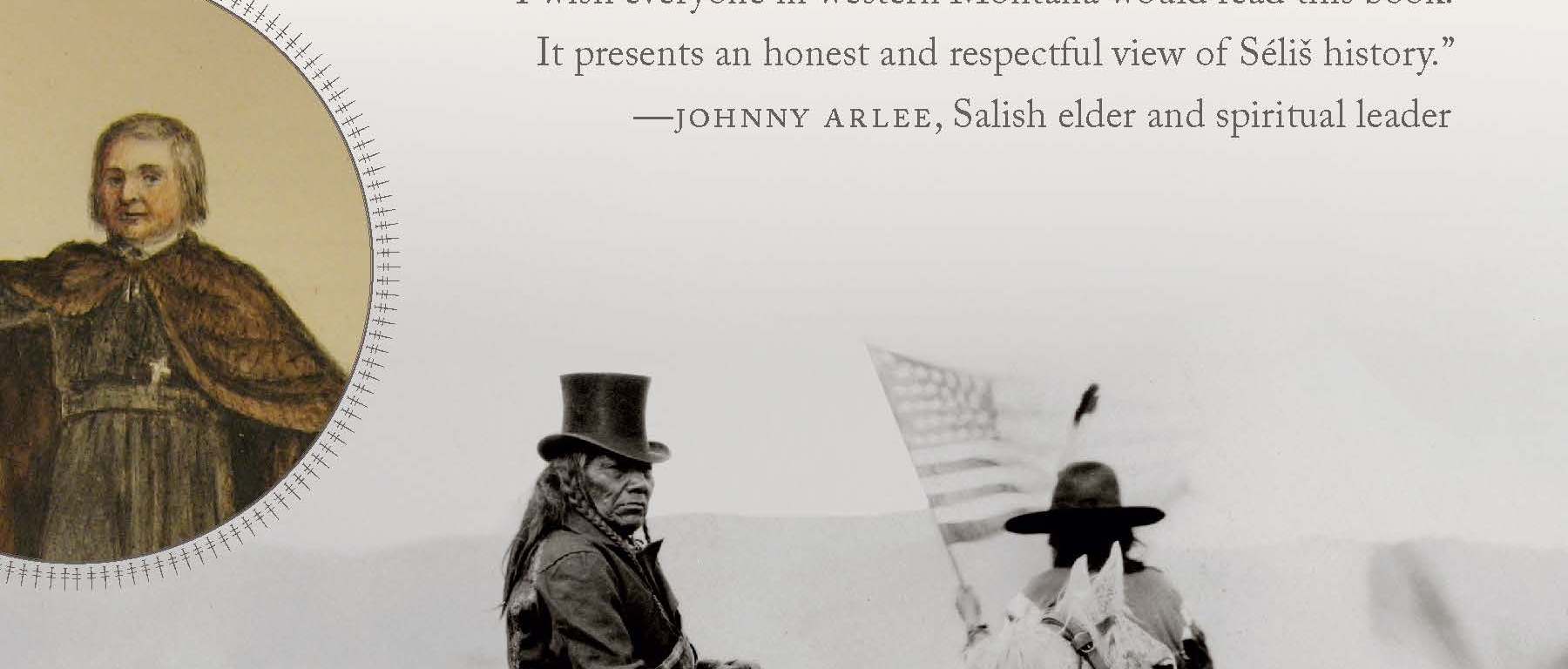
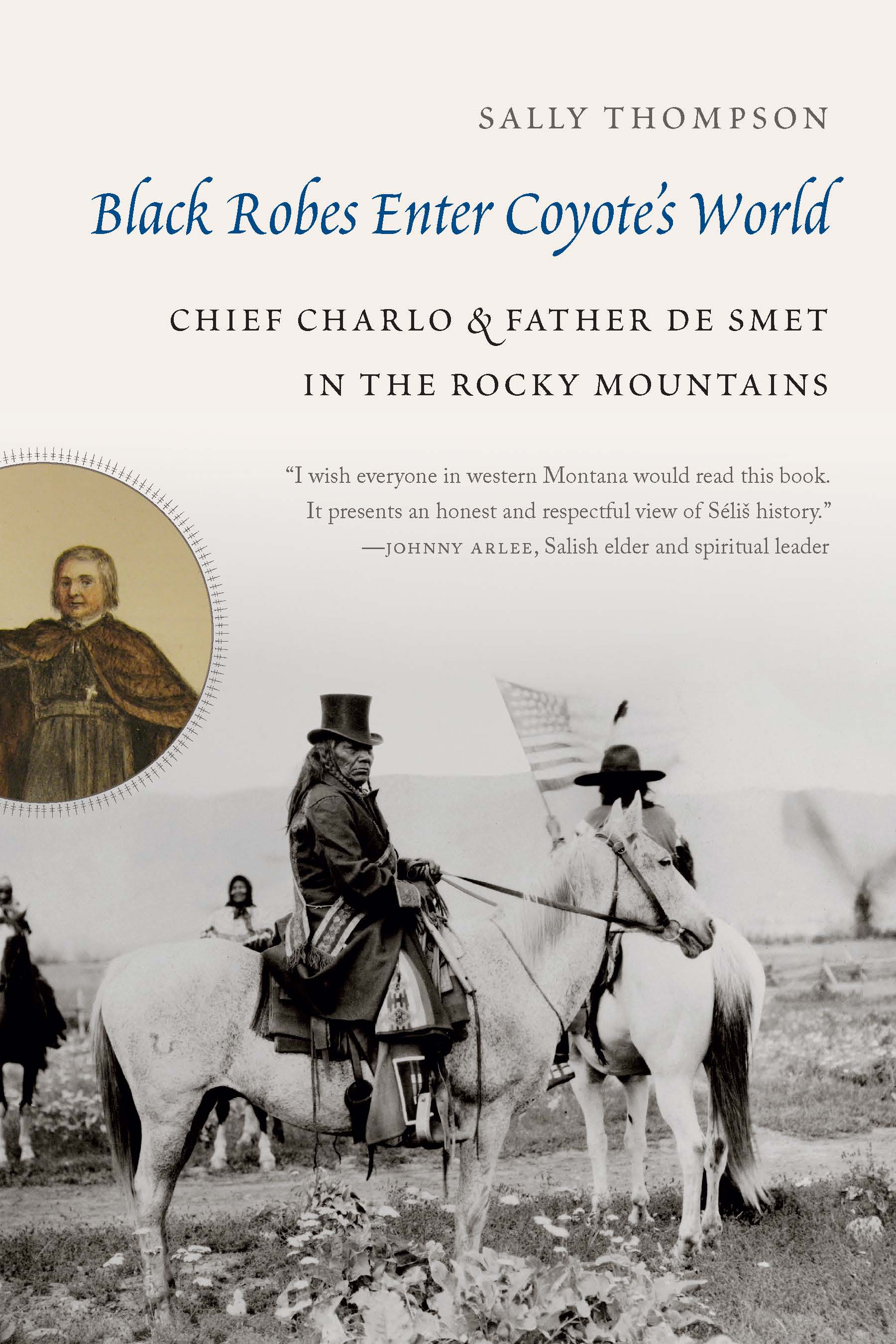
Black Robes Enter Coyote’s World brings to life the complicated history of Jesuit missionaries among Montana’s Native peoples—a saga of encounter, accommodation, and resistance during the transformative decades of the mid-to-late nineteenth century. Sally Thompson tells the story of how Jesuit values played out in the lives of the Bitterroot Salish people. The famous Black Robe (Jesuit) Father Pierre-Jean De Smet actually spent little time among his “beloved Flatheads.” Instead, he traveled extensively between the Pacific and the Rockies, mapping the pathways and noting the valuable resources. His popular writings helped spark the westward movement of white settlers.
Thompson picks up the story of the Salish peoples and black-robed missionaries at a Potawatomi mission on the Missouri in 1839 and follows their intertwined experiences throughout the lifetime of Salish chief Charlo, who eventually cursed the day white immigrants came into his country. Chief Charlo attributed the missionaries’ disconnected beliefs and exploitative actions to their status as orphans rejected from their place of creation, as he had learned from the story of Eden. Despite Charlo’s valiant efforts to protect his homeland, the Salish endured a forced removal from their beloved Bitterroot Valley to the Flathead Reservation in 1891. Charlo died in 1910, just before the massive giveaway of more than half of the Salish’s treaty-guaranteed lands through implementation of the Allotment Act. Despite it all, his people endure.
Introduction
Midstream Moment
Each of us is responsible for how we see, and how we see determines what we see. Seeing is not merely a physical act: the heart of vision is shaped by the soul.
—John O’Donohue, The Invisible Embrace
Bitterroot Valley, Montana Territory, 1876. On a cold day in February in the year of the nation’s centennial, the mood among those gathered at the Place of Wide Cottonwoods was far from celebratory. The Native people of the Bitterroot Valley were there to learn from their chief, “Claw of the Small Grizzly,” about the latest threat to their well-being. Chief Charlo, as he was known in the white world, wanted his impoverished people to understand the property taxes about to be levied against them by the Missoula County Commission.
On that crisp morning, heart as cold as the air, Charlo looked into the faces of his people and then to the snowy peaks beyond and took courage. He began, and his words were harsh: “Yes, my people, the white man wants us to pay him.” Charlo’s voice carried through the hushed crowd. “[The white man] says we must pay him—pay him for our own—for the things we have from our God and our forefathers; for things he never owned and never gave us.” The chief thought back to the day that the white man first stepped foot onto their treasured homeland, reminding those gathered there of their shared history.
“More than seven times ten winters have snowed and melted,” Charlo called out, referring to the time since the Lewis and Clark expedition had arrived among them. His grandfather Three Eagles had been chief then, and he had taken pity on the poverty of these hungry, pale-faced travelers. Charlo’s father, Many Horses, known to the whites as Victor, had been a young teenager then and told his son stories of that time. The Salish had fed these travelers, changed out their broken-down horses, and showed them the pathways through their lands. Without Salish help the famous explorers would likely have failed in their attempt to cross the snowy Bitterroot Mountains in September 1805.
When Charlo was about ten years old, thirty-six winters after that first encounter, the Salish had welcomed into their midst the first Jesuit priests, led by Pierre-Jean De Smet. These “Black Robes” had established St. Mary’s Mission not far from the very place where Charlo was addressing new threats to his people’s existence. The mission was where they had learned stories of the Bible when they were children. Charlo’s father had become head of the first Christian men’s society.
The Jesuits had arrived at a pivotal time in Salish history, before the Place of Wide Cottonwoods became Stevensville, before boundary lines defined property, and before the buffalo were gone. The missionaries had built the first fences and planted crops of Europe—alongside a fear of the devil. They had imposed a very European world onto an ancient Salish landscape and onto the people themselves. They would be transformed through baptism, Christian teaching, and general education in the ways of civilization. The missionaries had worked to replace Salish stories with those of the Bible, not understanding that the traditional stories reflected the lived experience of their ancestors and themselves in that very place they still called home. The abstract world of the priests could never fully replace this cultural biography.
It was this disconnect between worlds that set into motion the despairing speech of Chief Charlo three decades after De Smet had left the area. Since first contact, the Salish people had shown kindness to white visitors—explorers, fur traders and trappers, missionaries, railroad surveyors, and treaty makers—but their efforts had not served them well. In 1855 Charlo’s father and other leaders signed a poorly understood treaty in which they ceded the majority of their vast homeland to the U.S. government. Each side, Indian and white, had its own understanding of the document to which the representatives affixed their marks. The Indians were promised monetary compensation, along with goods and services, in exchange for their agreement to open their lands to others. The U.S. government expected the Indians to move to the Flathead Reservation, some sixty miles to the north, after loose ends regarding the Bitterroot Valley were resolved. Some of the people did move, especially those drawn there by the new mission of St. Ignatius, but many, led by Victor, refused to leave the place where their ancestors were buried.
By 1876 those Salish families who remained in the Bitterroot Valley were suffering. They had received little of what had been promised in the treaty. Their small farms were insufficient to provide for their needs, and each year the buffalo were harder to find. The very survival of these people, who had never lifted a hand against a white man, had become tenuous. These were the circumstances that led to Charlo’s speech.
After he concluded his overview of the Salish history with Euro-Americans, his thoughts took a different turn. Every white person gathered there must have been astonished to hear what came next. The white man “is his own snake,” the chief declared, “which he says stole on his mother in her own country to lie to her.” Although the translation reported in the Weekly Missoulian newspaper begs clarification, the words clearly alluded to Eve and the snake. Charlo went on to say that these Europeans, based on their own story, believed “that man was rejected and cast off,” in reference to the casting out of the first people from the Garden of Eden. The perceptive Salish chief had come to believe that the meanness and greed he experienced among Euro-Americans were rooted in their own creation story. These cast out, “fallen” people—orphans from another land, with no sense of rooted belonging—had needs that could never be filled.
“Why did we not reject him [the white man] forever?” Charlo asked, and his question triggered heartbreaking memories for all the people gathered under that overcast sky. They remembered dead relatives, broken promises, and lost lands. Now this taxation, if levied, might force them from their homeland and the graves of their ancestors.
The angry leader understood the consequences if taxes were levied. The Salish people would lose what little livestock they had, and the losses would be catastrophic. Their horses took them to food, especially to buffalo, and their cattle provided a safety net when they returned from buffalo hunting empty-handed, an increasingly frequent outcome.
Concluding, the chief reminded his people about what truly mattered: their own laws, which were established by the Creator at the beginning of time. They should remember that the white man’s laws never gave them “a blade nor a tree, nor a duck, nor a grouse, nor a trout.” Charlo then made clear his position on the white man’s notion to tax the Salish: “We owe him nothing; he owes us more than he will pay.”
 UNP blog