
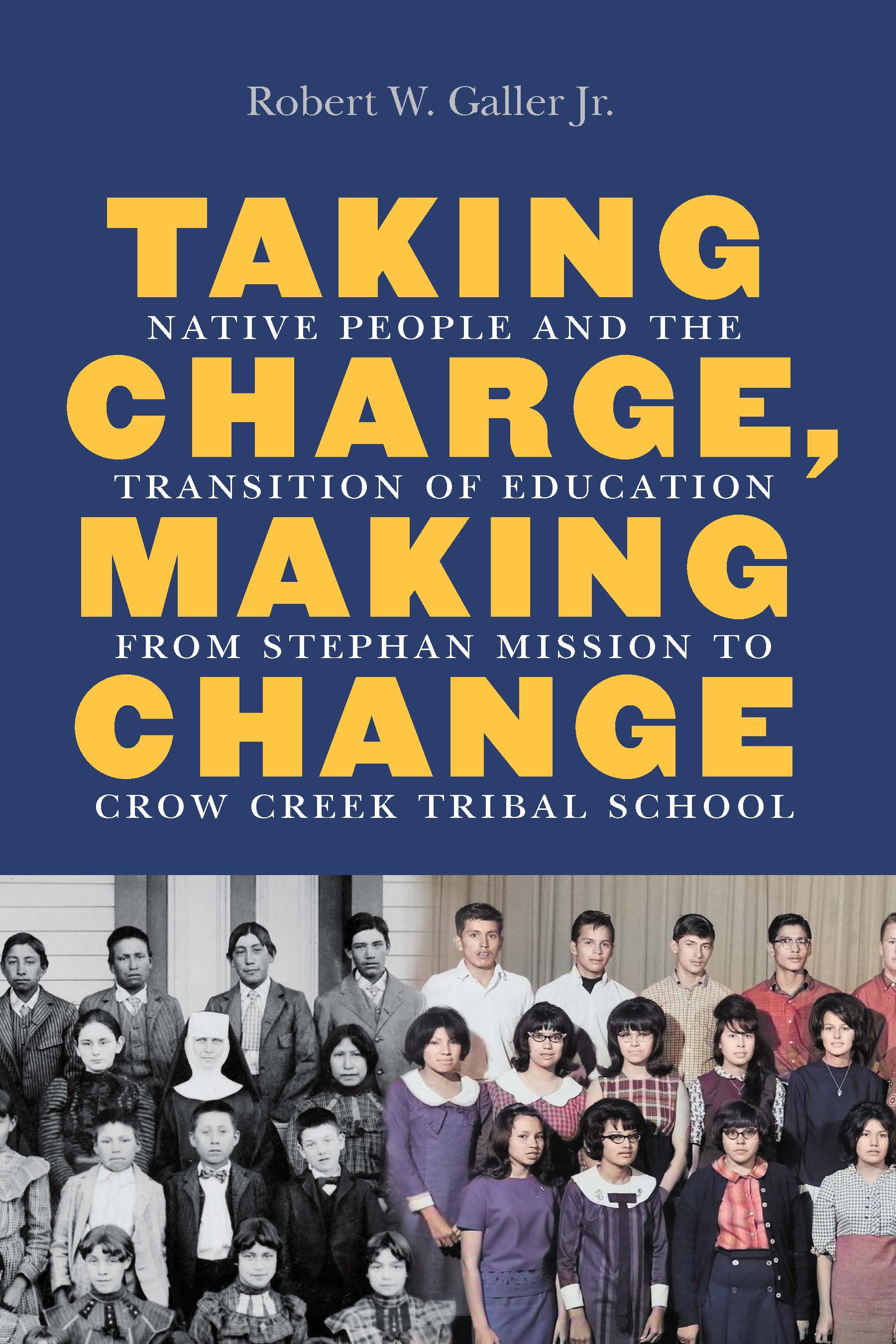
Robert W. Galler Jr. is a professor of history at St. Cloud State University. His new book Taking Chage, Making Change: Native People and the Transition of Education from Stephan Mission to Crow Creek Tribal School (Nebraska, 2025) was published in January.
Taking Charge, Making Change gives voice to generations of Native people—from Crow Creek, Lower Brule, and other reservations in North Dakota and South Dakota—who shaped a school originally designed to foster Catholicism and assimilation. Local initiatives and collaboration transformed the Catholic Stephan Mission boarding school into the Crow Creek Tribal School, which now features both tribal traditions and American educational programs.
Through archival research and interviews with parents, graduates, teachers, and staff at Crow Creek and the surrounding community, Robert W. Galler Jr. places Native students at the heart of the narrative, demonstrating multifaceted family connections at a nineteenth-century, on-reservation religious school that evolved into a tribally run institution in the 1970s. He shows numerous ways that community members worked with Catholic leaders and ultimately transformed their mindsets and educational approaches over nearly a century. While recognizing the many challenges and tragedies that Native students endured, Galler highlights the creativity, collaborations, and contributions of the students and graduates to their communities.
Introduction
Travelers heading north of Chamberlain on a hilly stretch of South Dakota Highway 47 might wonder what they will encounter as the road moves away from meandering Missouri River vistas. Soon they will see a welcome sign that reads “Crow Creek Hunkpati Oyate Reservation.” The landscape levels out, featuring mixtures of plowed and pasture lands, cattle and a few bison, invasive grasses and bits of remnant prairie, numerous electric towers, some houses, and next to one of them, a tipi. As the road rises slightly, about ten miles north of Fort Thompson, drivers’ eyes are drawn to the left and a cluster of structures with two water towers emerging from the flat horizon. The buildings, just south of Lake Ambrose, are part of a school that is more than 130 years old. A nearly seventy-year-old, red-brick school building with adjacent modular classrooms sits next to the Immaculate Conception Church on the original site of Stephan Indian Mission. West across the Crow Creek Loop Road stands a new, earth-toned school and dormitory that architecturally evokes lodges and tipis and constitutes Crow Creek Tribal School today.
The multiple structures resonate with multigenerational stories for Dakota, Lakota, and other Native families. Having personally studied in these buildings or learned about them from family oral history, many see the campus as a mixture of reminders: of childhood separation, lessons learned, lives lost, and challenges faced. The school also disrupted cultural traditions, contributed to intertribal friendships, and provided educational experiences that launched students into their adult lives. Alumni hold a complex set of perceptions of their school, and some send their children to the new school built during their lifetime. As in countless locations across rural America, varied dimensions of history are seemingly hidden in plain sight. Still, even as the school’s mission and structures have changed, the land and the people remain connected to various layers of their past that reach back to the school’s 1886 founding.
Near the Catholic church and old, brick school building sits a cemetery with gravestones marking the graves of many mission school students. The headstones of Hunkpati Dakota chief Magababdu, known as Drifting Goose, and Fr. Pius Boehm, of the Order of Saint Benedict (OSB), given the name Ista Maza (or “Iron Eyes,” due to his rimmed glasses), represent two of many contributors to the mission and region. Taking the time to see their headstones might prompt questions about the relationship between the two starkly different men. Why were both laid to rest in such proximity to each other? What is their significance to the school, church, and American history? Drifting Goose had a decades-long connection to the region, and the Hunkpati leader was even recognized with his own reservation (later revoked). He traveled to Washington DC in the name of his peoples’ rights to land and ultimately helped bring the school to the northern part of the Crow Creek Sioux Reservation. His descendants have attended the school for several generations, bearing last names like Turner, Seeking Land, Shoots the Enemy, Harrison, Hawk, and others.
George Boehm was born in southern Indiana to German immigrant parents, made religious vows at St. Meinrad Archabbey and took the name Pius before arriving on the South Dakota prairie in the winter of 1887. The Benedictine priest led the mission school for nearly fifty challenging years. Over time he drew to the mission members of his family with the surname Holtzmann and other Benedictine monks who contributed to the school for decades. The school and the multicultural community that grew out of it persist in new forms today. It remains a product of many more than these two men, but the presence of their headstones is a regular reminder of the deep and complex context of the contemporary school.
Taking Charge, Making Change examines the history of a school that was shaped by the actions, support, and commitment of countless men and women. There is no denying the impact of colonialism and the influence of the state. Following the treaty period, federal efforts to eliminate tribal traditions continued through assimilation programs and land seizures that persisted through the twentieth century. And yet tribal leaders and Native communities showed constant influence on their schools and communities. They promoted tribal delegations, petitions, and, as anthropologist James C. Scott argues, “everyday forms of resistance.”
Throughout this work I focus on Native agency—tribal members acting on their own accord rather than being passive recipients of history—with full recognition of its limitations. Federal policies and economic systems placed constraints on individual actions and tribal sovereignty, while boarding schools led to family separations and loss of language and cultural traditions. Recent scholarship shows, however, that Native people found ways to exert influence on their communities and retain cultural identities. In addition to resistance, families exhibited agency in acts of persistence and adaptation. Archival research and oral history tell multigenerational stories of educational evolution until the 1970s, when tribal leaders took control of the school. Ultimately, the book reveals numerous contributors, supporters, and shapers of the school as it shifted from Stephan Indian Mission to Crow Creek Tribal School.
Just as significant as what gets marked in history is who strengthens an institution from the inside. As at many federal boarding schools and the U.S. Indian Service, women contributed greatly to Stephan’s history and demographically represent a majority of staff over decades of service. Priests often get the most credit for managing school finances and federal requirements, but Benedictine sisters played crucial roles keeping a multicultural community clean and fed, teaching classrooms of students, and ultimately serving in leadership roles from the World War II era into the 1970s. Some worked at Stephan for a year or two before their superiors reassigned them to other Catholic institutions, but other sisters worked at the school for more than a decade. Some contributed to domestic departments (laundry, bakery, or kitchen), as seemingly anonymous servants, while others influenced student lives and were remembered for many years. Stephan’s history is a story of Benedictine sisters like Clementine Brown, Edward Schonley, Miriam Simon, Jeanne Giese, Charles Palm, and many others.
Native women made significant contributions too. While many male surnames link generations of students, it was often Native women who promoted the enrollment of their children at the Catholic mission school. Consequently, Stephan’s history is filled with stories of former students like Grace Drifting Goose, Ida (Turner) Seeking Land, the LaRoche sisters (Aurelia and Helen), Corine (Jewett) Mendoza, Regina (Rousseau) Ducheneaux, Lucy (Swift Hawk) Sargent, the Spotted Bear sisters (Alyce, Sandy, Gertsy, Roberta, and Ivetta), Marcella (Grey Owl) Howe, and many others. Individual and collective stories humanize popular national narratives and reveal new layers of American Indian history. This work places women more prominently into school and regional history. As later chapters show, these members of distinct families stand out due to their actions at school and in their postgraduation lives.
 UNP blog
Cheers to lessons in agency, of many forms and from a multigenerational perspective of usually unrecognized people!