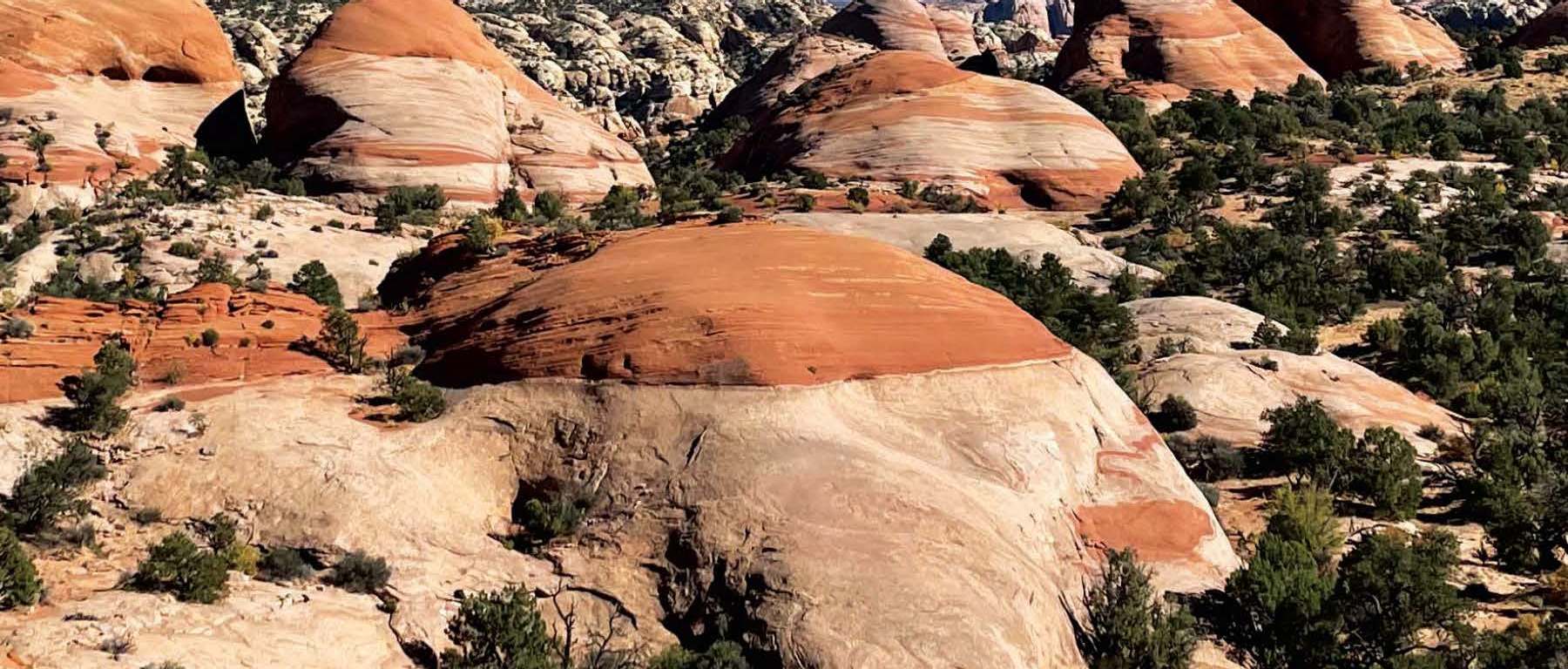
Julie Brugger was previously a research social scientist at the School of Natural Resources and the Environment at the University of Arizona. Her book Public Land and Democracy in America: Understanding Conflict over Grand Staircase-Escalante National Monument (Nebraska, 2025) is the latest title in the Anthropology of Contemporary North America series.
In recent years the Grand Staircase-Escalante National Monument in southern Utah has figured prominently in the long and ongoing struggle over the meaning and value of America’s public lands. In 1996 President Bill Clinton used the Antiquities Act to create the monument, with the goal of protecting scientific and historical resources. His action incensed Utah elected officials and local residents who were neither informed nor consulted beforehand, and opposition to the monument has continued to make its day-to-day management problematic. In 2017 President Donald Trump reduced the monument’s size, an action immediately challenged by multiple lawsuits; subsequently, President Joe Biden restored the monument in 2021.
In Public Land and Democracy in America Julie Brugger brings into focus the perspectives of a variety of groups affected by conflict over the monument, including residents of adjacent communities, ranchers, federal land management agency employees, and environmentalists. In the process of following management disputes at the monument over the years, Brugger considers how conceptions of democracy have shaped and been shaped by the regional landscape and by these disputes.

Preface
What does democracy mean to ordinary people in the United States? This question motivated my research on conflict over the management of Grand Staircase-Escalante National Monument (GSENM) in southern Utah, on which this book is based. Because the research was conducted between 1999 and 2008, much of this book serves as an ethnography of recent history in the early twenty-first century, when democracy was on the rise in the world and its final victory over other systems of government was assumed. The understanding of democracy it presents can shed light on how the meaning of democracy in America may be changing today and the role that conflict over the public lands can play in shaping its meaning.
In 1996 President Clinton used the 1906 Antiquities Act to create the 1.9-million-acre GSENM on public land administered by a federal land management agency, the Bureau of Land Management (BLM). Its creation by presidential proclamation provoked widespread opposition in Utah, and during the period of my research, controversial issues concerning the monument continued to arise, often making national news and making its day-to-day management problematic. As public land, GSENM is held in trust by the federal government for all Americans, who, owing to federal environmental legislation, have a voice in its management. Drawing on anthropologist Victor Turner’s observation that social conflict brings people’s passionately held beliefs and values into prominence, I approached conflict over the management of GSENM using his concept of a “social drama,” in which participants mobilized ideas about democracy as they engaged with federal, state, and local governments and each other to have a say in how public land was managed.
I first became interested in what democracy means in 1994, when I was in South Africa during the run-up to the first democratic election ever held in that country, followed by the election on April 27 and the inauguration of Nelson Mandela as the country’s first democratically elected president. Although I was not interested in politics in my own country, I was caught up in and irrevocably changed by the emotionally charged atmosphere leading up to and following the election. Preceding it, the national mood was one of tense anticipation and preoccupation with every development. People were hopeful but at the same time worried that the election might be disrupted by violence or boycotted by some faction. On election day, people traveled long distances and waited with great dignity and patience in legendarily long lines to vote. When the election miraculously came off without disruption, a collective sigh of relief could be felt. But it wasn’t until May 10, the day Nelson Mandela was inaugurated, with the realization that the years of struggling and believing had finally ended, that overwhelming joy swept the country. As it was transformed into “the new South Africa,” I felt transformed by a new awareness that the efforts and conviction of ordinary people really could change their world.
The word “democracy” was on everyone’s lips at that time, and the word was radiant, powerful, alive. It was suffused with triumph at the end of the long struggle, and it meant much more to South Africans than the electoral process they had just participated in. It also carried their hopes for the future. The ideals of jobs, peace, and freedom proclaimed by campaign posters could now take tangible shape in their lives. Amid the rejoicing, I paused to consider what democracy would come to mean in this country that had just begun the process of making dreams of democracy into reality. And I wondered why the word “democracy” didn’t evoke the same enthusiasm and emotion in the United States, arguably the world’s oldest existing democracy. In my experience, Americans seldom used the word, and when they did, it seemed they were more often complaining about how it wasn’t working than celebrating it. Nevertheless, the U.S. government had gone to great lengths to defend democracy in, or extend it to, other countries since the mid-twentieth century. So what had democracy come to mean in the United States?
Initially, I planned a comparative study that would seek to compare the meaning of democracy in the two countries. I wanted to site my research in each country in a national park or protected area where collaborative management efforts were underway, assuming that its status as public land in a democratically governed country would bring out participants’ ideas about democracy as they created management plans. Attempts to develop more collaborative and democratic approaches to conservation were underway and being celebrated worldwide at the time. Personal reasons also motivated this choice. Because I have come to love wild, rugged, beautiful places through my pursuit of alpine and rock climbing throughout the world, I wanted to be able to conduct my research in such a place, knowing that the landscape would help sustain me during what was likely to be a challenging research process. Choosing a field site based on attachment to the landscape turned out to be a fortunate decision because, from the start, it gave me something in common with the people who lived there.
I chose GSENM as the site for the U.S. side of my project because, despite the conflict its creation had ignited, attempts at collaboration existed. The initial Monument Management Plan had been drawn up by a team that included local residents; tribal representatives; representatives of city, county, and state governments; non-BLM scientists; and monument staff. In 1999, when I first visited GESENM, the beginnings of a collaborative effort among the monument, the state of Utah, Southern Utah University, and local residents existed in the form of the Escalante Center. It aimed to build a cooperatively run nonprofit arts and sciences education and information campus in the community of Escalante adjacent to the monument. For various reasons, some described in this book, these initiatives unraveled or did not result in the desired outcomes. Conflict persisted, and my research focus shifted from collaboration to conflict—a shift that profoundly shaped the understanding of democracy that emerges in this book. When I asked people in the Grand Staircase-Escalante region what they wanted to get from my research, their response was: “Just tell our story. We just want our voices to be heard.” That was something I felt I could do.
 UNP blog