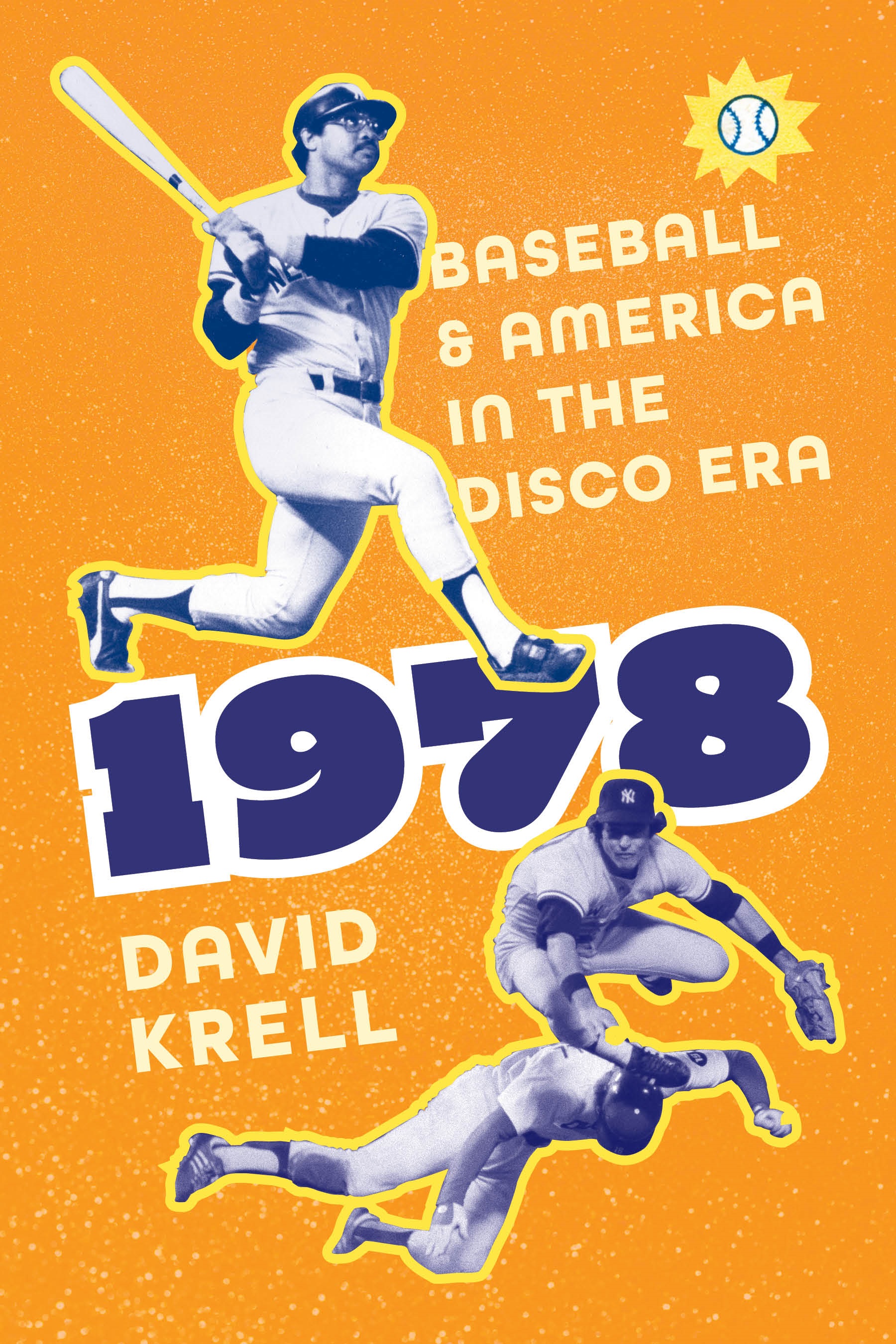
David Krell is the author of 1962: Baseball and America in the Time of JFK (Nebraska, 2021), Do You Believe in Magic? Baseball and America in the Groundbreaking Year of 1966, and The Fenway Effect: A Cultural History of the Boston Red Sox (Nebraska, 2024). His most recent book 1978: Baseball and America in the Disco Era will be published in April 2025.
Wee Willie Keeler said, “Hit ’em where they ain’t.” The same concept applies to authors.
I looked around for a topic that hadn’t been done before in the baseball arena and settled on 1978. Sure, Roger Kahn had written October Men. But that book focused on the New York Yankees. Their story had undeniable import, underscored by being fourteen games behind the Boston Red Sox in July; inching forward to tie their New England rivals at the end of the season; winning the American League East pennant in a one-game playoff thanks to home runs by Reggie Jackson and Bucky Dent; defeating the Kansas City Royals in the AL playoff; and trailing the Los Angeles Dodgers two game to none then rebounding to win a World Series championship in six games.
There was terrific baseball fodder in 1978 beyond Reggie, Bucky, et al. showcasing determination, skill, and endurance. Events on and off the field became the spine of 1978: Baseball and America in the Disco Era, my third book with University of Nebraska Press.
The San Diego Padres fired manager Alvin Dark during Spring Training, Commissioner Bowie Kuhn disallowed the trade of Vida Blue from the A’s to the Reds, and Bob Lemon replaced Billy Martin as the Yankees manager halfway through the season. Tom Seaver pitched a no-hitter, Pete Rose tied a National League record with a 44-game hitting streak, and Don Sutton set a Dodgers record for career strikeouts. Willie McCovey swatted his 500th home run; Gaylord Perry notched his 3000th strikeout.
Researching the events of this extraordinary baseball season required extensive studying of game accounts in newspapers from 1978 accessible through ProQuest and newspapers.com. I also availed myself of the New York Public Library’s fantastic collection of New York City newspapers on microfilm at the Main Branch in Manhattan in addition to the Inter-Library Loan program, which allowed me to borrow microfilm from other libraries and archives.
Plus, the year’s cultural aura presented opportunities for me to research the events that formed the backdrop of my childhood in Springfield, New Jersey. Going through microfilm of The Star-Ledger at the Jersey City Public Library provided great material regarding the debut of gambling in Atlantic City, the terrifying blizzard that hammered our region, and the exceptional array of films from Hollywood.
Grease reflected a longing for a simpler time, offered a soundtrack that dominated the record industry, and anchored a wave of nostalgia for the late 1950s and early 1960s. American Hot Wax, The Buddy Holly Story, and Animal House also gave Americans a nostalgic outlet in 1978 as they tried to soothe their psyches during the years following the Vietnam War and President Nixon’s resignation in the wake of the Watergate scandal in the mid-1970s.
ABC banked on nostalgia with Happy Days, originally set in 1956. It premiered on ABC as a mid-season replacement in 1974 and eventually became a blockbuster in the Nielsen ratings. Robin Williams guest starred as the alien Mork from Ork in an epic performance that I recalled watching while northern New Jersey recovered from the blizzard.
To refresh my memory about the storyline, dialogue, and performance, I screened the episode at the Paley Center for Media in Manhattan. Williams showed his genius instincts for comedy, vaulted into the stratosphere of fame overnight, and benefited from a TV network executive’s cherished device—the spinoff. Mork & Mindy premiered in September and ran for four years. Pam Dawber co-starred.
Researching the events of any year demands an inquiry regarding popular music. Donna Summer was the Queen of Disco, emphasized by her 1978 anthem “Last Dance” and performance in the movie Thank God It’s Friday set in a Los Angeles nightclub. Listening to her songs brought me back to an era when young women wore bell bottom jeans and feathered hairstyles influenced by Farrah Fawcett’s gorgeous mane.
Naturally, I pitched my proposal to Rob Taylor at University of Nebraska Press. Rob has shepherded an outstanding roster of baseball books, so I hoped that this idea merited inclusion in a future UNP catalog. It did!
I’m honored to be associated with Rob and his UNP team, whose books occupy a highly significant part of my personal library including Branch Rickey: Baseball’s Ferocious Gentleman by Lee Lowenfish; Mover & Shaker: Walter O’Malley, the Dodgers, & Baseball’s Westward Expansion by Andy McCue; Dodgerland: Decadent Los Angeles and the 1977-78 Dodgers by Michael Fallon; Red Barber: The Life and Legacy of a Broadcasting Legend by Judith R. Hiltner and James R. Walker; Cobra: A Life of Baseball and Brotherhood by Dave Parker and Dave Jordan; and 1921: The Yankees, the Giants, and the Battle for Baseball Supremacy in New York by Lyle Spatz and Steve Steinberg.
Chronicling the events of 1978 for University of Nebraska Press has been a privilege. I turned 11 years old that year, so this project allowed me to relive my childhood and arrive at some heartwarming conclusions.
It was a great year to be a kid.
It was a great year to be a moviegoer.
It was a great year to be a TV viewer.
It was a great year to be a baseball fan.
It was a great year to be an American.
Steal some savings on this forthcoming baseball book and more during our Baseball Sale. Use promo code 6BAB25 for 40% off at checkout, offer expires June 13, 2025 and is good for U.S. and Canadian shipments only.
 UNP blog