
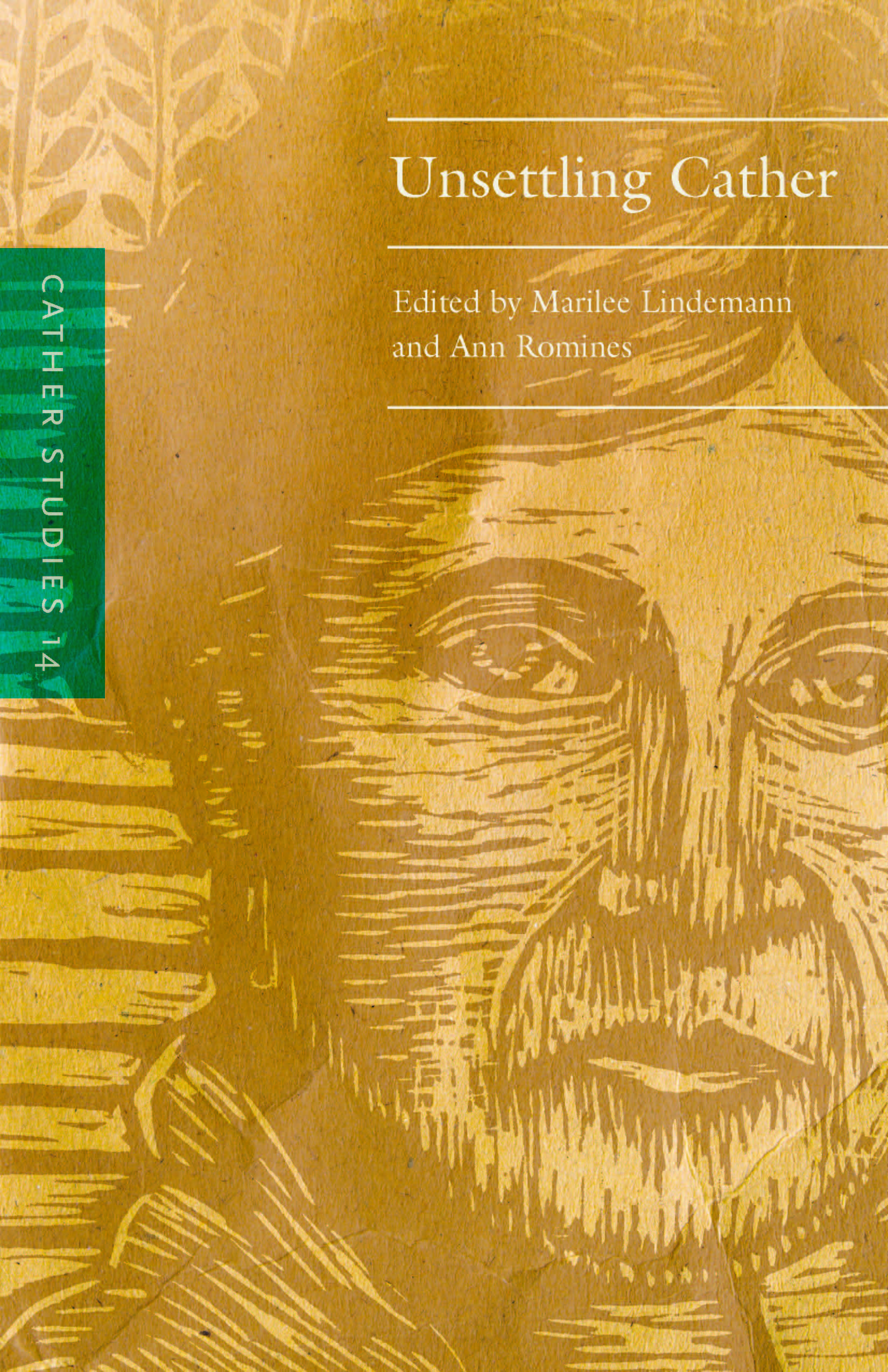
Marilee Lindemann is an associate professor of English and executive director of College Park Scholars at the University of Maryland. She is the author of Willa Cather: Queering America and editor of The Cambridge Companion to Willa Cather and editions of Alexander’s Bridge and O Pioneers! Ann Romines is professor emerita of English at George Washington University. She is the author of The Home Plot: Women, Writing, and Domestic Ritual and many essays on Cather. Lindemann and Romine are editors of the lastest entrant in the Cather Studies series, Cather Studies, Volume 14: Unsettling Cather
American author Willa Cather was born and spent her first nine years in the Shenandoah Valley of Virginia. Here, as an observant daughter of a privileged white family, Cather first encountered differences and dislocations that remained lively, productive, and sometimes deeply troubling sites of tension and energy throughout her writing life.
The essays in Cather Studies, Volume 14 seek to unsettle prevailing assumptions about Cather’s work as she moved from Virginia to Nebraska to Pittsburgh to New York City to New Mexico and farther west, and to Grand Manan Island. The essays range from examinations of how race shapes and misshapes Cather’s final novel, Sapphira and the Slave Girl, to challenges to criticisms of her 1935 novel, Lucy Gayheart. Contributors also frame fresh discussions of Cather’s literary influences and cultural engagements in the first decade of her career as a novelist through the lens of sex and gender and examine Cather’s engagements with region as a geopolitical, sociolinguistic, and literary site. Together, the essays offer compelling ways of seeing and situating Cather’s texts—both unsettling and advancing Cather scholarship.
Introduction
Unsettling Cather
Anne Romines and Marilee Lindemann
For the Seventeenth International Willa Cather Seminar, held in June 2019, we invited Cather scholars and readers to join us for six days at Shenandoah University, in the Shenandoah Valley of Virginia, the lush and complex site of Willa Cather’s birth and first nine years. Here, as an observant daughter of a privileged white family, Cather first encountered differences and dislocations that remained lively, productive, and sometimes deeply troubling sites of tension and energy throughout her writing life, extending to and beyond her last novel, Sapphira and the Slave Girl, set in her family’s Virginia.
Seminar participants visited many places that were important to young Willa’s family—and to other Virginians, both Black and white—as they experienced the persistent powers of enslavement, the French and Indian War (one of Cather’s best-known ancestors was a prominent local “Indian fighter” in the eighteenth century), the Revolutionary War, the Civil War, and the Reconstruction era. They also visited the still-new National Museum of African American History and Culture in Washington dc to learn more about how institutionalized enslavement had shaped the world into which Cather was born. prominent local “Indian fighter” in the eighteenth century), the Revolutionary War, the Civil War, and the Reconstruction era. They also visited the still-new National Museum of African American History and Culture in Washington DC to learn more about how institutionalized enslavement had shaped the world into which Cather was born.
Of course the sixty-five papers presented at this seminar, as well as the conversations they sparked, were not rooted solely in Virginia. They covered the whole expanse of Cather’s life and work. We hoped that this seminar would unsettle some of our prevailing assumptions about Cather’s work and a life that moved from Virginia to Nebraska to Pittsburgh to New York City to New Mexico and farther west, and to Grand Manan Island. Experiences of difference and dislocation, which began for Cather early in her Virginia childhood, continued until her death in 1947 and her New Hampshire burial. We were especially eager to hear from new voices with new perspectives on Cather and the conference theme as we came together in a beautiful Virginia summer week, when the state was observing the four hundredth anniversary of enslavement, begun in the new Virginia colony in 1619, as well as the annual celebration of Emancipation known as Juneteenth.
Seminar participants did not disappoint us. The thirteen essays in this volume of the Cather Studies series are a rich sampling of the fresh and provocative scholarship shared in Virginia in 2019. We welcomed both familiar and new voices, and they introduced us to a variety of compelling ways of seeing and situating Cather’s texts—ways that both unsettle and advance Cather scholarship. We have organized the volume in loose groups or clusters of essays that examine a common text or theme. We begin with four essays on Sapphira and the Slave Girl that, in different ways, build upon the project begun in Toni Morrison’s influential reading, in Playing in the Dark, of how race shapes and misshapes the novel. Sarah Clere examines material culture in Sapphira and finds that, although that discourse is often oriented toward white characters in positions of power, considering the “historical context and function of objects and household spaces fractures the dominance of the narrative’s white perspective and provides insight into the lives of its Black characters.” Clere argues that “objects in Sapphira and the Slave Girl frequently undermine the idea of a static identity determined by race and social class, pointing instead to the possibility of adaptation and ultimately self-fashioning.” Barry Hudek explores biblical allusions in the novel, including some that Cather excised from the typescript, which serves as evidence of the author’s awareness of a justice-oriented mode of reading the Bible that would later be termed Black liberation theology. Although Cather rewrote a clearly subversive scene in which the dying Jezebel asks Henry Colbert to read her the story of the Israelites escaping slavery in Egypt, Hudek sees in numerous remaining biblical allusions and in references to songs and hymns a thread of resistance to the imperialist order that produced and justified slavery. Sapphira and the Slave Girl contains, Hudek concludes, “clear moments of identification with and, potentially, celebration of Black liberation theology.”
Tracyann Williams’s reading of Sapphira attends not to resistance but to the persistence in the United States of “the unresolved disease of racism and slavery.” Williams sees the novel as “a major work, precisely because it is difficult and uncomfortable.” Cather’s story of the dropsical Sapphira’s obsession with the mixed-race young slave woman “offers a window into the American collective cultural and political psyche and the fraught relationship that exists between the races. Much in the way the miller takes in brown wheat and produces white flour, I argue that Cather is refining away the confusion of changing political dynamics, restoring a world in which a mistress with limited mobility can oppress those around her, denying citizenship and agency to those perceived as Other.” Speaking of wheat and flour, Steven Shively concludes our Sapphira cluster with a chapter that uses the folk song “Weevily Wheat,” which explicitly appears in My Ántonia and is more cryptically embedded in Sapphira, to affirm that traces of Cather’s roots in the South are not confined to the single novel she set in Virginia. Drawing widely on music and cultural history, Shively explores the “racial mobility” of “Weevily Wheat,” which had connections to the Scots-Irish people of Britain (from whom Cather was descended) and ties to nineteenth-century Black entertainments (e.g., play-parties) as well as to the coded language enslaved people used to convey messages of resistance and protest. Whatever Cather’s intentions in engaging with the song in both My Ántonia and Sapphira, Shively sees it as “a rich example of the ways Cather mixed experience, memory, and her broad cultural life to create art. The song is present as a Black American cultural artifact that adds significant meaning to the novel and to the ways American culture ignores, conceals, and reveals race.”
 UNP blog