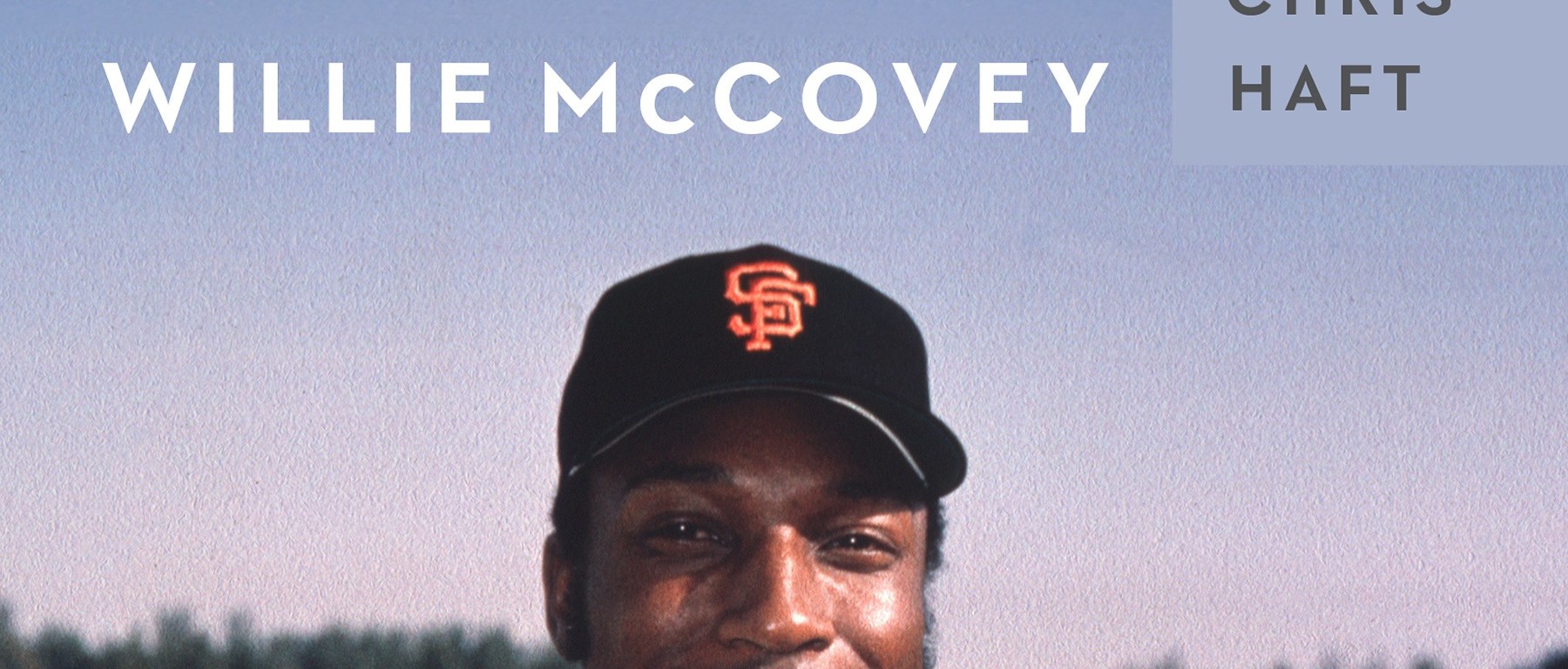
Chris Haft has spent nearly thirty years covering Major League Baseball, including fourteen seasons on the Giants beat: 2005–6, with the San Jose Mercury News, and 2007–18, for MLB.com. He is the author of If These Walls Could Talk: Stories from the San Francisco Giants Dugout, Locker Room, and Press Box, among other books. His latest book A Giant among Giants: The Baseball Life of Willie McCovey (Nebraska, 2025) was published last month.
Willie McCovey, known as “Stretch,” played Major League Baseball from 1959 to 1980, most notably as a member of the San Francisco Giants for nineteen seasons. A fearsome left-handed power hitter, McCovey ranked second only to Babe Ruth in career home runs among left-handed batters and tied for eighth overall with Ted Williams at the time of his retirement. He was a six-time All-Star, three-time National League home run champion, and 1969 league MVP, and he was inducted into the Baseball Hall of Fame in 1986 in his first year of eligibility. Known as a dead-pull line drive hitter, McCovey was called “the scariest hitter in baseball” by pitcher Bob Gibson.
In A Giant among Giants, the first biography of McCovey, who passed away in 2018 at the age of eighty, Chris Haft tells the story of one of baseball’s best hitters and most-beloved players.

Introduction
He was iconic.
—Hall of Fame catcher Johnny Bench
Speakers at the celebration of Willie McCovey’s life, which was held at San Francisco’s Oracle Park on November 8, 2018, accented their remembrances with intense emotion, evoking the power—the powerful feelings, the powerful presence—that the legendary Giants first baseman displayed in a Major League career that spanned four calendar decades.
Mike Krukow choked back tears as he recalled how he wanted to emulate McCovey’s character. Barry Bonds remembered asking the imposing McCovey as a youth if he could call him “Uncle Willie” (permission granted). Longtime Giants coach Joe Amalfitano, a teammate of McCovey’s in the Minor and Major Leagues, referred to the slugger’s “love affair” with San Francisco, where he remained a favorite son long after he played his final game in 1980.
The most moving tribute of all may have been the nonverbal one delivered by Mike “Tiny” Felder, who brought his 1992 Willie Mac Award plaque to the sun-splashed event. Felder, a former Giants outfielder who won the award that’s emblematic of the ballclub’s most inspirational player, clutched the home plate–shaped totem to his chest through much of the ninety-minute tribute to McCovey, who died eight days earlier on October 31 at age eighty of ongoing health issues. The plaque spoke eloquently for Felder.
“It was a no-brainer,” Felder said of his decision to bring the trophy. He related that upon arising that morning at his Richmond, California, residence, he declared to himself, “I’ve got to bring my Willie Mac award and show what Willie Mac meant to me.”
Felder didn’t just express the depth of emotion that McCovey stirred within him. He also demonstrated how legions of others felt about the man. “The more people saw him and the more people reacted to him, the more people loved him,” former Giants owner Bob Lurie said. “When you got to know Willie, you had to love him.”
McCovey’s home in Woodside, California, afforded him views of his kingdom of fans. Unbeknownst to them, he could see them drive past on Highways 101 or 280. San Francisco International Airport was visible too. Imagine how thousands of commuters would react if they sensed that Willie McCovey could be staring down at them. The distraction would cause some nasty pileups.
“I’m still amazed [by] how much you can touch people and how much you mean to them,” McCovey said less than a year before his death. “I don’t know how to explain it. I’ve met people who tell me, ‘You were the only reason my grandmother or somebody lived the last few years, because of you.’ Things like that, you listen to it, and you wonder, ‘God, that’s amazing.’”
Baseball purists everywhere admired McCovey for his hitting prowess and defensive flair. Cincinnati’s Johnny Bench, the finest catcher of his generation and perhaps all others, adored McCovey so much that he couldn’t bear to witness the big man’s physical erosion. “It hurt me so much to see his demise,” Bench said, “and his wheelchair was the saddest thing I ever had to see.
“He was too much of a hero to me. He was iconic.”
Bench was among those who understood McCovey’s true significance, which lay in the personal warmth that he exuded and others reciprocated. McCovey’s life wasn’t measured in his home run and RBI totals. For him, it was all about respect and love.
“You hit it on the head,” former Giants shortstop Chris Speier said. “Among people who played with him or against him, those are the words that come out.” They echo, too, among his closest friends—most notably, the Dudum family. “I’ve known Willie McCovey all my life,” Jeff Dudum said of his godfather. “He’s like family to me.”
I began one conversation during the early portion of the interviewing process for this book and quickly felt as if a dog were sniffing at my shoetops. Except this was no ordinary canine. This was a Doberman named Vida Blue, fully prepared to deliver a crippling bite to my integrity if he didn’t like my answers to his questions. I pictured Blue firing dozens of phone and text messages like so many fastballs, all warning fellow Major League alumni not to speak to me. This project would have ended before it began. Said a wary Blue, “First, let me ask you—why are you writing something about Willie McCovey?” I responded to the marvelous left-hander—who asked McCovey to serve as the best man at his 1989 wedding—by essentially repeating what I had said to Speier. “I just think it needs to be written, Vida,” I replied. “He shouldn’t fade from the consciousness of people on this earth without somebody trying to point out how much respect he commands and how much love he inspires.”
That was good enough for Blue, who started reminiscing happily about receiving the dressing stall next to McCovey’s after being sent from Oakland to San Francisco for seven players in the March 15, 1978, trade that revitalized the Giants franchise. Blue also remembered that Joe Liscio, San Francisco’s head athletic trainer, had a distinctive way of honoring McCovey. Perhaps McCovey’s name would come up in conversation. Or McCovey himself would pass through the clubhouse or stop by the trainer’s room. Whatever the prompting was, Liscio would be moved to say, “He’s a giant among Giants.”
 UNP blog