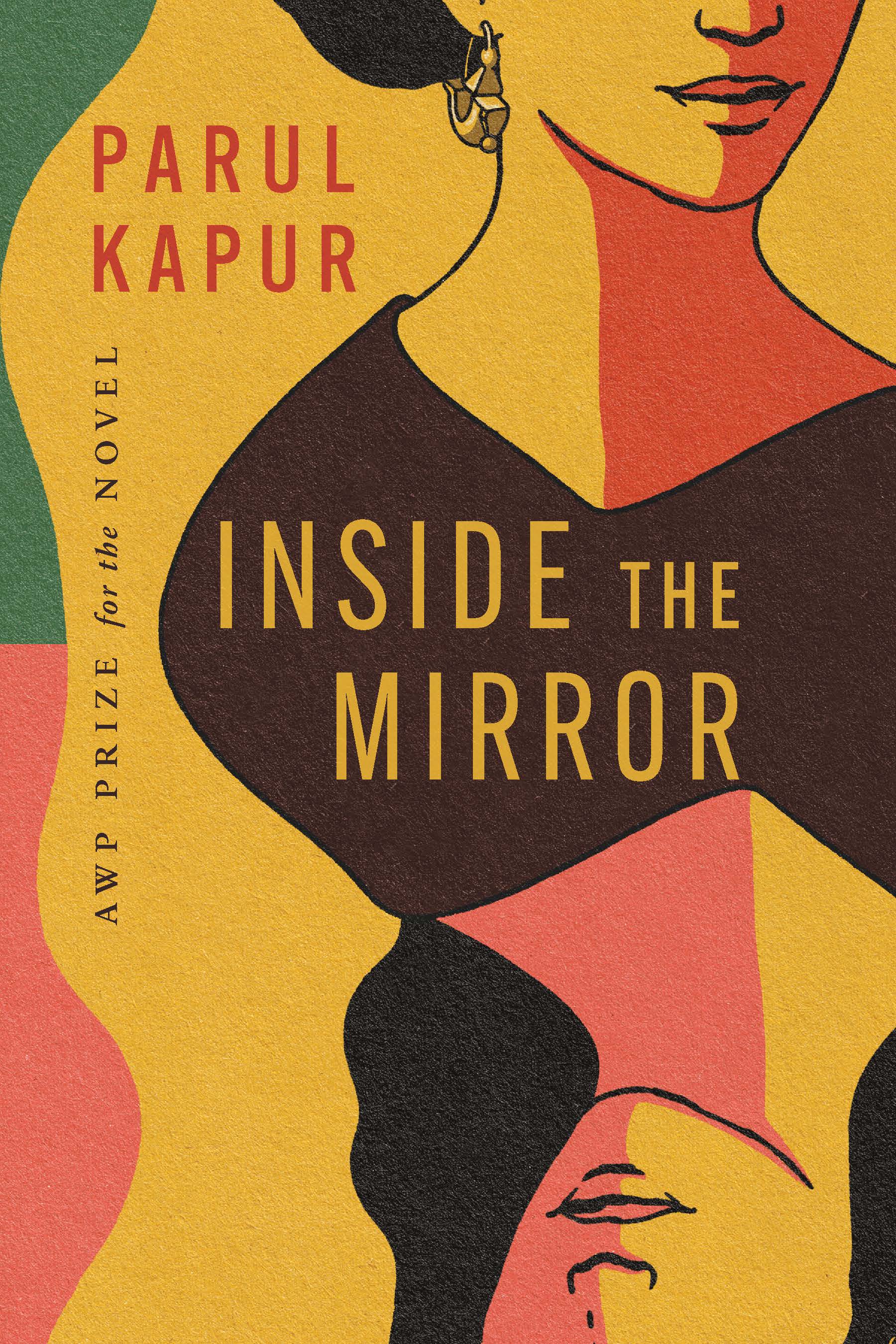
Book Birthdays celebrate one year of a book’s life in social media posts, reviews, and more. This month we’re saying Happy First Book Birthday to Inside the Mirror (Nebraska, 2024) by Parul Kapur.
About the Book:
In 1950s Bombay, Jaya Malhotra studies medicine at the direction of her father, a champion of women’s education who assumes the right to choose his daughters’ vocations. A talented painter drawn to the city’s dynamic new modern art movement, Jaya is driven by her desire to express both the pain and extraordinary force of life of a nation rising from the devastation of British rule. Her twin sister, Kamlesh, a passionate student of Bharata Natyam dance, complies with her father’s decision that she become a schoolteacher while secretly pursuing forbidden dreams of dancing onstage and in the movies.
When Jaya moves out of her family home to live with a woman mentor, she suffers grievous consequences as a rare woman in the men’s domain of art. Not only does her departure from home threaten her family’s standing and crush her reputation; Jaya loses a vital connection to Kamlesh.
Winner of the AWP Prize for the Novel, Parul Kapur’s Inside the Mirror is set in the aftermath of colonialism, as an impoverished India struggles to remake itself into a modern state. Jaya’s story encompasses art, history, political revolt, love, and women’s ambition to seize their own power.
A Word from the Author:
The evening of my book launch, it poured in Atlanta. My husband drove through a wall of rain to the Georgia Center for the Book, and I braced myself for reading to an empty room. But when we walked into a hall draped with bright, beautiful saris my spirits lifted. Everything shifted with that delightful gesture by the Center’s director to celebrate my book. I began writing Inside the Mirror, a story of twin sister artists coming of age in mid-century India, as a graduate student at Columbia. A projection of my own struggles as a young writer in America, it became my connection to the homeland I’d left behind as a child.
About thirty people showed up that night and my heart was full. A friend who wasn’t much of a reader told me that my reading of the opening pages captivated her. Someone else asked what took me so long to write my book—I had labored on it off and on for twenty-five years and then put it away for another dozen years before it won the AWP Prize for the Novel and was published by the wonderful team at the University of Nebraska Press.
It had taken so long because I didn’t know who I was or where I came from when I started, and the book’s creation was my discovery of those things. And it had taken so long, also, because I’d spent a decade of that time in Europe, writing in isolation, not knowing where I was going. But past failures didn’t matter that night—friends, acquaintances, and complete strangers had come out to receive my book in a storm.
I’m thrilled by the recognition given to a novel whose composition was a deeply internal process that involved resurrecting my parents’ India of the 1950s. Inside the Mirror was longlisted for the Center for Fiction’s First Novel Prize and for the New American Voices Award, which recognizes writers of immigrant background. It was also just named a Finalist for the Foreword INDIES award in Literary Fiction and Multicultural Fiction. A book has a long life and I’m happily holding events a year after publication—in April I will speak to students at the Savannah College of Art and Design about writing and publishing. I might tell them the most remarkable connection my novel struck for me was an invitation to the White House.
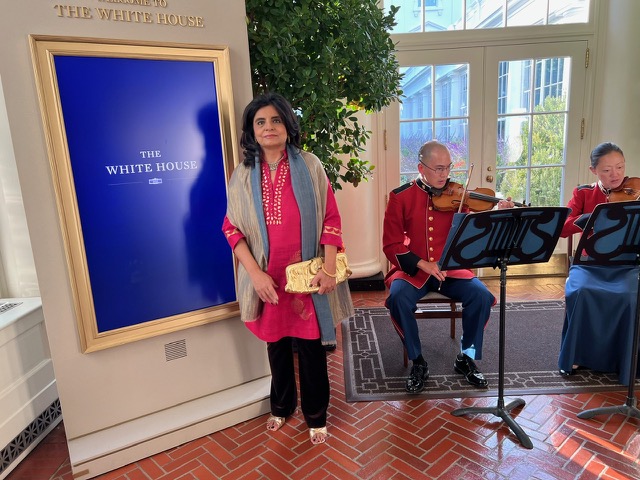
Nothing could have stopped me from attending the Bidens’ Diwali party, not even a surgery ten days earlier. When I arrived in America with my family in 1969, Indians were an unknown people. Children used to follow my mother around like she was the Pied Piper, fascinated by her sari. Growing up in a small town in Connecticut, I felt lost. I started my book to find my way home. Inside the White House, several hundred accomplished Indian Americans in beaded lehengas and silk suits streamed through the glorious rooms, giving off an opulent air of Bridgerton. After President Biden welcomed us, acknowledging the talents and rich cultural traditions we brought to America, we were told grandly, “All rooms are open to you!” It was an exhilarating moment. Perhaps for the first time in America, I felt I belonged. I was part of this large, transplanted community who could rightfully claim a place here. It was a symbolic moment, but the emotion was real. A new sense of connection to America was made possible, unexpectedly, by a novel in which I’d spent decades voyaging back to a lost home.
Reviews:
“Kapur perfectly conveys the twins’ attempts to find their purpose while defying the expectations of a turbulent post-partition Indian society. This is a beautiful exploration of the hardships endured by women artists.”—Publisher’s Weekly starred review
“An engaging examination of female independence and familial devotion”—Kirkus Reviews
“Kapur’s vivid descriptions of Jaya’s paintings and Kamlesh’s dancing bring them to life on the page.”—Booklist, starred review
“The writing comes alive in the descriptions of Jaya’s and Kamlesh’s artistic endeavors, with the details of both art forms rendered precisely and painstakingly. The reader in effect gets a master class in art appreciation—and gains an appreciation of its contested practice by young women in post-colonial India straining against class, status, and social norms.”—Girija Sankar, KhabarMagazine
“Focused on gender roles, art and reimagination, this remarkable debut features twin sisters who take different paths in 1950s India. As one complies with her father’s wishes, the other risks it all to live with agency, authenticity and ambition.”—Karla J. Strand, Ms. Magazine
“This is a dense story packed with rich characters and brimming with timely references to India’s changing landscape. A forbidden Bengali boy adds to the social pressures the Malhotra sisters must navigate on the harrowing road to self-fulfillment. Through it all, Kapur infuses her protagonists with agency even as she remains honest in her depiction of the personal cost Jaya and Kamlesh pay.”—Leah Tyler, The Atlanta Journal-Constitution
This was a fascinating conversation with author Parul Kapur about Inside the Mirror, which is set in India during the aftermath of colonialism and explores art, history, political revolt, love, and women’s ambition to seize their own power: https://t.co/bDM4OJig6Kpic.twitter.com/msXIFm3wkF
Up on the WLT Weekly, “All Art Is History,” Sangamithra Iyer’s conversation with Parul Kapur, whose novel Inside the Mirror, set in 1950s Bombay, won the AWP Prize for the Novel.https://t.co/e9PGjETbUjpic.twitter.com/FGXzksPxFE
— WorldLiteratureToday (@worldlittoday) July 17, 2024
Parul Kapur argues that employing the investigative techniques of a reporter can help fiction writers vivify their narratives; a journalist’s tools can help world-build, develop characters, and add cultural and historical specificity to stories. at.pw.org/DoYourResearch
"Making decisions for herself, pursuing a man she is attracted to, choosing her vocation—these are all aspects of a woman’s self-creation. Of course, this was anathema in India in the 1950s." – Q&A with Parul Kapur, author of #InsidetheMirrorhttps://t.co/GAPCZQQCJfpic.twitter.com/fWvI8srrz3

 UNP blog