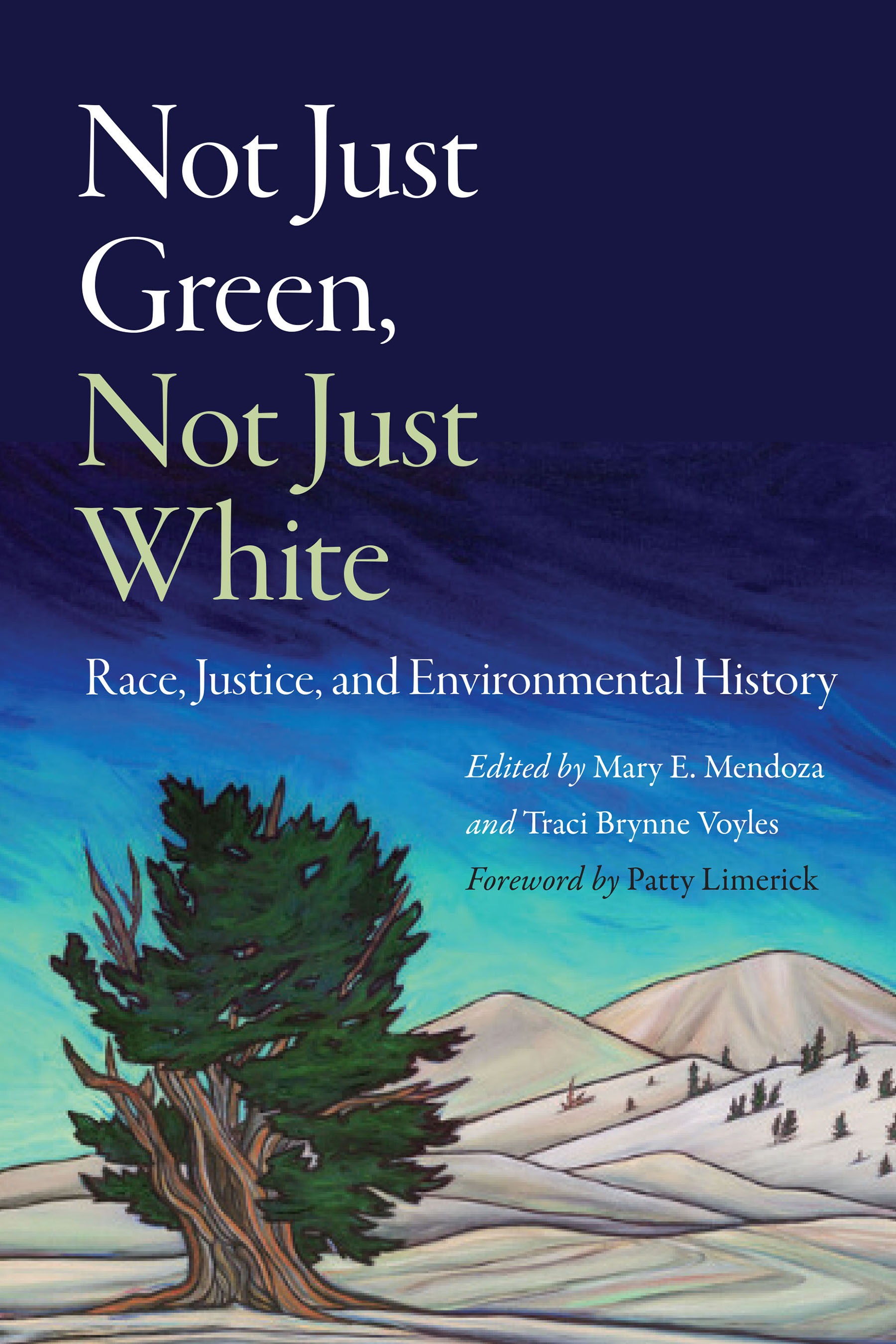
Mary E. Mendoza is an assistant professor of history and Latino/a studies at Pennsylvania State University. She is the author of several journal articles and book chapters about the intersections of race, environment, health, and disability. Traci Brynne Voyles is a professor and department head of history at North Carolina State University. She is the author of The Settler Sea: California’s Salton Sea and the Consequences of Colonialism (Nebraska, 2021) and Wastelanding: Legacies of Uranium Mining in Navajo Country. Mendoza and Voyles are editors of Not Just Green, Not Just White: Race, Justice, and Environmental History (Nebraska, 2025) which was published last month.
Not Just Green, Not Just White brings together a group of diverse contributors to explore the rich intersections between race and environment. Together these contributors demonstrate that the field of environmental history, with its core questions and critical engagement with the nonhuman world, provides a fertile context for understanding racism and ongoing colonialism as power structures in the United States.
Earlier historiography has defined environmental history as the study of the changing relationships between humans and the environment—or nature. This volume aims to redefine the field, arguing that neither humans nor environment is a monolithic actor in any given story. Both humans and the environment are diverse, and often the environment causes conflict between and among peoples, leaving unequal access and power in its wake. Just as important, these histories often reveal how, despite unequal power, those who carry less privilege still persist.
Introduction
The Ownership of the Earth
Mary E. Mendoza
Always, somehow, some way, silently but clearly, I am given to understand that whiteness is the ownership of the earth forever and ever, Amen!
— W. E. B. Du Bois, “The Souls of White Folk,” 1920
The world’s oldest living organism sits deep within the Inyo National Forest on the east side of California’s Sierra Nevada. At nearly five thousand years old, Methuselah, a mighty bristlecone pine tree, rests in a grove about an hour’s drive from the town of Bishop. This community of trees has survived storms, droughts, and fires. Their dense wood has shielded them from bug and fungal infestations. Their genomes, which are nine times longer than the human genome, have allowed them to adapt to climate changes. These trees can “deal with crisis by sectioning off parts of their structures, enabling the rest of the tree to keep living” while an injured limb dies. They thrive in Death Valley despite severe weather and poor soil. Each ancient tree, from seedling to sapling, to mighty, gnarly, twisted, colorful elder, tells a story of survival, resistance, and knowing when to let go.
People of color and Indigenous peoples in the United States tell similar stories of environmental endurance. The goal of Not Just Green, Not Just White is to push historians not only to think more judiciously about race as a power structure that shapes and informs U.S. environmental history but also to consider the ways that marginalized communities resist those very power structures. The white settler project is just that—a project—and it is long-standing and ongoing. That project is complex, contingent, contested, and fraught, and at its heart are stories of human relationships to nonhuman nature. Our purpose as scholars and in this volume is to move the field of U.S. environmental history in a direction that exposes the problems of white settler supremacy in the past and present by looking at the entanglements of racial and colonial relations of power with the nonhuman world. Through critical analysis of white settler supremacy, we offer un- or underexplored histories of injustice (environmental and social), but also uncover stories of resistance to injustice and of diverse human relationships to myriad environments. By expanding what environmental historians have traditionally analyzed about people, power, and the natural world, we begin to reimagine and redefine the relationship between race and environment.
The field of U.S. environmental history has long suffered from a dearth of scholarship that meaningfully engages with race or the formation of racial hierarchies and their relationship to the environment. Several scholars note that although the field’s early work was notoriously white, more robust engagement with histories of marginalized communities has emerged since the 1990s. Others argue that even these shifts have been paltry. Adequate or inadequate, there is still much to be done. So far, this kind of work in environmental history has focused on relatively narrow questions of environmental inequalities and the disproportionate exposure of communities of color to industrial pollution in urban areas. Although the body of scholarship on race and environment has increased, environmental history narratives continue to be troublingly uncritical of racial power structures and couched wholly within what we call a white settler supremacist framework—a framework that combines histories of settler colonialism and white supremacy. By deconstructing and looking critically at white settler supremacy in U.S. environmental history, the essays in this book highlight a range of nuanced and diverse histories across space and time. To peel back stories centering on whiteness is to reveal a world of overlooked understandings of and experiences with a multitude of environments.
More often than not, existing histories of race and environment articulate how racial difference works to the detriment of nonwhite actors. In these histories, communities of color and Indigenous peoples might be dispossessed in the name of conservation, their bodies may suffer as they toil in plantations in the South or the orchards of the hot and arid West, or they may find themselves exposed to toxins at the hands of powerful corporations. These are familiar stories about race, environment, and (in)justice, and they are important. But there are other stories to tell: stories of strength, of finding freedom in the clouds as they float over a prison or detention camp, of finding one’s ancestors, oneself, or one’s future in nature. Stories about race and nature need not just be stories of environmental injustice and degradation—they can also be stories of liberation, grit, and resistance. They can, in fact, be stories of different kinds of environmentalism, of underrepresented politics of advocacy or understudied relationships with the nonhuman world. The challenge for scholars of environmental history is to analyze and interpret our diverse histories and myriad relationships with the natural world while understanding the racial hierarchies that undergird this nation’s settler colonial past and present.
This debate, then, over whether U.S. environmental history has done a good job with race, should not merely address the number of books published “about” nonwhite and Indigenous people and communities—our evaluation of the field must be more robust than that. We must ask how our accounting of these histories addresses power structures such as white settler supremacy, settler colonialism, racism, and patriarchy and how these power structures intersect to mediate historical relationships among different kinds of humans and their environments. We must ask how nonwhite and Indigenous peoples are represented in our studies and what kinds of archives we turn to when we write about communities whose worldviews have too often been excised from official or colonial documentation. Finally, and crucially, we must ask who is doing the representing, how to diversify the academy itself to include more scholars of color, how to mentor and support students and faculty who are systematically deterred from doing scholarly work, and how to push our institutions to be robustly diverse intellectual spaces. This means that the work falls on white and nonwhite scholars alike.
We use the term white settler supremacy to broaden understandings of the United States’ troubled settler colonial history (and present) from one that is often mostly associated with Native dispossession to one that encapsulates the experiences of many peoples across many environments and historical moments, caught up in what historian Alaina Roberts calls the “dual nature of settler colonialism”—“spatial occupation and white supremacy.” In short, we use white settler supremacy as a term that combines both settler colonialism and white supremacy into a single holistic frame—one that explicitly calls out whiteness, places emphasis on structural supremacy, and points to not only the eliminatory logic of settler colonialism but also the ways in which acts of expulsion, enslavement, exclusion, and exploitation have served as critical avenues for racial and colonial domination. These acts—expulsion, enslavement, exclusion, exploitation, and elimination—are central tools of white settler supremacy. Each of these terms carries with it significant environmental components.
The effects of white settler supremacy involve racial domination and environmental exploitation of multiple diverse groups, landscapes, and resources, but this approach also makes room, in historically contingent ways, for many distinct relationships between people and nature. Contrary to the assertions of some environmental historians that the frame of settler colonialism renders nature and Natives as passive actors or that environmental history and settler colonialism are at odds, we contend that settler colonialism is actually organized and enriched by the combination of environment, resources, and territory. In fact, we concur with major works in Indigenous studies that see these things as foundational to settler colonialism. Because much of the earliest processes of settler colonialism involved massive dispossession of land, access to natural resources for Native peoples became severely limited, forming a lopsided power system in an emerging capitalist society. That uneven power system produced a structure in which white people controlled land and wealth, rendering them more powerful than other populations. Put succinctly, settler colonialism created a context for white supremacy. Together, they built a system of structural racism that was generally governed by white domination. Building on settler colonial frames, then, white settler supremacy does not preclude Native agency, nor does it omit environmental intervention from the historical record, just as structural racism today does not mean that marginalized communities cannot or do not resist those structures. Similarly, it does not homogenize white settlers; rather, it holds all white actors accountable to a power structure that accrues wealth and privileges to them at the expense of other people and the environment. Although not all white settlers actively sought (or seek) to destroy or dispossess marginalized peoples, they did (and do) all benefit from systemic remunerations—this is critical because when we ignore this truth, we cannot take environmental or social justice seriously.
 UNP blog