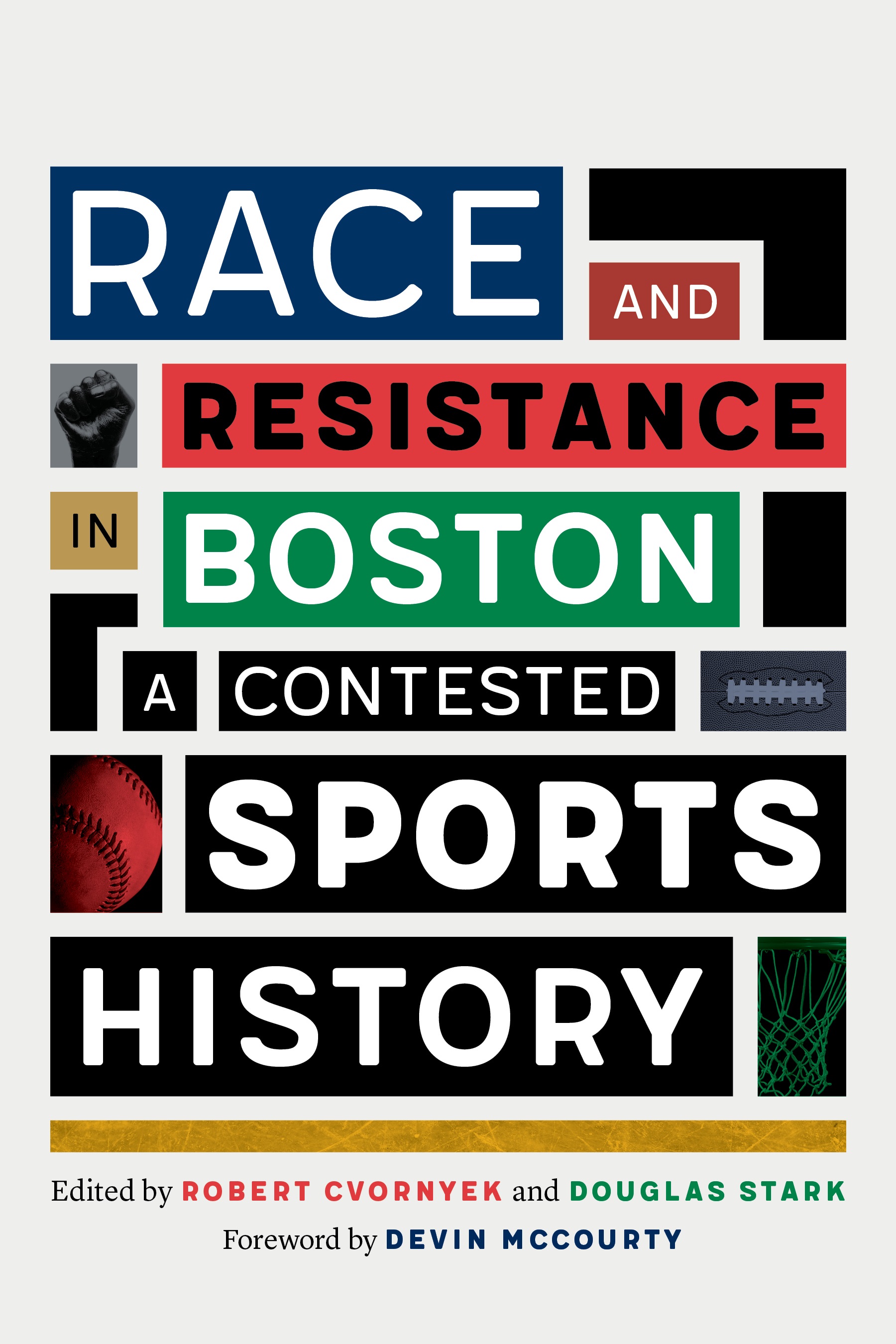
Robert Cvornyek is professor emeritus of history at Rhode Island College. He is the author of Black Grays and Colored Giants: A Comprehensive Guide to Black Baseball in Rhode Island, 1870–1949. Douglas Stark is a museum consultant and sports historian. He is the author of The James Naismith Reader: Basketball in His Own Words (Nebraska, 2021). They are the editors of Race and Resistance in Boston: A Contested Sports History (Nebraska, 2025) which was published in February.
Boston is a city known for its sports as well as its troubled racial conflict. But generations of Black athletes, teams, sportswriters, and front-office executives have exercised historic influence in Boston over the years as they advocated for racial integration and transformed their sports into modes of racial pride, resistance, and cultural expression. Race and Resistance in Boston goes beyond the familiar topics associated with the city’s premiere professional teams, the Red Sox and the Celtics, to recount the long history of Black sporting culture in the city.
Introduction
The collision of race and sport in present-day Boston resonates with stories and events connected to the past. Though known as the “Cradle of Liberty,” Boston rarely escaped the combined indignities of racism and segregation fueled, in part, by economic and residential conflicts between the city’s working-class ethnics and Black Americans. These tensions revealed themselves in most aspects of the city’s life, including the social and cultural world of sport. Historian Zebulon Miletsky aptly concludes that “as a symbol, Black Bostonians have always been emblematic of that distinctly American of dilemmas—the curious conundrum of what it means to be Black in the cradle of Liberty.” The juxtaposition of Boston’s liberal tradition and troubled racial past provides the historical backdrop for many of the chapters in this book.
In sport, this juxtaposition has traditionally focused on the city’s premier professional teams, the Celtics in basketball and Red Sox in baseball. The relationship between Boston and these clubs mirrored the city’s tense racial history and has been the focus of much scholarly attention. The distinctive approach to racial integration that each club pursued encouraged authors to contrast the binary policies of both teams and highlight the individuals who navigated the city’s color line in mid-twentieth-century America. Boston sport during the modern civil rights era remains a familiar trope. The Celtics drafted the first Black player in the National Basketball Association (NBA), Chuck Cooper, in 1950, whereas the Red Sox were the last Major League Baseball team to integrate, signing Elijah “Pumpsie” Green in 1959. During this nine-year interim, the Celtics signed Bill Russell, the person who delivered the team eleven championships but was never fully accepted in the city he represented. Russell’s encounters with racial hostility as a Celtic led him to label Boston a “flea market for racism.” The interrelationship among the Celtics, the Red Sox, and the city of Boston framed a dominant narrative that helped explain the city’s racial complexities. This story occupied center stage and largely overlooked the wider contexts of race and sport in the city.
This volume’s collection acknowledges this customary account but offers a counternarrative that examines the influence that generations of Black athletes, teams, sportswriters, and front-office executives exercised to shape the city’s racial identity. Long before Chuck Cooper, Bill Russell, and Pumpsie Green tested Boston’s racial consciousness, Black athletes participated in a variety of individual sports and created teams of their own making. These athletes retained their focus on racial integration, but they concurrently utilized sport as a form of racial pride, resistance, and cultural expression. Boston’s Black athletes strengthened racial solidarity and created opportunities for race-based economic uplift for themselves and others. In return, the Black community nurtured its own teams and sportspersons within a city that repeatedly sought to narrow or exclude equal athletic participation. In 1959, two competing narratives unfolded to illustrate the variety of approaches to interpret race and sport in Boston. During the spring of 1959, Pumpsie Green, the first African American ballplayer to wear a Red Sox uniform, captivated the attention of national sportswriters and subsequent historians. Not since Jackie Robinson’s ill-fated tryout with the Red Sox in 1945 had the team entertained interest in a Black player. Green would indeed finish what Robinson started when he joined the Red Sox as the final player to integrate a Major League Baseball team. Green’s courageous journey, however, delineates only one route to understanding the city’s intersection of race and sport. Boston’s Black athletes struggled in the trenches, fighting racism for decades before and after Green’s arrival.
Green’s appearance in Boston coincided with another narrative, a story fixed deeply within the city’s Black community. In April 1959 the Amateur Athletic Union selected John Curtis Thomas as the indoor track season’s most outstanding performer. As a seventeen-year-old student attending Boston University, Thomas set a new indoor record in the high jump at the Knights of Columbus track meet in Boston and then became the first person to clear seven feet at the Millrose Games in New York City. Sports Illustrated magazine touted him as “America’s bright new hope against the Russians” in the upcoming 1960 Olympics. Thomas participated in the 1960 and 1964 Cold War Olympics as one of several Black American athletes who personified the paradox of representing a nation that marginalized and discriminated against people of color.
Thomas was born in Cambridge, Massachusetts, across the Charles River from Boston. His father, Curtis, drove a city bus, and his mother, Ida, worked in the kitchen at Harvard University. As a high school student at Rindge Technical School, he exemplified the dreams and determination of many African Americans living in Greater Boston. At Boston University, “he was always fighting to be the best,” and despite a devastating ankle injury that nearly ended his career, Thomas later competed successfully in the 1960 Olympics. Thomas’s talent, spirit, and determination ensured his induction as the first African American member of the Boston Athletic Association. According to former association spokesperson Thomas Grilk, “For those of us growing up in Greater Boston in the 1950s and 1960s, John Thomas in the high jump was our personal connection to national, international, and Olympic track and field.” Equally important, local Black neighborhoods applauded his achievements and comforted his disappointments. He acknowledged his neighbors’ support by spending his life in service to the community as the athletic director at Roxbury Community College, as a trustee at the Brockton Public Library, and as a volunteer at the local YMCA. Thomas was one of Boston’s own, and the recollection of his accomplishments remains a proud fixture in the Black community’s collective memory.
The Green-Thomas scenario affirms the conclusion reached by historians David Wiggins and Ryan Swanson—namely, that scholars remain more interested in integration and historic firsts “rather than the individual athletes and various events and organizations integral to the development of a black national sporting culture.” This volume, through a collection of new and critical assessments, asserts the historical significance of race and sport in local sporting culture while positioning Boston within a broader regional and national Black sporting tradition. The chapters include a range of topics, themes, and sport personalities that strengthen our understanding of race relations in Boston and contribute to the growing scholarship on urban race and sport. The book’s focus is certainly on race, but several of the chapters occupy space in the intersectional realm of race, gender, class, and sexual orientation.
 UNP blog