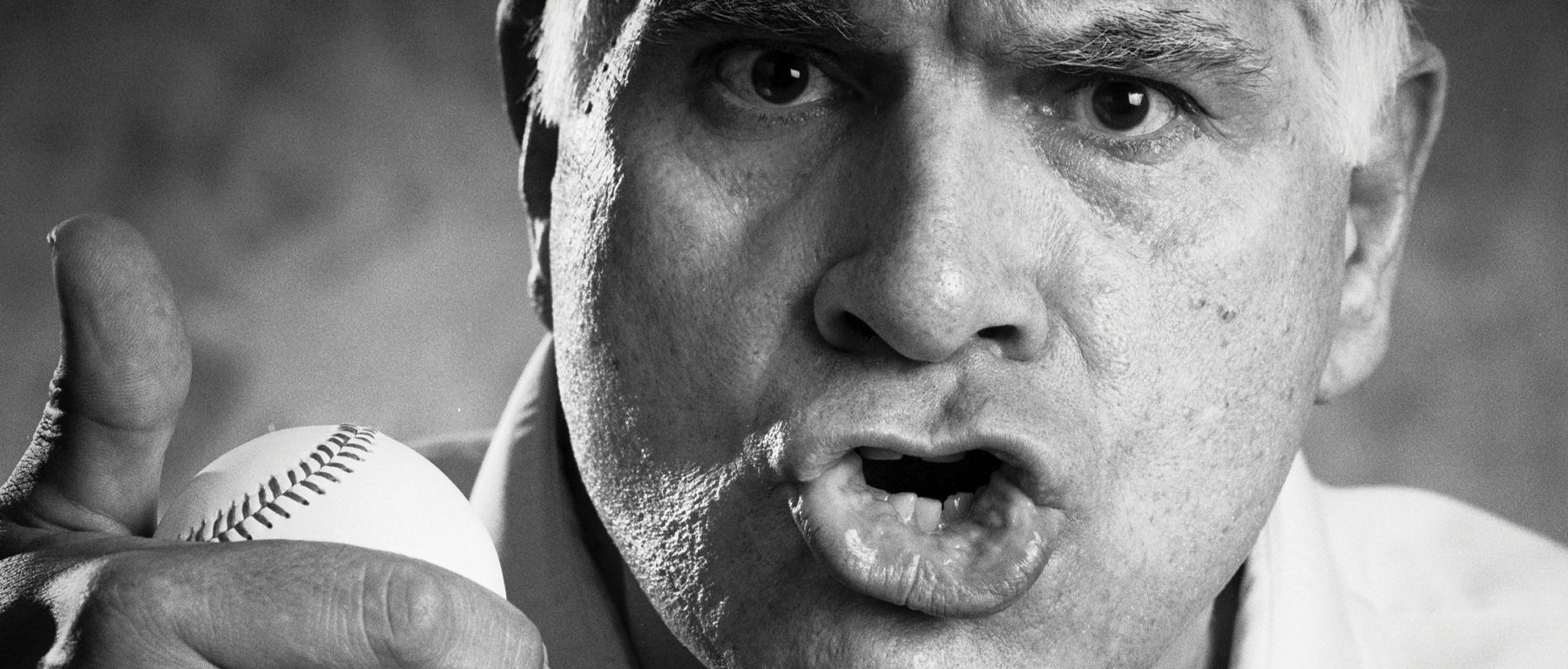
Jim Leeke is an author and editor. His latest book, Big Loosh: The Unruly Life of Umpire Ron Luciano, is forthcoming in July from University of Nebraska Press.

This season Major League Baseball (MLB) is using an Automated Ball-Strike System (ABS) for the first time at thirteen spring training ballparks. The system allows each team two challenges per game, which only pitchers, catchers, or batters can signal by patting the top of their caps or helmets. Some love it, a few despise it, and Terry Francona’s Cincinnati Reds are instructed to ignore it.
Ron Luciano, MLB’s most flamboyant umpire of the 1970s, would’ve absolutely hated the idea of ABS. He was no hidebound traditionalist, though. Ronnie embraced the designated hitter rule in the American League, for example, and expected its acceptance by the National League long before it happened. He also worked the opening game at the Kingdome in Seattle. The stadium scoreboard showed him calling a Mariner runner out at second base, the video replay still something of a novelty in 1977. Ronnie said he didn’t mind the boos that followed—he was used to that, after all—and rightly predicted that “at some point in the future instant replay might be used in conjunction with the officials.”
But Ronnie would have detested ABS for removing one element of human judgment from the game. Big, loud, and entertaining, a former All-America football tackle, he often lamented the monochromatic nature of modern umpiring. Some writers refer to the new ABS now as a “robo-ump,” a term that umps and the powers-that-be both dislike. When ending his MLB career in 1980 to become a TV color analyst, Ronnie commented that many umps in fact trained themselves to perform like robots. This kind of behavior didn’t suit his personality. “I’m a fan,” he said. “I can’t live the game? Then hire a robot.”
Usually he thought of umps, managers, and league officials more in terms of a creaky religion than robotics. He cheerfully violated the orthodoxy of the Church of Baseball—Bowie Kuhn’s parish, not Annie Savoy’s. “Ronnie did something baseball didn’t like—he tried to have fun,” umpire and protégé Ken Kaiser later wrote. ABS isn’t much fun today. Neither is losing the opportunity to give the arbiter behind the plate an earful after an occasional bad call. Why give up satisfying interactions for pale graphics on stadium boards and TV screens?
Ronnie recognized that fallibility is part of baseball. Players appreciated that he’d admit an occasional mistake. In 1975 he willingly reversed a home run call, after California Angel Tommy Harper bashed a long fly ball near the left field foul pole in Baltimore. “Diogenes, the mythical Greek who spent his life searching for a completely honest man, could have found one in the umpires’ dressing room,” The Sporting News said afterward.
Angel manager Dick Williams, no softie, objected to wiping three runs off the board. He demanded to be ejected with the same vigor the ump had shown in making his initial call, and Ronnie obliged. Afterward he said he hadn’t seen the ball, had to make a call, and figured he had a fifty-fifty chance of being right—an explanation he used several times during his eleven seasons in the big leagues. Today, the ABS offers no audible explanation at all, only pale graphics that leave no room for argument, debate, or comment.
In addition to his on-field duties, Ronnie was president of the MLB Umpires Association in 1979, his last season in uniform. He led a strike for better pay and benefits, and probably would’ve fought the ABS with equal determination . . . as any number of fans on social media encourage the current union to do in 2025. And if he’d lost such a fight, the old arbiter would’ve been delighted to see how often ABS shows that plate umps are correct in their calls.
The ever advancing sophistication of wearable tech, cameras, and sensors conceivably could lead far beyond ABS to the elimination of human umpires from the big leagues. Ronnie certainly would’ve detested and opposed any such notion. Normally chatty and jovial, the big man reacted with a rare flare of anger in 1979 after an implied threat to fire him and the other striking umps and hire replacements. “I can’t believe they’ll be that stupid,” he snapped. “But, having seen baseball men operate, you never know!”
Ronnie’s American League nemesis fifty years ago was “the Earl of Baltimore,” fiery and argumentative Earl Weaver, who managed the Orioles. Weaver simply never believed that most umpires at any level were very good at their jobs. His screeching, nose-to-nose confrontations with umpire Luciano delighted fans for years and have since become legendary. Weaver likely would have applauded the ABS. Ronnie, not so much.
The burly ump once tossed diminutive Weaver from a 1974 game in Baltimore while working first base, even though the Birds’ skipper hadn’t vocally protested his checked-swing strikeout call on batter Bobby Grich, but merely looked toward the heavens in silent appeal. “With his cap off and his arms raised high up in the air, I thought Weaver was praying, ‘Please throw me out,’” Ronnie said. “So I threw him out.”
Let ABS do that.
 UNP blog
One thought on “From the Desk of Jim Leeke: Ron Luciano would thumb ABS out of the game”