
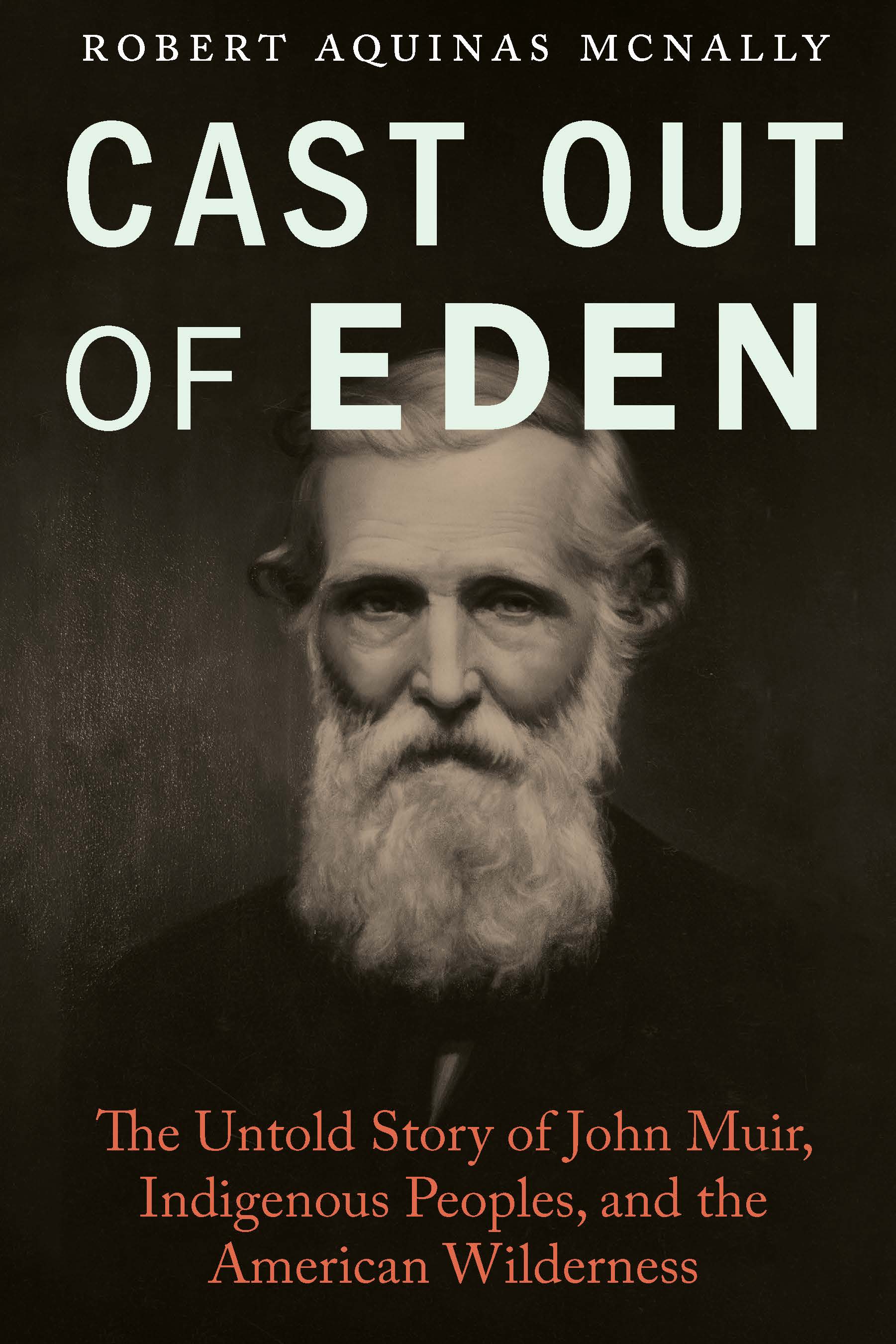
Book Birthdays celebrate one year of a book’s life in social media posts, reviews, and more. This month we’re saying Happy First Book Birthday to Cast out of Eden: The Untold Story of John Muir, Indigenous Peoples, and the American Wilderness (Bison Books, 2024) by Robert Aquinas McNally.
About the Book:
John Muir is widely and rightly lauded as the nature mystic who added wilderness to the United States’ vision of itself, largely through the system of national parks and wild areas his writings and public advocacy helped create. That vision, however, came at a cost: the conquest and dispossession of the tribal peoples who had inhabited and managed those same lands, in many cases for millennia. Muir argued for the preservation of wild sanctuaries that would offer spiritual enlightenment to the conquerors, not to the conquered Indigenous peoples who had once lived there. “Somehow,” he wrote, “they seemed to have no right place in the landscape.”
Cast Out of Eden tells this neglected part of Muir’s story—from Lowland Scotland and the Wisconsin frontier to the Sierra Nevada’s granite heights and Alaska’s glacial fjords—and his take on the tribal nations he encountered and embrace of an ethos that forced those tribes from their homelands.
A word from the Author: Shining a Light on a Secular Saint’s Shadow Side
Right from the moment many years ago when I first encountered the figure of John Muir, something otherworldly, even sanctified, gathered in his being. Perhaps it was the photos of this father of the national parks peering into the Yosemite distance like a prophet beholding his god. Or his writings promising divine immanence in every walk in the woods. So when, in the course of researching The Modoc War (Bison Books, 2017), I found out that Muir had visited the battlefield only a year after the fighting ended, I had to dig deeper. A revelation awaited.
Unlike any other wild space before or after, California’s Lava Beds creeped Muir out. The cause of his discomfort was less the landscape itself than the Modocs’ hellish viciousness.
“Though in battle they appear incapable of feeling any distinction between men and beasts, even their savageness lacks fulness and cordiality. The few that have come under my observation had something repellent in their aspects,” he wrote. “Crawling stealthily in these gloomy caves, in and out on all fours, unkempt and begrimed and with the glare of war in their eyes, they must have looked very devilish.”
Clearly Muir saw the Modocs as dangerously other. Which got me wondering: Was his disgust specific to this one tribe at this one time, or did it encompass all Native Americans throughout his public career?
A deeper dive revealed what had been hiding in the plain sight of Muir’s writings all along. But for the singular exception of Alaska’s Tlingits—whom he saw mistakenly not as Native Americans but as misplaced “Mongols”—Muir looked down his Scottish nose at all peoples of every tribal variety. “The worst thing about them is their uncleanliness,” he emphasized. “Nothing truly wild is unclean.”
Nor did Indigenous peoples belong in the wild spaces Muir sought to preserve as pristine national parks; their very presence disturbed nature’s purity. “Somehow they seemed to to have no right place in the landscape,” Muir declared of a band of Kutzadika’as he encountered in the Sierra Nevada, “and I was glad to see them fading out of sight down the pass.”
Muir hardly invented such disdain. Rather, he took popular thinking that cloaked white Anglo-Saxon Protestant supremacy in fake science and extended it to America’s wildest reaches. Muir’s gospel of wilderness purity helped ensure that tribes from Yosemite to Glacier, from Denali to Rainier, were driven from their homelands even as white folks were invited in. As David Truer (Ojibwe, Leech Lake) writes, “The American West began with war but concluded with parks.” Muir had a hand in tracing that tragic arc. John Muir remains an important environmentalist who helped protect wild America from commercial exploitation. But, as Cast out of Eden makes clear, no saint, not by a long shot.
Reviews:
“In his well-researched and well-writtne book, Robert Aquinas McNally uses Muir’s diaries and letters to reveal a flawed activist, one who believed in the racial superiority of whites and the inferiority of Native Americans.”—David C. Noonan, Roundup Magazine
“This is a well-written exploration of John Muir’s life and legacy.”—James H. McDonald, New York Journal of Books
“Cast Out of Eden is another chapter in the painful process of evaluating major historical figures, recognizing that the same people who made significant, positive contributions could also be guilty of being terribly wrong.”— Davif Luhrssen, Shepherd Express
“A convincing, corrective portrait of a revered but flawed man, and of a movement’s original sins. It ends on a note of modest hope, as McNally jumps to the present to detail how Native Americans are claiming their rightful places in the nation’s national parks.”—Peter Fish, San Francisco Chronicle Datebook
“A revealing biography, Cast Out of Eden details the hypocrisy, cruelty, and astonishing achievements of John Muir.”—Erika Harlitz Kern, Foreword Reviews
“Award-winning historian McNally once again tackles a difficult topic, and readers will be discussing his conclusions on Muir for many years.”—Stuart Rosebrook, True West Magazine
“Robert Aquinas McNally’s new book, Cast Out of Eden: The Untold Story of John Muir, Indigenous Peoples, and the American Wilderness, prompts a fresh round of reconsideration by attending specifically to this side of the United States’ pioneering environmental crusader.”— Andrew Graybill, Los Angles Review of Books
“The book presents a fascinating and heavily documented view of John Muir and his generation along with their flaws, issues that still plague the US today.” —C.W. Bruns, CHOICE
Interviews:
On Social Media:
Robert Aquinas McNally explores John Muir’s complicated legacy in Cast Out of Eden: The Untold Story of John Muir, Indigenous Peoples, and the American Wilderness. My review in @SFC_Datebook https://t.co/FdOoTFiMOV
— Peter Fish (@PeterAFish) May 3, 2024
Yesterday I had an excellent conversation with Robert Aquinas McNally about his latest, Cast Out Of Eden. That means season 10 of A Book & Its Author is about ready to go! Keep an eye out tomorrow for the schedule. pic.twitter.com/sHDCpCiEC8
— A Book & Its Author (@its_author) July 4, 2024
"McNally contends that the true measure of Muir’s own racial chauvinism is found less in his observations than in his silences. The names of Indigenous individuals who helped with his excursions rarely appear in his writings." https://t.co/VQM9OnM08t
— Los Angeles Review of Books (@LAReviewofBooks) May 13, 2024
 UNP blog