
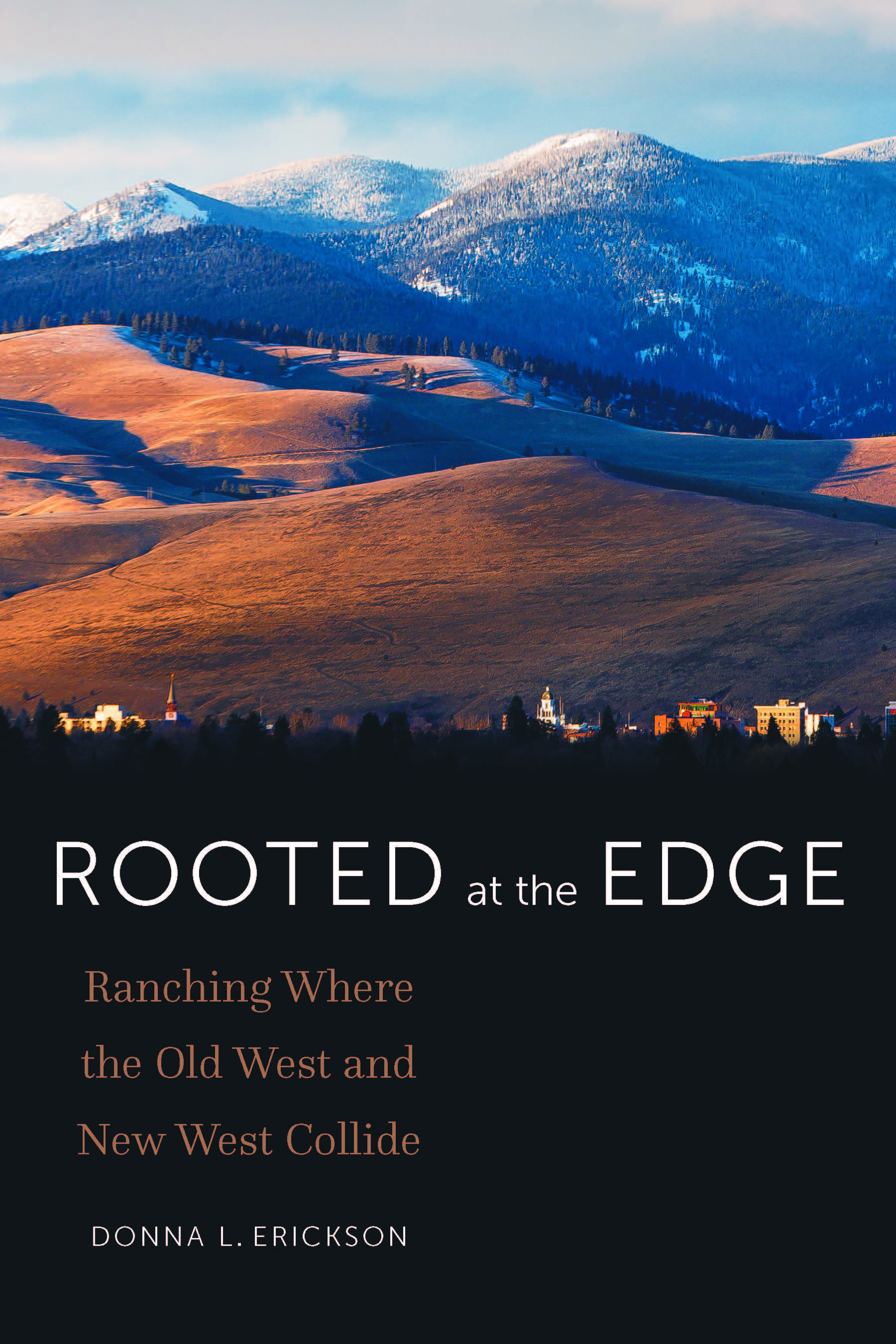
Donna L. Erickson is a consultant on open-space conservation in the Rocky Mountain West and was an associate professor of landscape architecture and planning at the University of Michigan for sixteen years. Erickson has published extensively in design, planning, and conservation journals and is the author of MetroGreen: Connecting Open Space in North American Cities. Her latest book Rooted at the Edge: Ranching Where the Old West and New West Collide
was published by Bison Books in April.
Rooted at the Edge paints a portrait of a ranching community in a threatened landscape steeped in history, conflict, and beauty. In this narrative nonfiction work, Donna L. Erickson explores the hilly skirt of ground at the northern boundary of Missoula, Montana, separating the town from the wilderness beyond. The North Hills region represents the critical—and often highly personal—issues at play at the edge of many western towns.
Prologue
You never know what events are going to transpire to get you home.
— Og Mandino
My son Rye and I visit Skyline Ranch’s highest point by exactly the same route but with different vehicles. Rye, twenty-nine, fights forest fires throughout the West from his base in Oregon and trains each spring for the grueling summer fire season. As he grinds his mountain bike slowly uphill, he’s wearing his weight vest with its many pockets, each holding a two-pound weight. He’s probably carrying an extra forty pounds today. It’s April 2004, spring break from my teaching, and I’ve coordinated my trip from Michigan to overlap with Rye’s. We’ve rarely gotten the chance to visit the ranch together in recent years. I drive my mom’s beat-up Forest Service–green 4×4 a comfortable distance behind Rye, crawling along the two-track road until we get to a steep hill. Then I pass him and holler, “Lookin’ good! See you at The Top,” out the window. He’s huffing and sweating, pulling in a low gear. I know I’ll be alone for a while as he labors uphill, but spending time up there always calms and soothes my spirit, in a bittersweet way.
We are heading “over The Top,” shorthand in our family for traversing, whether by foot, bike, horseback, or 4×4 pickup, a big circle from the ranch buildings up over the east–west ridge line of the North Hills—above Grant Creek on one side and the Rattlesnake drainage on the other. The ridge, with its scattered ponderosa pines, is the top of what my family calls the Big Pasture, a one-square-mile fold of hills visible from downtown Missoula, Montana. If it were fall, we might see the North Hills herd of elk, up to a couple hundred head, grazing on dried bunchgrass.
This ridge is truly an edge—the place where the dark forest falls northward for a half mile or so then rises toward the wilderness. At the high point of the ridge, I get out and walk a short distance to the edge of the steep hillside. I scan the city and the ring of hills and mountains circling it, a view I’ve enjoyed by horseback hundreds of times. A slight haze blankets Missoula today. It’s not uncommon for air inversions to trap air in the valley; in a couple of months smoke from wildfires in the surrounding mountains will linger there.
Rye and his bike look tiny as they enter the Big Pasture at the Four Corners far below. This geography is coded in place names for us: Four Corners, the Basin, Big Pasture, the Saddle, the Hundred and Sixty, the Lone Pine, Lookout Hill, the Meadow, the Lower Spring.
In the middle distance, I recognize most of Skyline Ranch’s main landmarks, even though the ranch buildings are hidden behind a hill. The buildings of the other two North Hills ranches are also invisible due to the lay of the land, but their rolling pastureland forms the middle-ground. The Carlson and Randolph places lie south and west of Skyline Ranch, respectively. Far less lovely, Missoula’s landfill is also part of the North Hills scene and, from my vantage point, looks like a large white blot on the landscape, with festering stitches carved in the hillsides angling out from sealed scar tissue
The long view south is out past the North Hills, over Missoula to the Bitterroot Mountains. We are at nearly the same elevation as Mount Jumbo, which creates the eastern edge of the Rattlesnake Valley. This iconic Missoula landform looks like a sleeping elephant, its rump at the Clark Fork River and its trunk pointing north to the Rattlesnake Mountains.
I moved away from Missoula on New Year’s Day, 1980, and for the past twenty-four years I’ve come back to the ranch for a few days in summer or at the Christmas holidays. I always feel as connected to the land as to the family. During our first eight years away, my two young sons, their dad, and I lived close enough that I could visit more often. The boys rode horses and provided “gopher” services for weeks at a time in the summer, which cemented their attachment to both the ranch and their grandparents.
Later, we returned less frequently from our homes in the Netherlands, Wisconsin, and then Michigan. Ironically, the longer I am away, the stronger my attachment to the ranch feels. Gradually, I sensed the ranch changing as my parents aged. Eventually, they got out of the cattle business and stopped raising horses, relying completely on off-ranch income. Now other peoples’ cattle graze at the ranch in the summer, and one elderly horse roams the hills alone. No one puts up hay, and the fields grow to weeds. Since my dad died last fall, the end of one chapter for the ranch is even more certain. It is increasingly painful to see the place lose its vibrancy. Although this has always been marginal ranch land—best for grazing livestock, not raising crops—a lot of tasty fruits and vegetables have come off the place over the past century. The ranch seems to be going dormant, waiting for new life.
As the ranch has changed, so have its surroundings. As I look out in spring 2004, development is closing in on two sides. I see new houses going up at the ranch’s edges, although the Carlson and Randolph places have stayed undeveloped. People want to live in and near these hills, particularly in the neighboring Grant Creek and Rattlesnake Creek valleys. This view from The Top now includes ranchettes that are neither part of Missoula nor truly part of the North Hills. In my time away from Montana, I’ve seen sprawling development at the edges of many towns, and I worry about the future of the ranch if Missoula sprawls northward. Still, landscape change is incremental. The view today is not startlingly different from last year.
 UNP blog