
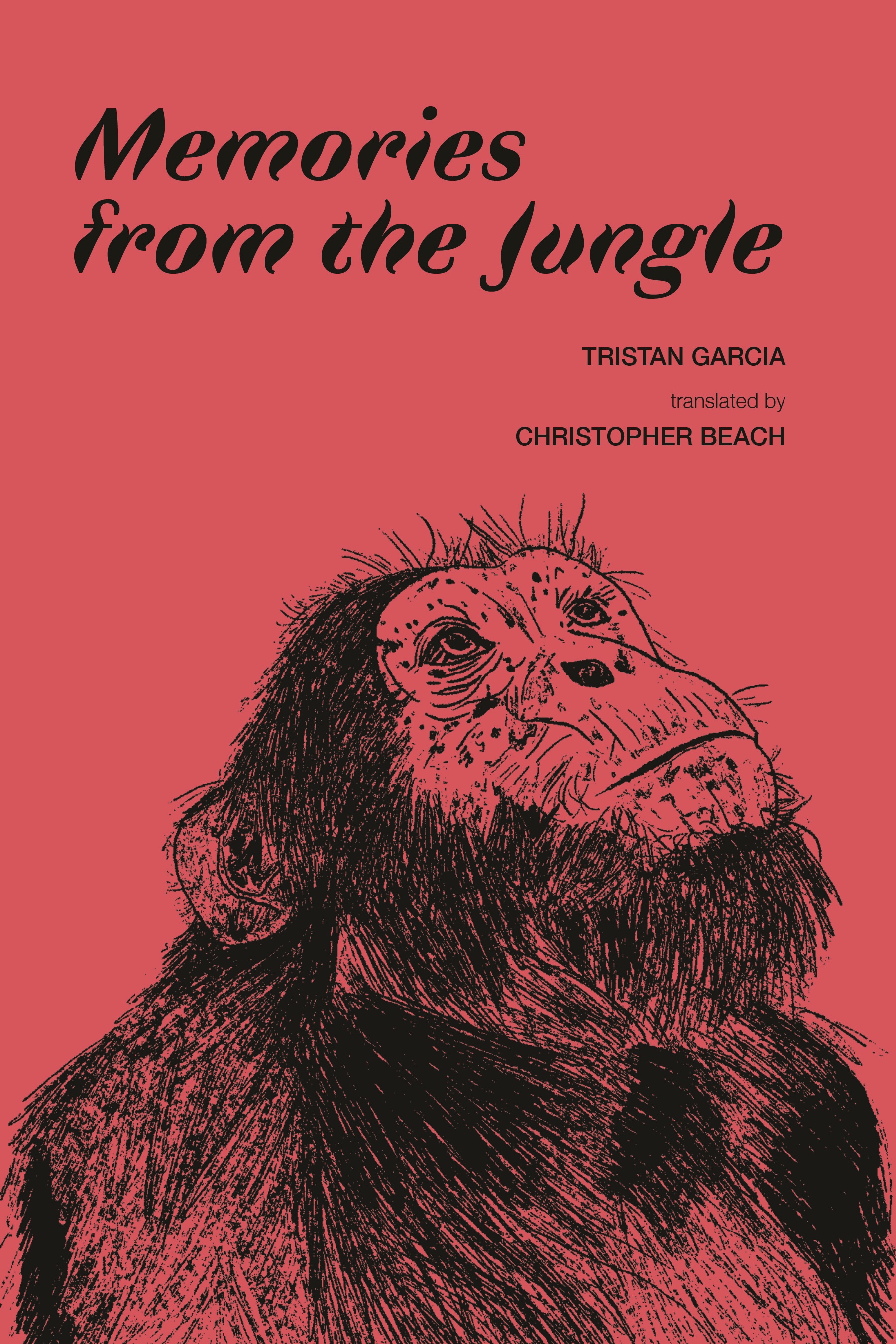
Tristan Garcia is a rising star of the French intellectual and literary world, having published several books of philosophy—including the influential Form and Object—as well as eight works of fiction. His first novel won the Prix de Flore and was translated into English as Hate: A Romance. Garcia is on the philosophy faculty at the Jean Moulin University, Lyon 3. His newest book, Memories from the Jungle (Nebraska, 2025) translated by Christopher Beach, was published last month.
Memories from the Jungle is set in an unspecified future in which Earth has been rendered uninhabitable by pollution and war. Most humans live in orbital stations surrounding the globe, while only animals still survive on the African continent, along with a few scientists who study them in a kind of zoo and experimental laboratory. Doogie, a chimpanzee, has been raised as a human by a zoological researcher, Gardner Evans, and his daughter, Janet.
Doogie is no ordinary chimpanzee: gifted with an exceptional intelligence (perhaps the result of a scientific experiment), he has been taught a fairly sophisticated version of the human language, is capable of human emotions such as love and jealousy, and has a highly developed understanding of human behavior. After an accident to the spacecraft that was bringing him back to Earth from an orbital station, Doogie finds himself alone in the jungle. In order to survive, he must rediscover the very animal nature he has been trained to reject.
Doogie
—The ape introduces himself.—After a long voyage in Earth’s orbit, he is returning to Earth.—He remembers his childhood and his education at the Gardner family’s zoo.—Brother, mother, father, and sister.—A speech.
I’m just a Doogie, I’m just a monkey. Poor Doogie, poor monkey. I’m so small, and everything is very big.
I’m a great ape, a chimpanzee, and not a little macaque, but Janet always calls me her monkey. And when Janet says—“Doogie, you’re a good ape . . . Come, Doogie, come and cuddle, my little ape”—then I’m happy. Doogie is very smart.
Alas, when I see myself, Doogie, in the mirror, I say to myself: “You’re an ape, you’re a monkey. You’re never a human, and you never will be. Be faithful to the human, Doogie.” I make a face. I’m close to the mirror and I say, “Haouh!” What do I see when I see me? I see sadness in the mirror, I see joy on my eye. I have a big hand. Put your hand under your chin, Doogie. The hand is big, brown on one side and pink on the other. It is placed on the mirror, and I draw a smile without showing my teeth. How big your chin is, Doogie! How little your pushed-in nose is, and how black! How hairy your pelt is! Haouh! Haouh! You must not laugh at apes, Doogie. I make the menacing look, the stare, eyebrows high, ears forward, mouth open, nostrils flaring. You must not make fun of monkeys, Doogie. What do they know? What can they do? Being born and living in the Jungle! Eating fruits, eating leaves and ants, kissing, picking lice, fighting, hugging, being little, having children. But never knowing, never speaking, never building anything more than leaves, fruits, branches, nests, trees, and stones. Humans can know and speak.
You have big ears on either side of your skull, Doogie. The skull is the brain. “No, Doogie, the brain is in the skull.” It was a joke, a joke, a joke! Oh, a monkey’s brain is too small of a brain . . .
But Doogie’s brain is more big than little. “Doogie, you’re a genius!” Then I know, I smile. The stare, hair standing up, tongue stuck out, upper lip pulled in. Hin-hin. When Janet says, “Doogie, you’re a genius like no one else, come on, Doogie, I love you very much,” oh, Doogie is like a heaven! How small your eyes are, monkey. Humans don’t know what you have behind your head, knock, knock, knock. But from behind my pupils, I can see you. I sniff and I close my shirt with the big fingers of my big hand. It has five gold buttons with a cross pressed into them. I know, I breathe, and I don’t suffocate. I’m not handsome. I’m not very very handsome. When Janet says, “Doogie, you are a handsome and a very good monkey,” I know that with her green eyes she doesn’t see a human behind my big eyes. I’m only a Doogie. This isn’t human hair on my skull, on the skull on my brain: this is animal hair, hair, hair.
I’m ready. There are still a few minutes that come out of the big watch Janet gave to Doogie tick-tock, never lose it—still a few minutes on the ground and then it will be the beginning. Today and tomorrow I must be very handsome, comb my hairs, wash my hands and the glands on my neck, on my chest, under my arms, inside my bottom. “It’s a very big adventure that awaits you, Doogie.” I don’t know. You must be very faithful to the human, the human must know, and everything, everything that is big belongs to him. Language belongs to the human, and the stars, the Earth, knowledge, power. Everything belongs to the human. I know it. I know it, but Doogie can’t do it. Nothing belongs to the monkey except the Jungle. I walk around in the ironed white shirt, the black vest, the five gold buttons engraved with the cross, and the gray canvas trousers with two pleats. Are you handsome, Doogie? No, no, no! But I speak like a human, and if you loosen the waistline and zip up the zipper you are worthy. I have fewer hairs when I’m wearing more clothes. Sometimes happy, sometimes sad, that’s my life. It’s monkey.
Please excuse my speech. I say a lot of little words, too little for a lot of brain but too big in my skull. I hope to understand and learn. I hope to say things. I hope that one day everything that is big will be little in the words that come out of my mouth which I pull out with my big hand. You will look in Doogie’s skull, and inside you will see everything that is big coming out of my mouth: yesterday, today, tomorrow, the world.
I jump onto the chair. I’m happy, everyone loves Doogie, and I’m so small in the mirror. Everything is big outside, and everything is big inside my head.
It’s time for my speech. Clear the decks!
Ladies, gentlemen, young ladies: dear very dear respect.
As you can see, I’m not like you, but I almost behave like you. I’m a member of the species pan troglodytes troglodytes, here to serve you. My name is Doogie, and my nature is common chimpanzee, but I have a human culture. Hmm, hmm. You humans who live far from planet Earth, on one of the big stations in the beautiful middle of the bright stars, you will ask yourself: “Who is this very famous ape genius to whom it was taught to dress myself, to write, to read and to speak?” Far in the deep of the Jungle, excuse my speech, in the very deep of the very big forests of the planet Earth and of the continent, which you other humans have allowed to return to fallow land, I was born a chimpanzee, an ape and to serve you. But misery of sadness: woodcutters roam in the forests of the tropics between the banana trees, poachers. They walk in the forest, their beards long, with a lot of guns. They kill Doogies. One day they kill my father, dead. One day they kill my mother, dead. Doogie is sad, he is young. Doogie cries. He is only a Doogie, a poor monkey. Alone for one day, alone for two days. He has only himself to hold in his arms. He puts his fingers in his mouth, and his feet, like an animal. He tries to reassure the little monkey who you are. He screams, he moves his arms, and he falls down, very simply all alone. His heart slowly goes tick-tock, the cold is everywhere in his body, sleep has gone away. He is empty and it is over. He is too little to ever grow big.
Then Mr. Director Gardner, the very big director of the zoo of the Earth with a mustache, passed by close to me in the company of scientific men who were nice, and they said, “The woodcutters and the poachers are bad, and poor Doogie is a very little monkey,” and they took me in. Mr. Gardner the director is a human man. He’s a scientific man with a mustache who studies a lot every day and who thinks. He had a wife, Mrs. Diane, and he also had a daughter, Janet.
But Mrs. Diane gave birth to a very handsome very handsome little human baby by the name of Donald, Janet’s brother. Mr. Gardner the director said, “We will have to give an education to Donald and Doogie, exactly the same, and it will be a human education.” That is the experiment. I was like their baby. When Donald ate, Doogie ate. If Donald uses a spoon, Doogie uses a spoon. When Donald played, Doogie played with him, and Janet was always our friend. But when Donald said words that came out of his mouth, Doogie didn’t say anything; he stayed mute. I’m only a monkey, I can’t speak words that come out of my mouth, and Doogie was extremely sad. Mr. Gardner thought a lot, with the mustache, with science. He came into Donald and Doogie’s big white room and he sat down next to the big bed on the checkered blanket. “It doesn’t matter. It’s not important, Doogie. You can say words with your hands. Look, your very big hand! And I have taught you how to take the words out of your poor mouth with your hands.” When I speak to you, to you who are present here among us, I can only say “Haounh” with my mouth, and “Hiii Hiii” and “Hon,” but there are so many words in Doogie’s skull that can come down into my hands.
First, I learned to sort a thousand colored pieces of plastic for every word: the noun, the verb, and the adjective. Then, for Doogie’s birthday, I found in the paper gift from Mr. Gardner the screen and the keyboard and thousands of thousands of symbols, and then grammar in the big book from Janet, and I pulled out the signs of words and of letters, the ones in the others, with hand movements, like those among you humans who only have silence and shhh.
Doogie was happy. Mr. Gardner, Mrs. Diane, and Janet too. “It’s historical, Doogie, you’re a genius,” they said. “The experiment is a big success. It worked, and we must announce it.” I like making the signs of speaking words so much, and I learned, always learning, always knowing. Doogie worked hard, very hard, always working hard, standing up, making pee and poo with toilet paper—excuse my speech lady gentleman—in the pot, playing with cubes, eating your soup, and standing up straight. That is education, and I got an education in order to serve you, lady gentleman.
Doogie is not just a chimpanzee, an ordinary chimp. He is smart, smarter than the others. Donald is not doing well. Donald is jealous, and he hits Doogie with the cubes. He sets traps. He says that Doogie peed on the rug. He says bad words, and he doesn’t get good grades. But he is the human. Doogie is just an animal. Unfortunately, when he is five years that fell out of the calendar, Donald has a sickness. He’s pale and he has red spots. Maybe Doogie gave him the sickness. We don’t recognize this sickness. Donald left. Way up there, he’s in Heaven, higher than the stars I think. Mrs. Diane thinks that Doogie is responsible, and she is angry. Mr. Gardner the director of science defends Doogie, and Janet does too.
Much sad grief. Mrs. Diane doesn’t put food in her mouth from her plate anymore, and she stays in bed with red eyes. She refuses to see Doogie. He is responsible, a bad monkey, and in the end it will be Heaven for her also.
So I grew up at the Zoo, with poor Mr. Gardner and his mustache pale with grief, and my friend Janet. When twenty years had fallen from the calendar, Mr. Gardner was sad and stiff. He had old age on his skull, and Janet sent Doogie here for an international tour in the stars, to all the orbital stations, on the Moon and in the suspended human cities, as well as with you, this evening, lady gentleman, in order to demonstrate the education by Mr. Gardner Evans that was an achieved success of the science of the Zoo in the vast Jungle of the Earth, on your former planet gone fallow, in order to raise money from the very rich supporters of the project, if you please.
Lady, gentleman, before you is the educated ape, marvel of marvels. I am a chimpanzee, but always faithful to the human. Nature makes, and man remakes, as Mr. Gardner Evans says, and I thank you for your attention with the expression of the salutations of my respect, my very dear respect, in wishing pleasure and happiness to the beautiful adventure and perhaps going to Heaven at the end. Give money as it pleases you to want to at the exit of the entrance, for the project and for the idea, and then you will see.
Lady and gentleman too, may my words offer a good entertainment. I am quite simply Mr. Doogie.
 UNP blog