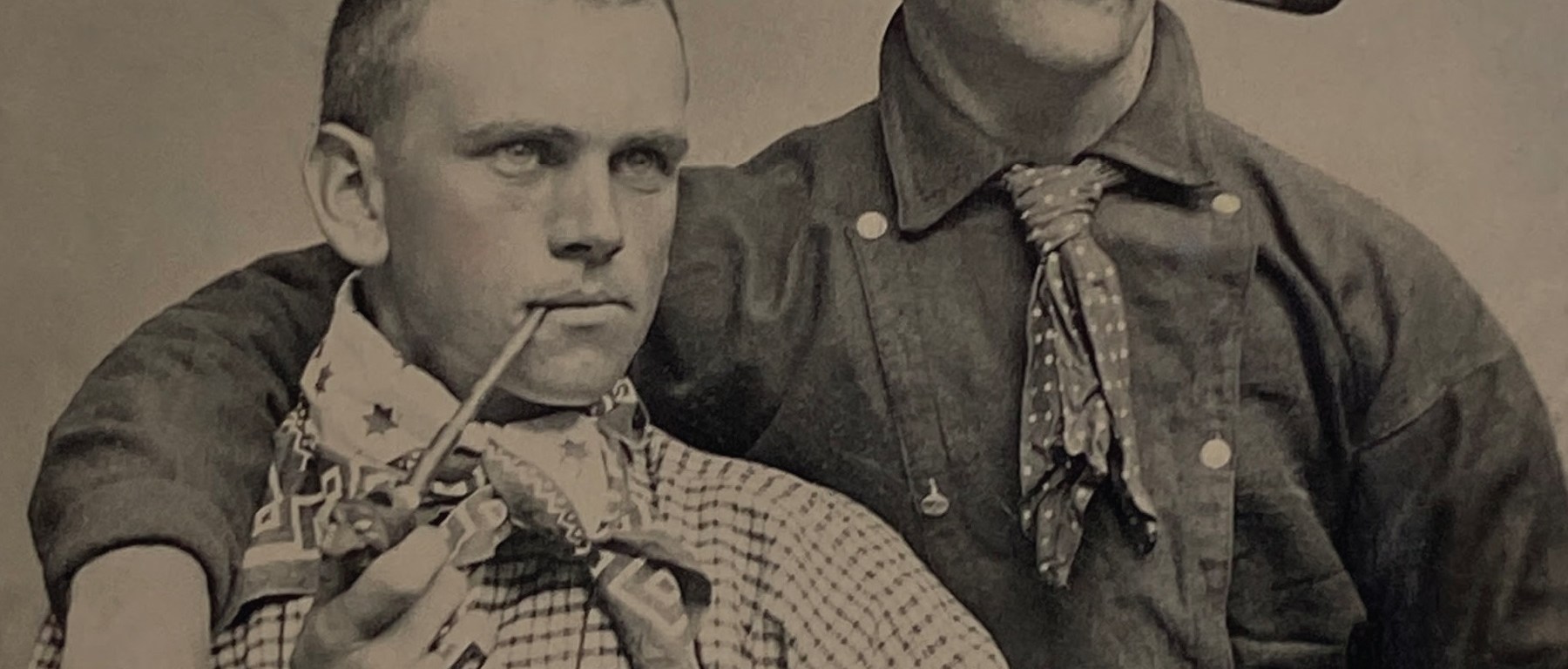
Jim Wilke is a former curator of technology at the Autry Museum of the American West and is a consulting historian on railroad and Western history for numerous organizations. He is the coauthor of Stagecoach! The Romantic Western Vehicle. His latest book Frontier Comrades: From the Fur Trade to the Ford Car (Bison Books, August 2025) is available for pre-order.

Over the summer of 1889, newspaper reports of the “lady lovers,” as they were dubbed by the press, spread across the continent. Ora Chatfield, a rancher’s daughter in Colorado’s Roaring Fork Valley, had eloped with Clara Dietrich, a local postmistress, despite her family’s attempts to stop them.
The story of their escape was read by people from nearly every state and territory. They read of how the two women were suspected of being in love, how the Chatfields sought to stop their relationship, how the Pitkin County Sheriff John White arrested Clara Dietrich for insanity on behalf of the Chatfield family, how they suddenly ran off from the silver mining town of Aspen, and how people searched for them across Denver and beyond.
It wasn’t for another century that some of these articles were reprinted in Johnathan Ned Katz’s groundbreaking 1983 work of LGBT history, Gay/Lesbian Almanac: A New Documentary, a work describing nearly 350 years of life for gay and lesbian people in North America. While the section reprinting articles regarding the “lady lovers” were brief, it introduced this writer to a remarkable pair of lives together with the occasional stifling, brutal realities surrounding anyone capable of recognizing oneself as lesbian or gay within late 19th-century society.
A marathon of microfilm followed in the Pitkin County library. Yet no matter how long I spent in researching their brave elopement from Colorado, their experience was nearly always accessed through the barrier of some form of intermediary media: microfilms and the scattered ancient directory, then the modern miracle of digital archives, each one presenting a silent blockade between our own time and theirs. I knew this event had happened, but the understanding was always formal, not visceral, like the gleam of a distant planet.
This changed the moment I went to the Pitkin County Sheriff’s Office to inquire whether they had the sheriff’s day books from 1889. In 1889, no one, at least in the Roaring Fork Valley, had any idea what lesbian women were; therefore, the Chatfield family had concluded that Clara Dietrich’s love was most likely a feeling of sentiment somehow sent in the wrong direction, like a two-headed calf, something ordinary gone badly awry. They were genuinely scared and asked the sheriff to have Dietrich arrested on grounds of insanity. If this had happened, there was possibly a formal record of it.
“Lesbians, huh?” remarked the sheriff at the counter. She spent the rest of that day in the basement, digging through records over a century old. She found it. The Sheriff’s Day Book was a small handheld register used by Sheriff John White for his day-to-day duties; this one ran from May to September 1889. The pages revealed various arrests, the transportation of women engaged in prostitution to the Good Shepard’s home in Denver, court costs and, remarkably, the occasional purchase of a “medicinal” semi-alcoholic bitters. Finally, I saw the account in its primary form: the sheriff’s handwritten notes detailing the investigation of a lesbian woman on charges of insanity. “The People vs. Carrie[sic] Dietrich” was received May 13, 1889, and returned the following day, with Dietrich “not found” guilty and a mileage cost of $6.50.

“This really happened,” I thought. “This really did happen.” Clara Dietrich suddenly became a real woman, and an incredibly frightened one at that, speaking up through the ages. This sheriff’s daybook was one of those moments when we begin to grasp some tiny sense of the full human experience and reality within history, and when the barriers of distance between 1889 and our own time melt away. It was hard not to sense the terror Clara Dietrich must have felt when confronted by the sheriff, nor the enclosing danger of being involuntarily locked in Pueblo’s insane asylum as she offered denial after denial. She was an ordinary woman trying to be brave amidst overwhelming circumstances, a woman who, far from the intellectual circles of Europe, had grasped and realized her “being’s destiny” as among women.
 UNP blog