
Hannah Kim is an associate professor of history and a co-coordinator of the social studies education program at the University of Delaware, Newark. Kim is the author of Ties that Bind: People and Perception in U.S. and Korean Transnational Relations, 1905–1965 (Nebraska, 2025).
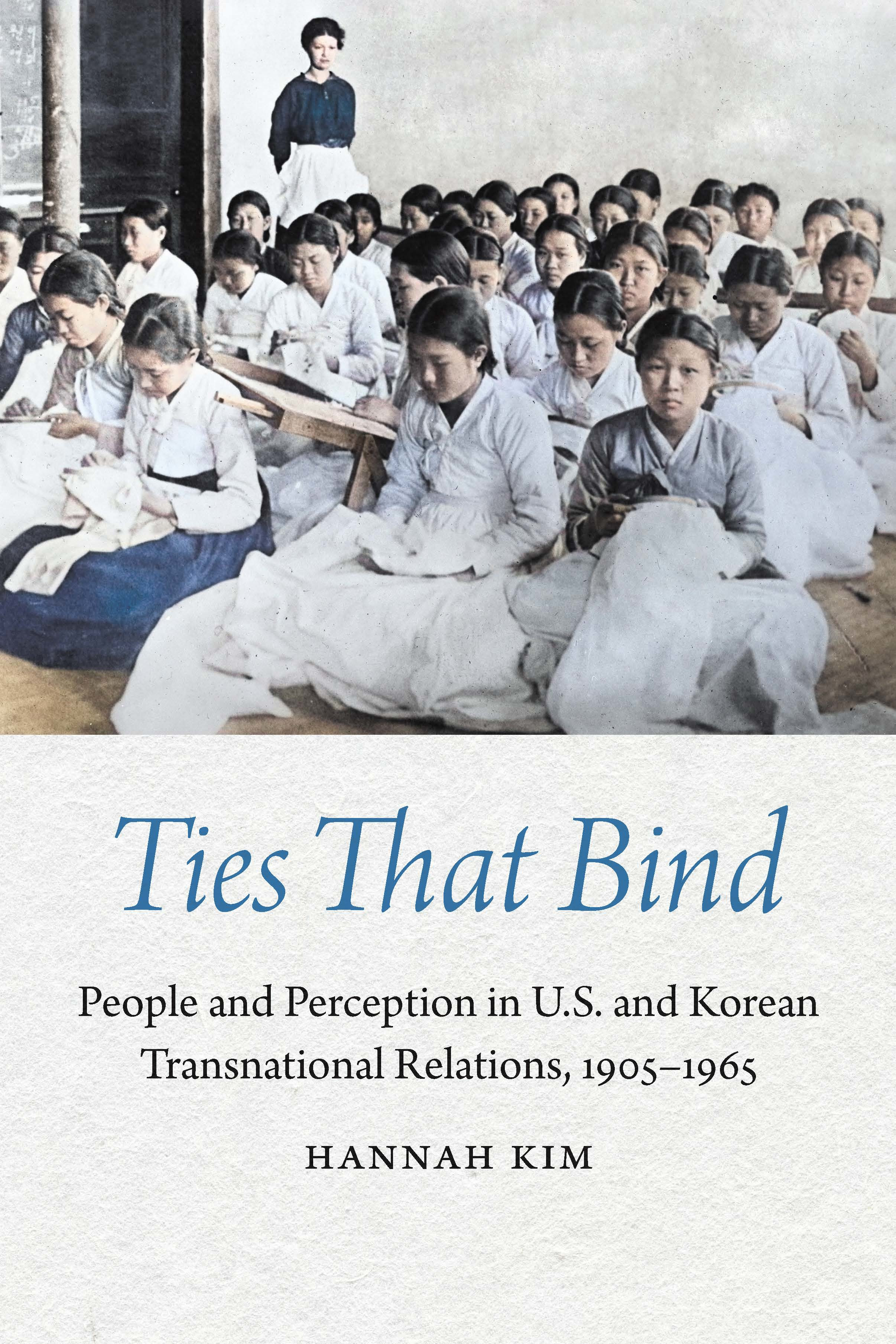
Ties That Bind narrates five stories of how a transnational community helped shape American perceptions and understandings of Korea and Koreans, from a time when only a small number of Americans knew anything about Korea to a time when most Americans were aware of Korea’s geopolitical significance. Three of the moments took place when Korea was a colony of Japan: the so-called Conspiracy Case in 1911, the independence movement of 1919, and the efforts to recognize Korean independence during World War II. The other two moments transpired in the context of the Cold War, when Korean orphans and Korean exchange students came to the United States in the 1950s.
In these five stories, the interplay of people, perceptions, and official and unofficial policy can be seen in the work of people who tried to influence U.S. and Korean relations by binding Americans and Koreans through shared values and experiences. They did so by portraying Koreans as Christian converts, as supporters of democracy and democratic ideals, and as people embracing Western or American cultural norms. The actors in this book did not always succeed in their goals, but through their endeavors, they facilitated policy discussions, forged ties between the United States and Korea, and began to break down cultural barriers between Koreans and Americans.
Introduction
From Alien to American
Philip Jaisohn, née Seo Jae-pil
In April 1885 Seo Jae-pil disembarked from the SS Empress of China at the port of San Francisco. Seo, who had fled from Korea after participating in a failed political coup, came to the United States with two friends. Their prospects in the United States did not seem much better and the two companions left San Francisco soon after, leaving Seo very much alone—an alien in an alien land. But Seo was not so easily deterred as his friends. Changing his name to Philip Jaisohn, he remained in the United States for most of the rest of his life, as both a Korean patriot and an American citizen. Jaisohn was an exceptional person and overcame rampant racism to achieve great personal, professional, and financial success. In Korea, he is hailed as a national hero; in the United States, he is lauded as a groundbreaking Korean American. As a member of the transnational community of interested parties who wished to forge ties between the United States and Korea, Jaisohn spent a lifetime trying to influence U.S. policy toward Korea and American thoughts about Koreans. He employed a strategy of creating connections between Americans and Koreans by portraying Koreans as having similar religious, political, and cultural aspirations. Although his life was unusual, Jaisohn’s story serves as an example of the interplay between people and perception and its profound effect on relations between the United States and Korea.
Seo Jae-pil was born in 1864 into the yangban or nobility class of Korea. Despite his privileged background, Seo was troubled by the corruption of Korea’s elite. After passing the civil service exam, Seo befriended a group of young men who had come to admire Japanese reforms and Western advancements and believed the Korean monarchy should institute similar reforms. In December 1884, at the age of twenty, Seo participated in the short-lived and unsuccessful Gapsin Coup. Seo was declared a traitor and fled to Japan. His family, whom he left behind, was almost entirely wiped out as punishment for his crime. Seo learned a hard lesson; his political actions could have devastating consequences. He also realized his naïveté—in both the lack of organization of the coup and his overconfidence in Japanese support. Perhaps this was when Seo Jae-pil turned away from Japan as a model for Korea and instead looked to the United States. Encouraged by American Protestant missionaries whom he befriended in Japan and armed with letters of introduction, Seo resolved to go to the United States to try his fortune there.
After arriving in San Francisco, Philip Jaisohn (as he now anglicized his name) made quick inroads into American society. He enrolled in English classes and regularly attended church. He eventually converted to Christianity. Jaisohn became friendly with one of the wealthy members of a Presbyterian church, an introduction facilitated by his American missionary friend in Japan. Through this acquaintance, Jaisohn met William Hollenbeck, a coal magnate from Pennsylvania.
Hollenbeck had strong ties to the Presbyterian Church and the missionary movement. He believed Jaisohn to be a perfect candidate for his plans to educate a young man to send to Korea as a missionary. He offered to finance Jaisohn’s education—first by sending him to the Harry Hillman Academy in Wilkes-Barre, Pennsylvania, and then to Lafayette College and Princeton Theological Seminary. Conveniently, Hollenbeck served as a trustee of all three institutions. Jaisohn quickly agreed, without disabusing Hollenbeck of the notion that he would return to Korea as a missionary. After all, Jaisohn really could not return to Korea unless the political climate changed, nor did he have any desire to be a missionary. But Jaisohn was smart enough to take the offer and worry about the consequences later.
Jaisohn traveled to Pennsylvania and graduated with honors from Harry Hillman Academy in 1888. That same year, by his own account, he also became a naturalized citizen of the United States. Hollenbeck finally tried to make Jaisohn commit to his plans for sending Jaisohn back to Korea as a missionary and asked that he sign papers to that effect. Jaisohn politely refused to do so and subsequently broke off his relationship with Hollenbeck. Jaisohn was once again cast adrift, but not for long. The very resourceful young man secured letters of introduction and presented himself, without invitation, at President Grover Cleveland’s office for a job. Although Jaisohn was not offered a job, the president’s secretary introduced him to the Civil Service Commissioner, who administered the newly instituted civil service exam. Jaisohn did quite well on the exam and through another letter of introduction and connection was able to secure employment at the Army Surgeon General’s Library. Through this fateful turn of events, Jaisohn attended and graduated from Columbian Medical School (now George Washington University) and worked closely with Dr. Walter Reed, the army surgeon and microbiologist who famously researched the spread and cure of yellow fever.
In 1894, a mere nine years after he set foot in the United States, Philip Jaisohn opened his own successful medical practice. That same year, he met and married Muriel Armstrong, whose father had been the founder of the U.S. Railway Mail Service and was a cousin of President James Buchanan. The young socialite and Jaisohn married in June 1894 in front of two hundred well-wishers. In its society section, the New York Herald hailed the wedding as the great social event at the capital.
 UNP blog