B.J. Hollars is a professor of English at the University of Wisconsin–Eau Claire. He is the author or editor of more than fifteen books, including Go West, Young Man: A Father and Son Rediscover America on the Oregon Trail (Bison Books, 2021) and Midwestern Strange: Hunting Monsters, Martians, and the Weird in Flyover Country (Nebraska, 2019). His book Dinosaur Dreams: A Father and Daughter in Search of America’s Prehistoric Past (Bison Books, 2025) was published this month.
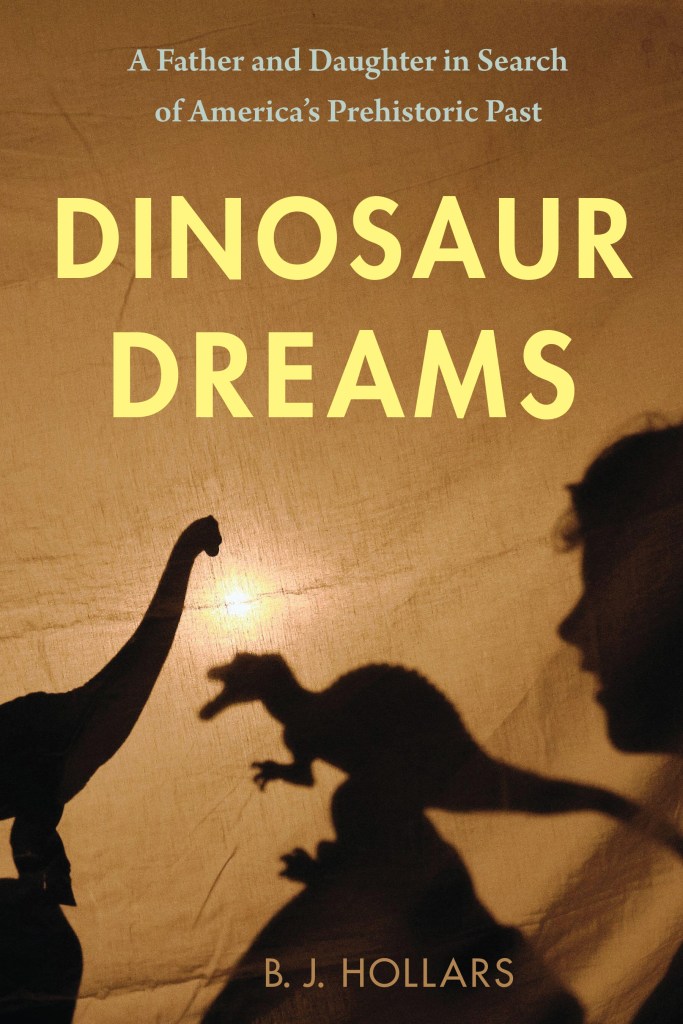
In the summer of 2023, one of the hottest on record, I set off with my nine-year-old daughter, Ellie, on a two-thousand-mile road trip to complete the Montana Dinosaur Trail—14-dino-themed stops across the Treasure State. What began as a father-daughter quest to find dinosaur fossils evolved into something larger: an excavation of our anxieties about extinction, survival, and the climate crisis looming before us.
I’d like to tell you that the resulting book, Dinosaur Dreams, sidestepped some of those thornier existential issues and stuck to the fun—just a dad and daughter digging up dinos in the dirt. However, I’m also glad to tell you that it’s a whole lot more than just that. Because while fun-in-the-sun family road trips have their place, so, too, does a proper accounting of our planet’s precarious moment.
How precarious?
According to the United Nations Climate Change Report, nearly “1 billion children (half the world’s children) live in countries classified as ‘extremely high-risk’ due to multiple climate and environmental shocks (floods, heat waves, disease, water scarcity).”
Translation: things are not good. And they are particularly detrimental for low- and middle-income countries, which emit lower levels of carbon emissions than high-income countries but bear a higher price.
The dinosaurs didn’t have to deal with the socio-political complexities. For them, an asteroid struck, the world caught fire, tsunamis soaked the shorelines, soot blotted out the sun, photosynthetic activity came to a standstill, plants withered, and plant-eaters followed, along with the carnivores. Variations of this chain reaction continued until, 33,000 years later, 75% of all species on the planet found their home uninhabitable.
While the dinosaurs cannot be held personally responsible for their demise (blame it on the asteroid), we humans certainly bear the brunt of our crisis. These days, when we talk about extinction, it’s often prefaced with the phrase “human-induced.”
Here’s the irony: for decades, we characterized dinosaurs as being “dumb, slow, and cold-blooded,” and as we now know, we were largely incorrect on all these fronts. Despite all our bone-headedness, we still fancy ourselves as the superior species, in part, because we’re still here.
But if a species’ longevity is the metric we use to prove our so-called superiority, then we’re in big trouble. Because dinosaurs ruled the planet for over 165 million years, whereas we’ve begun teetering toward our end in 300,000 years. Which means that to date, our reign has lasted approximately 0.18% as long as theirs.
In our defense, we’ve developed some impressive technology during that time. But, in many instances (see: nuclear weapons, biological warfare, artificial intelligence), we’ve proven ourselves wholly incapable of properly harnessing whatever new horror we unleash from Pandora’s Box.
What’s the answer for what ails us?
For me, it was a dinosaur-themed road trip with my daughter. Not only because it helped me understand what dinosaurs can teach us about our own present moment, but also because it reminded me why we ought to care.
What have the dinosaurs taught us?
First, they remind us that extinction is a natural event. It’s already happened five times before. The only difference this time around is that humans are the primary cause.
Second, they confirm that climate matters, and when carbon dioxide emissions and temperatures fluctuate over a short period, it spells disaster for species unable to adapt.
Third, they teach us that we can adapt. Not all the dinosaurs died because of the asteroid. Some of the small mammals, birds, and reptiles survived. They changed, and they survived. We, too, can change—our behavior, if nothing else.
Finally, dinosaurs serve as a giant reminder that while species die, the planet doesn’t. Which seems obvious, and yet it never occurred to me until it was brought to my attention by an amateur paleontologist during our trip. Approximately 99.9% of all species that have existed are now extinct. But the earth is still here. There’s something humbling in knowing that, despite our best efforts to the contrary, the world will likely endure.
Why does all this matter? That’s where Ellie comes in.
Because along every mile, as I glanced at her in the rearview, I was reminded of what we’re fighting for. Not only our own survival, but also that of the next generation. We of the 20th and 21st centuries have not been the stewards the world needed at a time when it needed it most.
But it’s not too late to make a change.
“Human-induced” means we are the cause, but also, maybe, the solution.
To learn more about Dinosaur Dreams, watch the book trailer.
 UNP blog