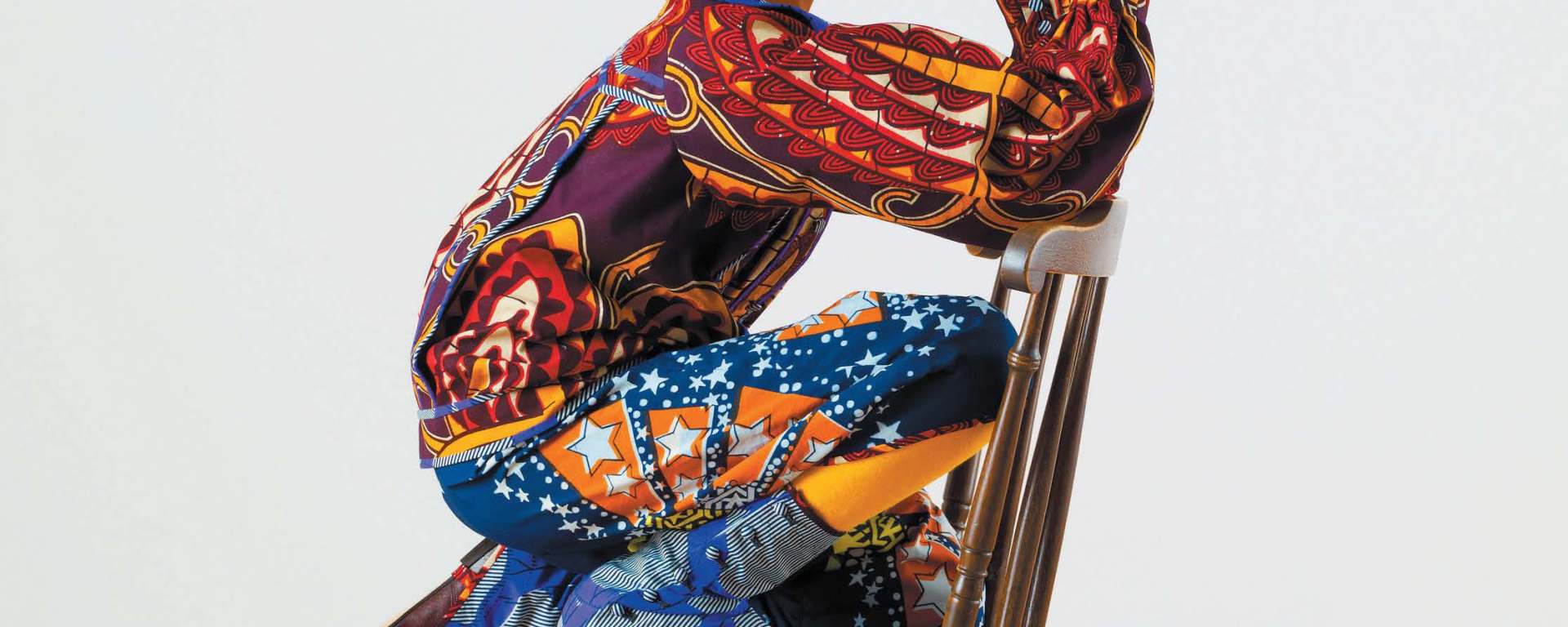
Gbenga Adesina, a Nigerian poet and essayist, is the inaugural Mellon Postdoctoral Fellow in Global Black and Diasporic Poetry at the Furious Flower Poetry Center, James Madison University. He received his Masters in Fine Arts from New York University, where he was mentored by Yusef Komunyakaa. He is the cofounder and editor of A Long House, a journal of diasporic art, thought, and literature. He has won multiple fellowships, and his poems have appeared in the Paris Review, Harvard Review, Guernica, Narrative, Yale Review, The Best American Poetry, the New York Times Magazine, and elsewhere. His book, Death Does Not End at the Sea (Nebraska 2025), was the winner of the 2024 Raz/Shumaker Prairie Schooner Book Prize in Poetry and was longlisted for the 2025 National Book Award in Poetry.
In Gbenga Adesina’s groundbreaking debut book of poems, a defiant and wise exploration of exile, voyages, and spiritual odysseys, we encounter figures embarking on journeys haunted by history—a son keeps dreaming he carried his dead father across the sea; a young Black father, tired of fear and breathlessness, travels with his son in search of the ghost of James Baldwin—to Paris, the south of France, Turkey, and Senegal to investigate his ancestral roots; and finally, a group of immigrants on small boats in the middle of the Mediterranean Sea sing in order not to drown, in a stunning sequence that invokes the middle passage.
In a lyrical voice at once new and surprisingly ancient, Adesina’s Death Does Not End at the Sea explores the complexity of elusive citizenship, an immigrant’s brokenhearted prayer for a new beginning, a chorus of elegies, and a cosmic love song between the living and the dead.

GLORY
Glory of plums, femur of Glory.
Glory of ferns
on a dark platter.
Glory of willows, Glory of Stag beetles
Glory of the long obedience
of the kingfisher.
Glory of waterbirds, Glory
of thirst.
Glory of the Latin
of the dead and their grammar
composed entirely of decay.
Glory of the eyes of my father
which, when he died, closed
inside his grave,
and opened even more brightly
inside me.
Glory of dark horses
running furiously
inside their own
dark horses.
I CARRIED MY FATHER ACROSS THE SEA
He was a child. He was dead.
He was the shaft of a long-tailed astrapia. He was a forest
of bruise. He wore a door on his face.
He wore the black suit
of his wedding. The square pocket
was still full of his vows.
He was light to carry,
his burdens and vows had bled out of him.
He was heavy
with the responsibility of the dead.
What sort of a son
leaves his father
chained to fatherhood?
I lifted and propped him up with my frame.
I measured the length of him with my length.
The feet stuck in sea sand, his weak knees,
his arms gripped my sides.
As the currents rose, the collar on his broken neck
flared into a float.
The gash the surgeon’s knife left on his head
became a halo, it signaled in the dark.
I put my nose to his nose.
I put my finger in his mouth.
I tied his IV tubes, now a human gill, around our waists
and swam in the vein
of the water.
“Look,” a sphinx in the waves said.
“A son carries a father.”
Death is not silence.
It is where I hear you most clearly.
What sort of a son
leaves his father’s body
chained to the dark grievance inside the earth?
I carried my father on my back.
I felt the bracing inside his afterlife heart
on the skin of my spine.
He wore his face as a door
he promised to open to me.
He bled
out his vows.
THE PEOPLE’S HISTORY OF 1998
France won the World Cup.
Our dark goggled dictator died from eating
a poisoned red apple
though everyone knew it was the CIA.
We lived miles from the Atlantic.
We watched Dr. Dolittle, Titanic, The Mask
of Zorro. Our grandfather, purblind and waiting
for the kingdom of God, sat on a throne in his dark
room, translating Dante.
The Galileo space probe revealed
there was an entire ocean hiding beneath a sheet
of ice in Jupiter’s moon.
The Yangtze River in China lost its nerve
and wanted vengeance.
Elsewhere a desert caught fire.
We got a plastic green turtle and named it Sir
Desmond Tutu.
A snake entered our house through the drain
and like any good son, I ran
and hid under the bed.
Google became a thing.
Viagra became a thing.
In July, it flooded at nights and a wind nearly
tore off our roof. I thought God is so in love
with us,
he wants to fill us with himself.
Mother, I saw her through a slit in the door, a glimpse
of amaranth-red scarf and swirling yellow skirt.
She thought no one was looking. She was dancing in a trance
to Fela Kuti. She laughed and clapped
at the mirror. It was the year our house became a house
of boys and girls, and a ghost, our little sister.
Calmaria. That’s what the Portuguese called it. When it rained
and the world was suddenly becalmed, we would run
and peel out of the door, waving at the aurora
of birds flitting past in the sky.
We knew one of them, the little one, used to be one of us,
those spectral white egrets.
 UNP blog
At last- a contemporary poet who does not wallow in self pity but is a true visionary through the chaos.