
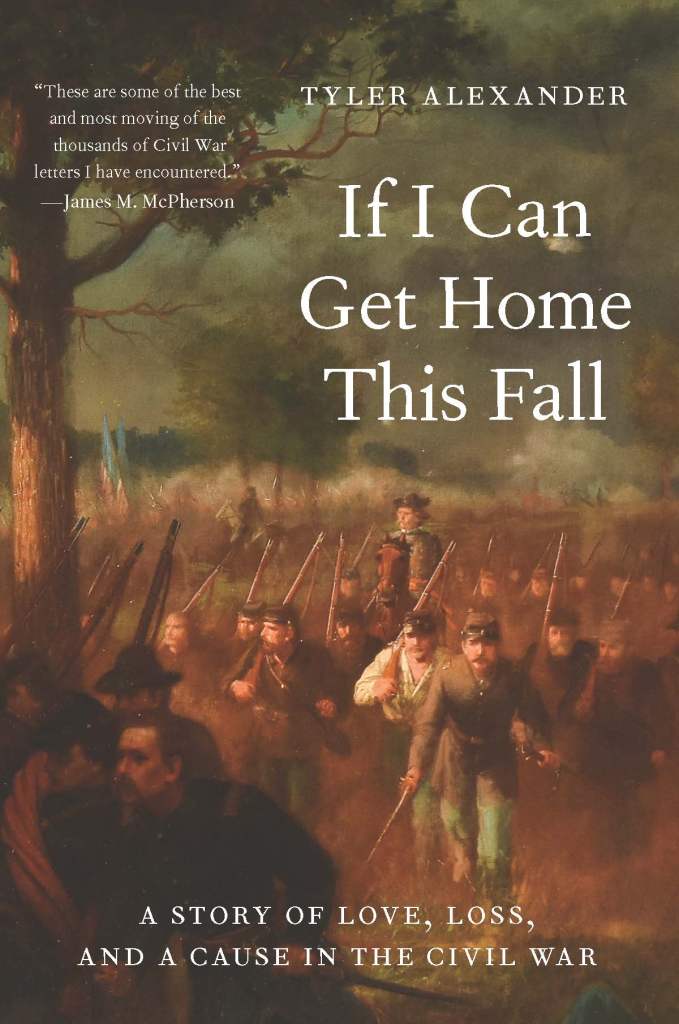
Tyler Alexander is an educator in Vermont who teaches American history and government. He is a former James Madison Fellow and studied forestry, history, and education at the University of Maine and the University of Vermont. One of Alexander’s ancestors served alongside Dan Mason in Company D of the Sixth Vermont. His new book If I Can Get Home This Fall: A Story of Love, Loss, and a Cause in the Civil War (Potomac Books, 2025) was published in September.
At Lee’s Mills:
“We crossed the stream amid a shower of leaden hail, part of the time in the water nearly to our arms. Just as we stepped on dry ground on the further side Chandler E Colburn of Troy fell back in the water dead but 2 or 3 steps from me. A ball had pierced his brain.”
At Antietam:
“Fri[day] morn before leaving I went over the field. What a sight—I should say there was 2 dead rebs to one of our men in an old road in particular they lay in heaps for a long distance in the Cornfield just beyond the ground was thickly dotted with them but enough of this . . . The heart sickens to tell.”
At Banks’s Ford:
“Hobart Bliss was severely wounded in left shoulder . . . I fear he is mortally wounded but hope he will turn up all right some time. It seemed hard to leave him in the hands of the enemy but—such is war.”
At the Wilderness:
“Your son was killed in the first day’s fight in the Wilderness. No one saw him fall as we made a charge through a thicket of oaks, but were obliged to fall back a short distance, leaving our dead between our lines and the enemy’s. We did not know whether your son was killed or wounded until the 7th, when I went on to the ground and found him dead and it was with sorrow that I found your noble son; He was hit in the breast, probably died instantly.”
At Petersburg:
“I saw one man blown up at least 20 feet—he came down in a good many pieces.”
On and on it goes, one after another. More lives destroyed, more shattered bodies, more widows and orphans, more grieving communities, all culminating in an endless stream of death and heartbreak.
My heart is broken. I am six generations removed from the Civil War, but I know these people and I feel their loss. The emotional weight of this story overcomes me countless times.
And yet . . .
What is most awe-inspiring is that after years of unprecedented carnage and bloodshed, with no end to the war in sight, with no sense of how many more will die, so many of the men and women who endured this eternal suffering remained truly steadfast in their devotion to the cause. Not all did; some lost faith, some rejected emancipation if it would mean an end to the bloodletting, some called for peace at all costs, and some made it clear that they wanted to restore “the Union as it was,” with slavery and white supremacy intact. But most of the soldiers and civilians from the tiny state of Vermont sincerely fought for a redefinition of American democracy and were willing to give “the last full measure of devotion” to achieve that end. In 1860, they voted for Abraham Lincoln by an overwhelming 75% margin—far more than any other state—and four years later he remained just as popular, if not more so. Vermonters are proud of this history of defending democracy when it was most imperiled, and this legacy is one we continue to cherish as we once again test whether “that nation, or any nation, so conceived and so dedicated, can long endure.”
Against this grand sweep of history are the lives of an ordinary man and woman—Dan Mason of the 6th VT Infantry and 19th USCT and his sweetheart Harriet Clark—from the small hill farms of northeastern Vermont, who love each other deeply and are desperate to be together as husband and wife. Finally, in March 1865, they are married while Dan is home on a furlough. He returns to the front, is then sent to the Mexican border largely as a result of racial politics, and writes to his newlywed wife the following in July 1865:
“How I would like to meet you once more & just smother you with kisses if no one was looking how happy we will be if we can ever get us a home by ourselves we shall be so happy & satisfied. . . . When we are alone we can act as we please & do many things that some people would call silly but if we enjoy it is no ones business . . . My precious darling wife I must be with you. My other friends though dear seem distant compared with you. How can I express my love to you words fail to convey my feelings. It is useless to try. But my precious one if I can get home this fall we will renew the honey moon so suddenly brought to a close last spring & we will just visit & live so happy if we can both be well we will have just as good a time as ever was had in this world . . . Oh woman virtuous woman how near an angel you can approximate.”
Earlier in the war, Dan told Harriet what kept him in the ranks:
“When one feels he is battling for the right, when he thinks of the principles he is supporting, when he thinks that he is knocking out the rotten treacherous walls of slavery on which our government has tattered & reeled threatening to engulf us from the commencement and substituting in place of the granite walls of freedom, when he thinks that his government is passing through the fiery ordeal, when he thinks that the eyes of all civilized nations are looking on speculating whether a Republican government can sustain itself or not—then it is that the soldier’s heart swells with emotions of pride & patriotism & trusting in the God of battles, he nerves himself to the conflict. Under such feelings the roar of cannon & the rattle of musketry & the din of war become grand & sublime.”
As I was reading this vast collection of letters, not knowing what to expect from page to page or from line to line, encountering such passages was an absolute thrill and I knew that I had to tell this intimately human, timeless story that so clearly resonates today.
The American Civil War looms larger than any other event in our national imagination and is deeply rooted in our collective psyche. As a country, we can’t help but keep coming back to it; its long shadow continues to haunt us, bedevil us, and shape who we are in ways both obvious and unseen. Today, we are still arguing about what caused the war, how it should be taught, whose stories should be told, who should be honored and memorialized, and what exactly the “proposition that all men are created equal” actually means.
But despite the extraordinary human desire to love, the men and women who put their lives on hold while enduring unimaginable loss for a cause greater than themselves were indeed the real patriots who we would do well to remember today, from Abraham Lincoln and Ulysess Grant to Dan and Harriet Mason of the small town of Glover, VT to Black men—and the families they left behind—from the Eastern Shore of Maryland who fought alongside Dan in the 19th USCT, hoping that by donning the blue uniform, taking up the musket, and giving their blood, that they could win a seat at the “table of brotherhood” that Dr. King dreamed of a century later.
 UNP blog