
Chris Serb is deputy district chief for the Chicago Fire Department. He is also a veteran Chicago freelance writer with almost thirty years of experience as a journalist. Serb’s articles, concentrated in sports and history, have appeared in the Chicago Tribune, Chicago History, Writer’s Digest, Chicago Athlete, and Men’s Fitness. He is the author of War Football: World War I and the Birth of the NFL and Sam’s Boys: The History of Chicago’s Leone Beach and Legendary Lifeguard Sam Leone. His most recent book is Eckie: Walter Eckersall and the Rise of Chicago Sports (Nebraska, 2025) which was published in October.

In January 1907 Walter Eckersall, so recently one of America’s football heroes, was down on his luck.
Under legendary football coach Amos Alonzo Stagg, “Eckie” was a rare three-time first-team All-American who quarterbacked University of Chicago to a national title in 1905. During his final game in 1906, the Maroons gifted Eckersall a beautiful gold watch in gratitude for his athletic service. Within weeks, all goodwill dried up. A woeful student barely one-third finished with his degree after three and a half years, Eckie was arrested for stealing from a Chicago tailor. With his PR value gone, the university quickly and quietly expelled him.
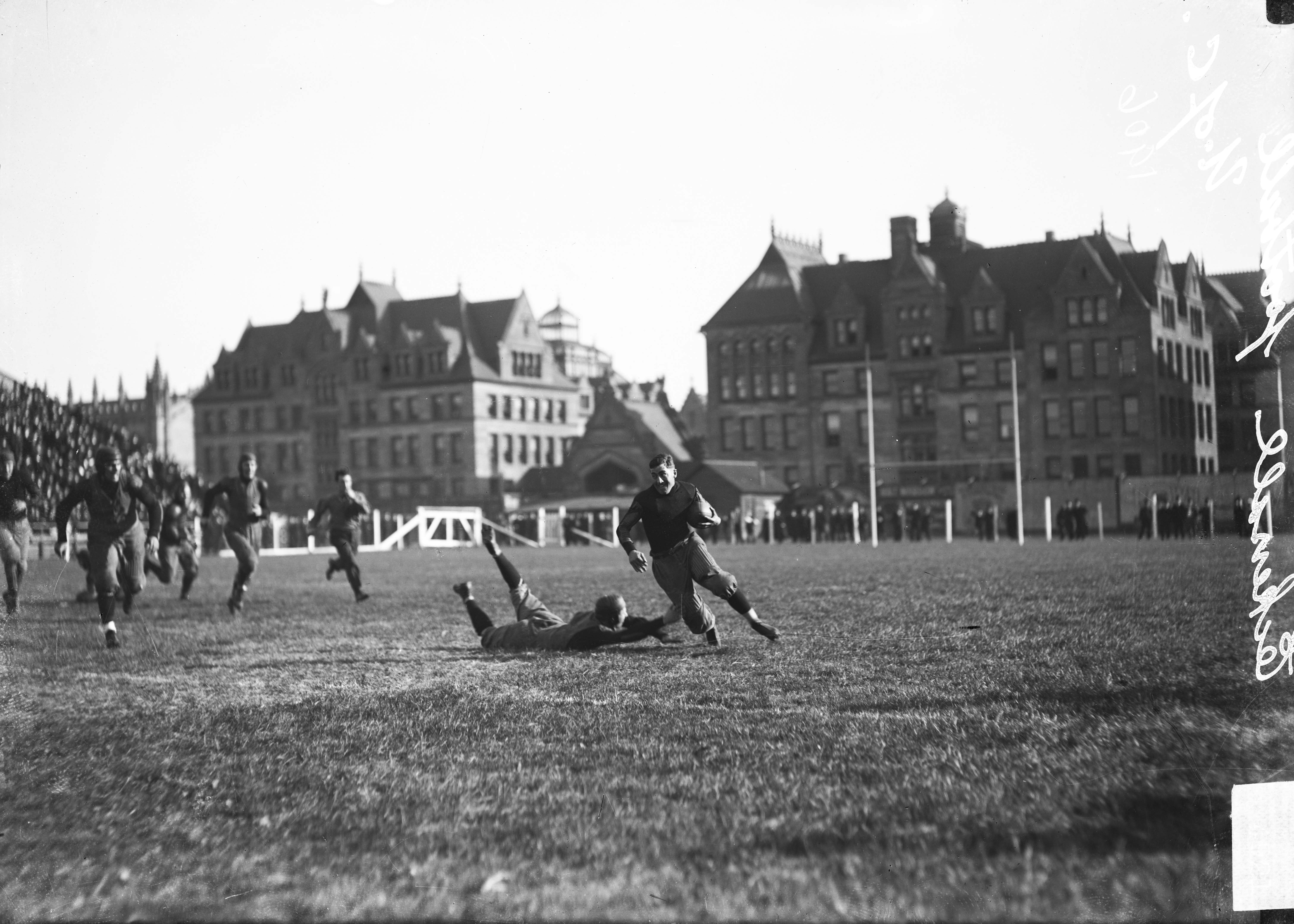
Eckersall became a serviceable semi-pro baseball player and a semi-pro football star, but those were low-paying, seasonal jobs. He sought a coaching position, but controversy-wary colleges dodged the fallen hero.
Wide-open newsrooms in a wide-open town had no such character qualms. Based largely on Eckersall’s celebrity, in late 1907 the Chicago Tribune hired him as its “football critic,” as the paper sought to improve and expand its sports coverage. The “sports page” was still a fairly new creation, somewhat primitive by today’s standards. Bylines were rare. Text was arranged “tombstone” style, in blocky columns. Large headlines were followed by several descriptive “subheads” or “decks” of varying font sizes. Cartoons or posed pictures occasionally broke up the visual monotony.
Eckersall joined the sports staff at a time of tremendous growth: More bylines, more column-inches of coverage, and more visual appeal, especially via action photographs. Eckie covered games, attended midweek practices, previewed the following week’s big matchups, gleaned gossip from coaches and athletes, and wrote columns based on insider knowledge. Also, in what’s seen as a conflict of interest today but which raised no eyebrows then, Eckersall frequently “double-dipped” by officiating the same games he was writing about.

Displaying a work ethic he had never shown in the classroom, Eckie threw himself into the job. By 1910 the Tribune expanded his role from part-time to full-time, and from football-only to general sports. He would churn out 5,500 bylined articles over a 23-year career, far outpacing most of his peers. Boxing and track joined football as Eckie’s bread-and-butter, but he also covered swimming, bicycle racing, speedskating, college baseball, and wrestling. Among minor sports, he dabbled in rowing, shooting, polo, even ski jumping.
If people could compete in something, Walter Eckersall probably covered it.
Eckie was productive, and influential, but never a great writer. His ledes follow a simple formula. (For the 1924 Notre Dame-Army game that inspired Grantland Rice’s still-famous “Four Horsemen” lede, Eckie’s story begins: “Using one of the most powerful running attacks seen in recent years, Notre Dame defeated the Army on the Polo ground here this afternoon, 13 to 7.”) He sometimes struggled with accuracy, misspelled names, and misremembered sequences of events.
“My chief regret nowadays is that I have such a poor command of the language,” Eckersall told a colleague in the 1920s. “Here I am supposedly an authority in sports and I doubt if I could secure a good grade in freshman college theme writing.”
Yet Eckie fulfilled the most important part of the job: “I’ve always found that there is only one guiding principle in sports writing: Just tell ’em what happened.”
Eckersall became an accidental pioneer of a now-widespread archetype: the sports star turned sports journalist. Other athletic figures, from football pioneer Walter Camp to boxing champion John L. Sullivan, dabbled in journalism part-time through weekly columns. A few, like two-sport Vanderbilt athlete Grantland Rice and former major league baseball player Tim Murnane, became working sportswriters, but these writers hadn’t been stars. Throughout the 1920s, Eckersall was the only high-profile sports hero to become a working sports journalist.

This would change with the emergence of broadcast media. In the 1930s, Red Grange began hosting football previews on the radio while still actively playing in the NFL; after retirement he shifted into the role of “color commentator” for both college and NFL games, first on radio, then television. Dozens of ex-jocks followed, and the long line leading to Tom Brady’s current Fox Sports gig began with Walter Eckersall at the Chicago Tribune.
Eckersall stood alone in another respect: As a consistent champion for Black athletes. Eckie’s stance stems from his early friendship with African-American teammate Sam Ransom at Chicago’s Hyde Park High School. As a sportswriter, Eckersall sought to humanize boxing champion Jack Johnson, referred to as “black brute” or worse by the press. He highlighted the feats of athletes such as Fritz Pollard, Duke Slater, DeHart Hubbard, and Ralph Metcalfe, at a time when most sportswriters either glossed over their achievements or ignored any mention of their race.
In 1918, Eckersall summed up the reasoning for his advocacy: “In my twenty years of athletic experience as a player and writer of sports, I have met colored athletics who, to my mind, were the superior of their white teammates.” With the deck stacked against these athletes, Eckersall sought a level playing field.
Throughout his career, Eckersall covered many of the biggest events of the Golden Age of Sports: the inaugural running of the Indianapolis 500 in 1911, 11 Rose Bowls, and the Dempsey-Tunney “long count” fight in 1927. Tasked by the Tribune with helping create sporting news, he also founded the once-famous “Silver Skates” speedskating race and the still-famous “Golden Gloves” amateur boxing tournament.
Eckersall was still at the top of the sportswriting game when he died unexpectedly in March 1930, in his mid-40s. His heart attack, attributed to congenital heart disease, may have been exacerbated by both alcohol abuse and overwork.
By the time of Eckie’s death, the Chicago Tribune had become the city’s leading newspaper, with the Midwest region’s biggest and best sports section. For 30 years, as both athlete and sportswriter, Walter Eckersall had been synonymous with Chicago sports. And for those same 30 years, Chicago sports—and Chicago Tribune sports—had grown tremendously, largely driven by Walter Eckersall’s influence.
 UNP blog