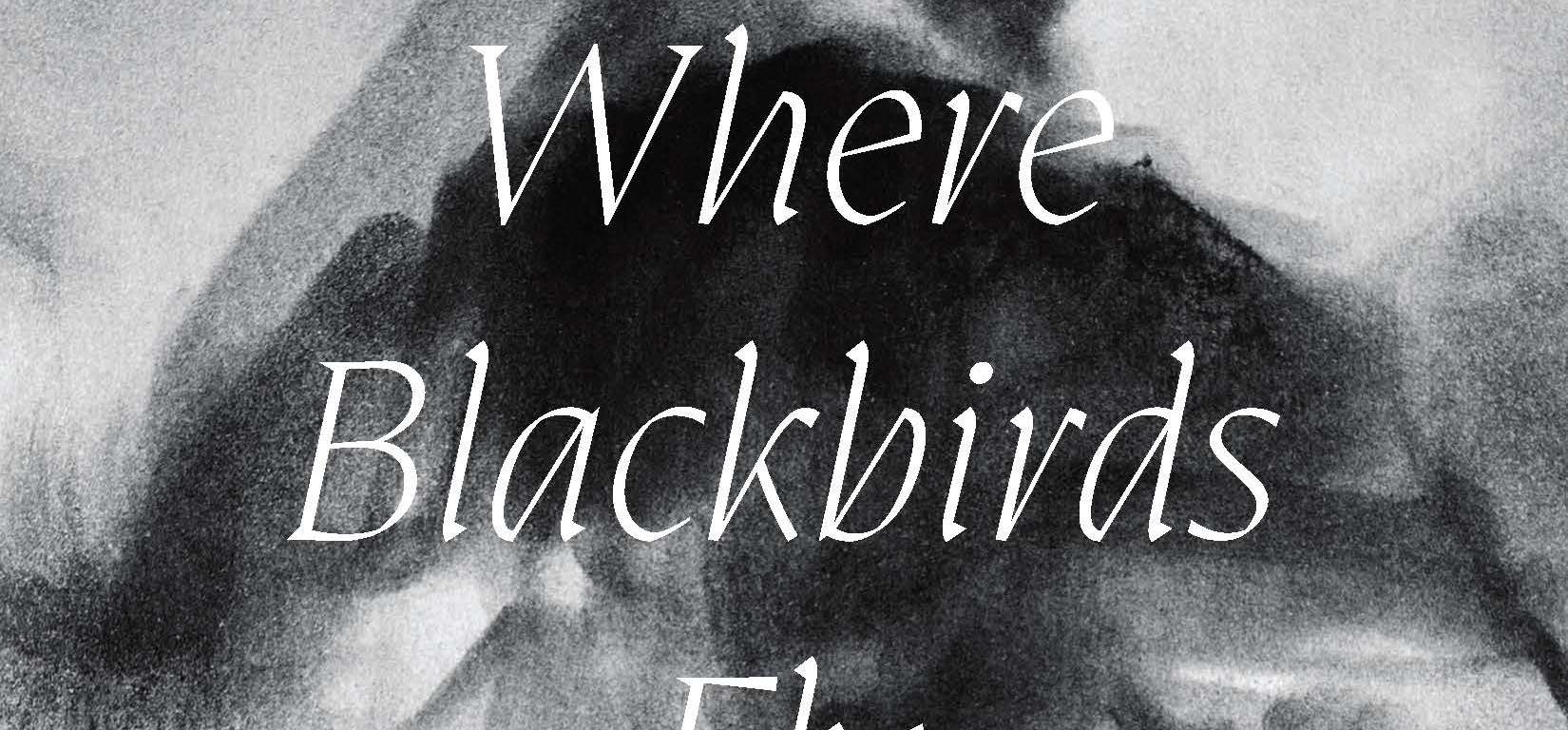
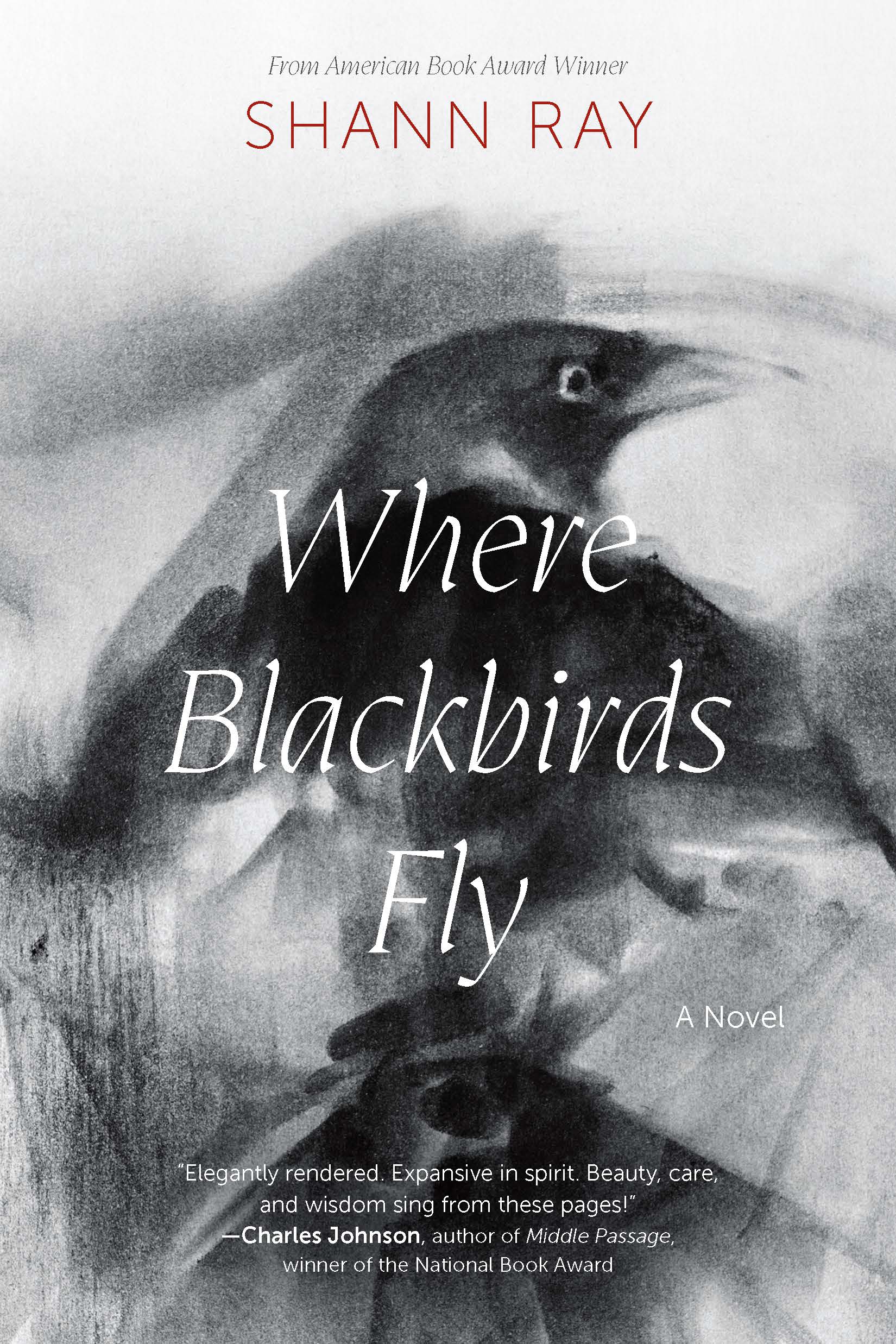
Shann Ray’s novel Where Blackbirds Fly (Bison Books, 2025) is a braided set of five novellas, each a tenderly told and brutally honest investigation into the nature of relationships and what it means to love. As with his previous work, Ray provides a metaphor-rich writing style that doesn’t shy away from intimacy or hard truths. There are heartbreaks and infidelities here, there is love and joy, as well as a broad sense of spirituality. But what is most rewarding is that even when writing about the darkest corners of the soul, light and grace shine from every page of this finely constructed novel.
Where Blackbirds Fly revolves around John Sender, an investment banker in Seattle and four couples that come into his orbit, all with ties to Montana in one way or another. We meet Elias American Horse, an Oglala Lakota and Assiniboine/Nakota with a PhD pulling in almost $500k a year who wears fitted suits and cowboy boots by day and Armani at night. We meet the opium addicted couple Phillip McBane and Alberta Amah who leave junk food out for their 8-year-old daughter as they float away on the poppy tea they mix. Coming from a variety of economic and cultural backgrounds, this cast of characters is richly complex and unapologetically diverse, and under Ray’s hand, each and every one of them deserving of love and compassion.
-Charles Finn
7 Questions on Love and Loneliness
Charles Finn: Part of your childhood was spent on the Northern Cheyenne Reservation in southeast Montana. How did that experience shape you toward love? And how does it shape your writing? In particular, how did your upbringing play a role in the writing of this novel?
Shann Ray: The Cheyenne people were referred to as ‘the beautiful people’ during the Indian wars of the late 1800s. They are also known to be among the most fierce of the high plains nations. My dear friends Lafe Haugen, Russell Tall White Man, Blake Walks Nice, and many of my basketball heroes, Cheyenne, Crow, Blackfeet, Assiniboine, Cree, or otherwise, such as Elvis Old Bull, Mike Chavez, Stanford Rides Horse, Juneau Plenty Hawk, Timothy Falls Down, Mark and Luke Spotted Bear, the Kills Night family, the Pretty Horse family, and Dana Goes Ahead, influenced my life and my conception of love beyond measure. Their way of life was reverberant with my own history in many ways, which is Czech, along with a mix of other countries. Basketball, like art, like life, is made of mountains and plains, rivers and sky, birds, wildlife of all forms, the human and the more than human, the spirit world, and reverence for God, as little as we know of God, the Great Spirit, or Maheo in Cheyenne. The entangled relationship between Catholicism and traditional Native beliefs carries shadow and light. Living in a place of ferocity helped shape who I am as an artist. This novel is met with both Cheyenne and Czech influence, where life is circular and cruciform, forgiveness is stronger than blood, and love is cultural resilience.
CF: Stylistically, this is a highly crafted set of novellas, but it is the individual sentences and careful construction of pacing that bring the real joy. Sparse yet lyrical, your prose pays attention to form as much as plot and narrative. Undoubtedly, this comes from your background as a poet, and it shows, the novel unspooling like a lyric poem, punctuated with sharp, crisp imagery and a startling amount of finely tuned and carefully chosen detail. Throughout the book, individual chapters work like stanzas, many have only one or two short sentences as you employ contemplative space in the same manner a poet does. Such intention—and attention—creates nuance and an opening of the relationship with the reader. There is nothing fanciful or gratuitous. There is listening, and in the silence is the mystery. How does your background as a poet play a role and influence this novel?
SR: I’m reminded of so many lines of poetry that came to me as a boy… ‘arise, shine, for your light has come’; behold ‘the man of sorrows’; for you have been given ‘the garment of praise instead of the spirit of despair.’ I’m also reminded of the poets who have placed a form of metaphysical fusion into my life such as Robin Coste Lewis, Natalie Diaz, Wallace Stevens, and Vincent van Gogh, all of whom play a visceral role in Where Blackbirds Fly. They’ve made a claim on my inner life, the heart of hearts, as have so many poets, and in return I hope to give them an echo-resonance of adoration with this novel. Also, the poetry and novellas of Jim Harrison are important to me. I hoped to build a book that would give love to the novella, through five novellas encased in something that could be read as intimately as a novel. With regard to poetry specifically, lines from Diaz and Stevens have a cadence and an anchoring into light and love beyond every abyss. From Natalie Diaz: her hand upon the beloved’s chest, her yearning to ‘disappear, not into violence / but into love, / into church and darkness.’ From Wallace Stevens: ‘A man and a woman / Are one. / A man and a woman and a blackbird / Are one.’
CF: As much as it is a novel of the city, these five novellas are rooted in the mountains and plains of Montana and the restorative properties of nature and family. When you describe field dressing an elk, the reader knows it comes from experience. You also make certain not to promote cliched Western stereotypes, especially of Native Americans, and you certainly don’t shy away from the atrocities of history, particularly those committed against the Lakota at Wounded Knee or the Dakota in Mankato with the hanging of the 38 + 2. That said, by all accounts, this is a uniquely generous novel. All of your main characters in the five novellas it encompasses are flawed, some of them quite deeply so. Yet you write them with such compassion and understanding, unapologetic of their situation, but never as an excuse and always without judgement. Can you speak to that, where does that come from and why was it important to show these people as you did? In addition, does your experience teaching forgiveness studies play into this and how? And exactly what is forgiveness studies?
SR: Thank you for your kindness, Charles. When envisioning the people in this novel, I spent time thinking of varied environments I’ve lived or worked in ranging from the Americas to Europe and from Africa to Asia: the beautiful people I’ve known everywhere. My life as a clinical psychologist gives unique insights into the souls of others. I then turned to the notion that America in my view, from Native nations to African nations to every culture that walks this blood-drawn soil, forms a robust family met with both frailty and great fortitude. As a family, like all families, we are fraught, fractured, resilient, harmful, loving, healed, graceful, and as you mentioned, generous. I want to be touched and moved by the people around me, I want to be changed by them. I want to listen deeply to the dream of soul housed inside us and inside our families. The novel emerged from that desire, a place grounded in the relationships throughout my life and throughout what I envision as a united country interwoven with the nations of the world.
I’ve spent most of my life as a researcher of forgiveness and genocide. Having visited so many genocide sites here in the U.S. and globally, and having encountered such a bright trajectory of both restorative justice and forgiveness in these forlorn places, I’ve devoted myself with others to the process of asking forgiveness, building bridges of atonement and restoration, and seeing things whole again. Likely a surprise to many, the research on forgiveness is staggering: those with higher forgiveness capacity experience significantly less anxiety, depression, and anger than their less forgiving counterparts. People with higher forgiveness capacity also experience greater overall wellbeing, less heart disease, and stronger pathways toward more robust immune systems. For these reasons The Mayo Clinic uses forgiveness treatment with their patients. Beyond science though, the freedom, awareness, and truth each of us finds in authentically forgiving and being forgiven is irrefutable.
CF: This novel in five parts is the work of a gifted writer unafraid to pull back the curtain of vulnerability. You do this by sharing your characters’ true goodness and innate flaws, their genuine friendships and the papercut (and larger) cruelties couples commit upon their partners, even while loving each other fiercely. In addition, there are fantastic metaphors, “He’d crossed the line when he’d shaken her shoulders but it was like shaking a bucket of rusted nails, the whole tangle solid with nothing breaking loose.” And a few lines later: “Like too many men, he’d physically harmed her… a porcelain bank he couldn’t empty.” The title is Where Blackbirds Fly, and there are references to blackbirds sprinkled throughout the book. Metaphor? Can you talk about the role blackbirds play in the novel, their importance, and why you chose to title it as you did?
SR: In noticing wilderness, in my own life and in the landscapes and cityscapes around me, I came to understand that birds always seem to calm me. I think they might be attuned to something like prayer, prayers of hope for my wife and daughters and for the world. I’ve been moved by the flight of birds, their pathways through the air, the great beauty of something so dreamlike as a mountain swift, a barn swallow, a mountain bluebird, or a red-winged blackbird. However, I didn’t know much else about them except that they had become vessels of beauty in my life. So I began researching their bone and body structure, their wing patterns, their diet, how they ward off predators, the nature of their refractive and often iridescent light, how they group together and the scale free correlation and syncopated patterns of their existence not only in flight but when sleeping at the base of trees or speaking to one another inside a line of willows, along the tips of cattails, or in the leafy covering of silver birch, aspens, maples, and alders. From that research they became a mirror of divine mystery inside the novel. They look upon humanity with a transcendent eye. The title emerged from spending a good deal of time with blackbirds.
CF: Where Blackbirds Fly is one of the most honest, tender, and understanding accounts of what it means to love another person. Seldom are characters so intimately and richly drawn. None of your characters are saints, all are tainted, some tremendously so, but never do you allow them to be less than completely human, each page revealing characters whose introspection and honesty are more fully described than any I have encountered in recent memory. What kind of additional research did you have to do in writing this novel and the detailed backstories that you provide? There are so many references to historical events, art, literature, and all manner of things: guns, particular coffee shops, mountain ranges. My guess is everything, every last detail, is accurate and true. Can you talk about what went into researching all this?
SR: I love novels that involve the intricacy and finesse surrounding the finer details of a given trade, or simply the holistic inside knowledge of people, their movements, and their vocations. I think of Edna O’Brien’s novels The Little Red Chairs and Girl, Willa Cather’s Death Comes for the Archbishop, Thornton Wilder’s The Bridge of San Luis Rey, and Michael Ondaatje’s The English Patient. You’re right, I’ve tried to make sure every detail in the novel is accurate and true, whether the characters work in coffee shops or bank buildings, live in trailers or waterfront properties, hold a given philosophy or theology, know the architecture of mile-high skyscrapers, take a path through the mountains, or fall in love with astrophysics and the unique aspects of star fields. I find this lifelike patterning in a novel’s subtext delightful.
CF: As a writer and poet, I read for the beauty of the sentences and the flow of the words. I want to be swept away, transported, transfixed by the language—and I was. Perhaps that’s why I loved Where Blackbirds Fly so much. You give us beauty, but you give us more than that too. I couldn’t stop thinking about the characters, many of whom I’d probably cross the street to avoid. But by the end of novel, I had compassion for each of them. This, I feel, is the novel’s greatest achievement. You made me rethink my prejudices and examine my judgmental tendencies, and at this point in time, at this juncture of history, isn’t that exactly what all of us need to be doing? What do you hope people take away from this novel?
SR: Your graceful way as a reader is a gift, Charles; I cherish this conversation. I think Tina Turner said it best: What’s love got to do with it? How many complexities are there in our individual and collective humanity, and what’s love got to do with it? Perhaps everything. And perhaps our lives, our association with time and being, life and death and the encounters we all have beholding the face of the beloved are numberless and should go less named, more left to God and to the mystery of who we are together inside our shared wilderness here in the known and unknown universe. I hope people feel loved by this novel and feel better able to love others.
CF: What is the meaning of love?
SF: Humbly I believe no one knows the meaning of love, and humbly I believe everyone knows. By living toward a modest and reverent notion of love in the present day I hope to affirm something held sacred by my Czech grandmother Catherine, my mother Saundra Rae, my wife Jennifer, and my three daughters Natalya, Ariana, and Isabella: among the great embodiments—faith, hope, and love—the greatest of these is love.
Charles Finn is author of Wild Delicate Seconds: 29 Wildlife Encounters, and On a Benediction of Wind: Poems and Photographs from the American West, winner of the 2022 Montana Book Award. He is co-editor of the textbook/anthology The Art of Revising Poetry: 21 U.S. Poets on Their Drafts, Craft, and Process, as well as co-editor of the poetry anthology, We Are All God’s Poems. He lives in Havre, Montana, with his wife Joyce Mphande-Finn and their two cats, Tija and Rilke. Former editor of High Desert Journal, Finn has helped forward and bring attention to many of the poets and writers of the American West including Gary Snyder, Ursula K. Le Guin, John Daniel, Rick Bass, Gretel Ehrlich, Aaron Abeyta, CMarie Fuhrman, David James Duncan, William Kittredge, Ellen Welcker, Craig Lesley, Kim Barnes, Joe Wilkins, Kim Stafford, and Robert Wrigley.
Czech American artist and American Book Award winner Shann Ray teaches leadership and forgivenes studies at Gonzaga University and poetry at Stanford. A National Endowment for the Arts Fellow and group Fullbright recipient to South Africa, through his research in forgiveness and genocide Shann has served as a visiting scholar in Asia, Europe, Africa and the Americas, and as a poetry mentor for the PEN America Prison and Justice Writers Program. He has delivered poetry engagements at Cambridge and the Center for Contemplative Leadership at Princeton Theological Seminary, and values mutual work involving art, leadership, and the reconcilliation of people and nations. Having collaborated as a visiting poet with painter Makoto Fujimura on a United Nations grant entitled Intercultural Dialogues through Beauty as a Language of Peace, Ray is also an International Book Award winner, a three-time High Plains International Book Award winner, Bread Loaf fellow, Bakeless Prize winner, and winner of the Western Writers of America Spur Award and the Foreword Book of the Year Reader’s Choice Award. His work comprises a libretto and 17 books, of which 12 are poetry, fiction, and creative nonfiction including Where Blackbirds Fly, Atomic Theory 7, The Garment of Praise, Forgiveness and Power in the Age of Atrocity, Balefire, American Masculine, Sweetclover, Blood Fire Vapor Smoke, American Copper, The Souls of Others, and Transparent in the Backlight. His poems and prose have been featured in Poetry, Esquire, Narrative, McSweeney’s, Prairie Schooner, Poetry International, Montana Quarterly, Big Sky Journal, and the American Journal of Poetry.
 UNP blog