
Anthony R. Pahnke is an associate professor of international relations at San Francisco State University and serves as the vice president of Family Farm Defenders. He is the author of Brazil’s Long Revolution: Radical Achievements of the Landless Workers Movement and Agrarian Crisis in the United States: Pathways for Reform. His most recent book Mobilizing Hope, Fighting for Change (Nebraska, 2025) was published in November.
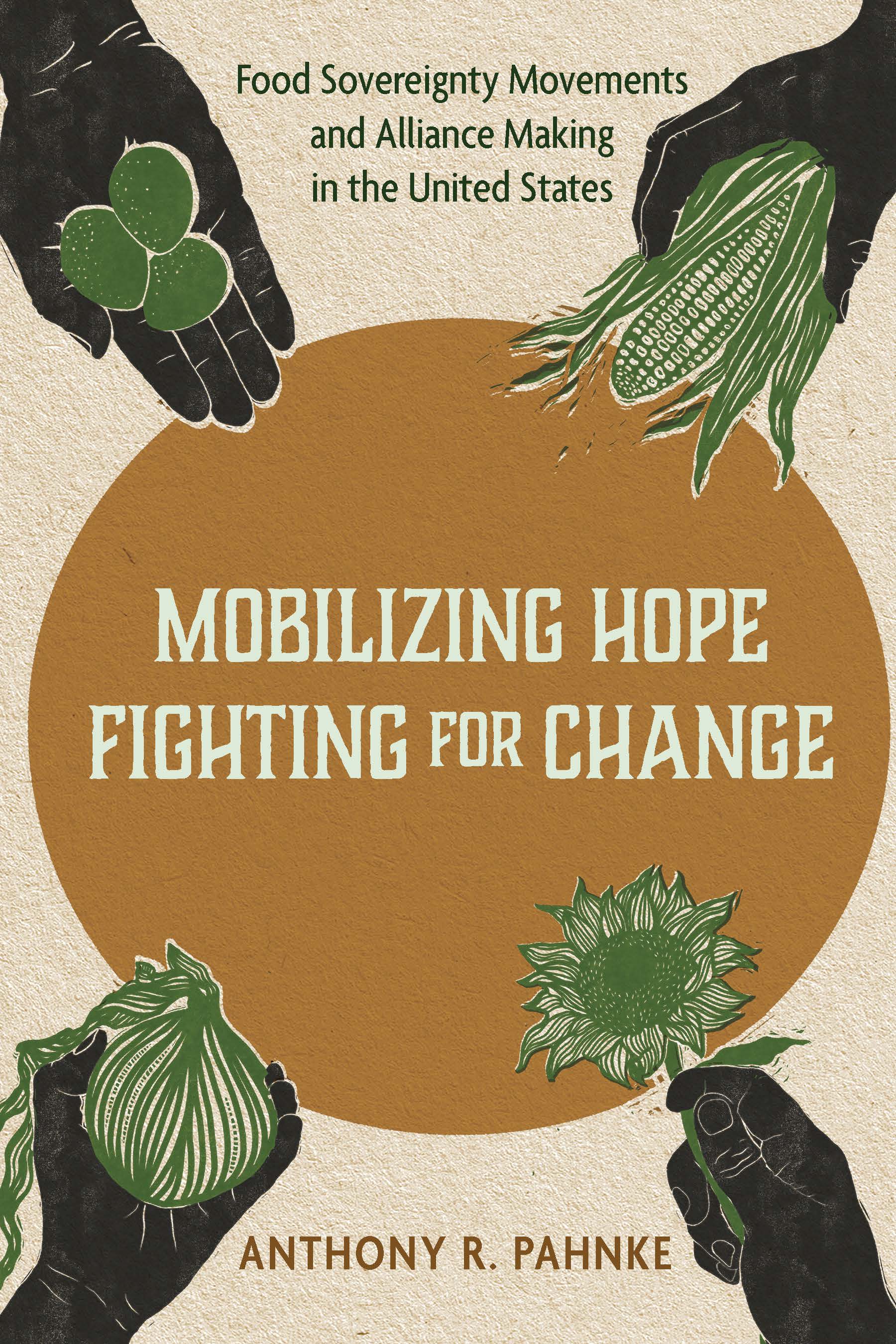
Mobilizing Hope, Fighting for Change analyzes an unusual development in social movement studies and food politics more generally: the formation of an interracial alliance of farmers and farm workers who together demand transformative changes to U.S. agriculture by calling for food sovereignty. Such an alliance, as Anthony R. Pahnke shows, is unusual given how social movement alliances in the United States, particularly those related to agrarian issues, have historically been deeply divided by race and occupation.
Pahnke’s study offers a novel theory for social movement alliance formation, focusing especially on the dynamics of learning. He documents how since the 1980s there have been unprecedented openings for people to work together due to the rise of transnational activist networks, changes in the international political economy, and evolving forms of state authority.
Foregrounding the voices of activists, Mobilizing Hope, Fighting for Change compares the trajectories of four U.S.-based movements over time—the Mvskoke Food Sovereignty Initiative based in Oklahoma, the Family Farm Defenders of Wisconsin, the Farmworker Association of Florida, and the Mississippi Association of Cooperatives—documenting how they have united in demanding food sovereignty while remaining distinct from one another.
Introduction
Chainsaws and Commitments
Chainsaws seemed like a good idea—the problem was figuring out how to get those tools to the people who were asking for them. Our principal challenge was logistical, as I was living in Minnesota at the time and the people who needed to clear away the fallen trees were in Florida. The additional and just as essential element in this story was who was requesting these tools. I was not trying to help a group of lumberjacks who were stuck working with old, broken equipment. I was speaking with farmworkers. With hurricanes increasing in intensity and frequency due to climate change, disasters are devastating more and more people, including farmworkers who have come to call coastal areas in the United States their home.
But wait, why would farmworkers request chainsaws? After all, picking lettuce or strawberries, for instance, most likely comes to mind when thinking about the work required of the people who play an indispensable role in feeding Americans. I learned, while doing my fieldwork in Florida, that after hurricanes hit and the federal government arrives to remove debris such as fallen trees and provide other forms of assistance, outreach to people of color, especially immigrants, is minimal if not nonexistent. To make matters worse, if someone does not have legal authorization to work within the United States—or, in other words, is undocumented—they must rely almost exclusively on charity to recover from such catastrophes. Accordingly, migrants, including farmworkers, are left to fend for themselves. And when it comes to cleaning up after a hurricane, sometimes they need chainsaws.
Ultimately, the chainsaw delivery project was not meant to be. Logistical challenges proved too difficult to overcome, and people decided to make financial contributions to assist the farmworker families instead. But the story is instructive as over the years, when conducting research for this book, I found myself often fielding similar requests and thinking with movement members about how to deal with particular challenges. Upon reflecting on these experiences, sending chainsaws across the country would probably have been easier than many of the other things that I ended up doing with movements, including organizing trips for activists to attend conferences, writing grant proposals and project evaluations, and even cooking meals for groups.
Regardless, the experience with the chainsaws stands out for how I was approached. At the time, I was visiting a community garden that members of the Farm Workers Association of Florida (FWAF) were managing. I was there to learn about the challenges that movement members face in terms of land access and how they understand food sovereignty. Following that visit to one of the garden sites that the movement organizes, I, along with a small group of movement members, found a table to continue our conversation. As we were concluding, one leader leaned over and said to me almost in a whisper, “You know, your visit is all good and so on. But, you know, you should do something for us.”
That quiet, simple request stuck with me. Yes, I have been involved in social movements, some of which are allies of FWAF and that appear in this book. My involvement has not been limited to attending the periodic meeting, paying membership dues, or receiving newsletters. I do not repost things on Facebook to “raise awareness.” My engagement has taken many forms, which, in addition to some of the activities listed above, include efforts to engage in the policymaking process and develop strategy. Over these years, I have built deep relationships with many of the people whom I have met. I have also learned many tough lessons on the complicated, sometimes tense work of bringing activists and community members together. Put otherwise, I have been engaged in building alliances—the dynamics of which is the cen-tral theme of this book—where a chainsaw is always more than a chainsaw.
When I was doing the fieldwork for this project on alliances, difficult themes often arose in conversations with activists. For instance, racism frequently came up, as did how to challenge corporate power, poverty, and sexism. The farmworkers I met in Florida regularly mentioned the racial discrimination that they endured from local city representatives, as well as the undue amount of influence that dominant economic actors wield in the food system. Farmers in Mississippi brought up similar themes when we met. One difference was that whereas some farmworkers in Florida mentioned problems within the fern industry, in Mississippi, I heard of the expansion of lumber companies and the history of land loss that African American farmers have suffered. Also, while farmworkers expressed their misgivings about certain city officials, their real concern dealt with Immigration and Customs Enforcement (ICE) agents and the United States’ ongoing immigration policy disaster. In Mississippi, farmers expressed more dismay about the United States Department of Agriculture (USDA) and how its officials for most of the twentieth century denied loans to Black farmers. But at the same time, as I learned, these issues—immigration and anti-Black racism—do not drive wedges between them as they work across their differences to find common ground and work together in the twenty-first century.
What I noticed—which led me to focus on movements in Oklahoma and Wisconsin, in addition to organizations in Florida and Mississippi—was that although groups in different regions faced different experiences and challenges, they were all making similar demands and working together in campaigns to transform the U.S. agrarian system. More precisely, I found a growing interracial alliance of people from different agricultural occupations who were active within food, farm, and labor movements. Their overarching demand is for food sovereignty.
I am far from the first to document the emerging movement alliances that demand food sovereignty. In this literature, which will be worked through more substantively in chapter 1, a certain consensus exists concerning historical events. First, the demand itself is often bound up with the creation of the transnational movement, La Via Campesina (The Peasant’s Way, or LVC), and its recognition that the policies related to food security, as endorsed by the Food and Agriculture Organization (FAO) of the United Nations (and by various state governments), are inadequate when confronting hunger, economic inequality, and racism. Tracing LVC’s origins to a meeting of activists in 1993 in Belgium, the call for food sovereignty was first made public when movements protested the World Food Summit that took place in Rome in 1996. The document that they issued—Food Sovereignty: A Future without Hunger—is one of the first declarations to feature the demand’s central elements. Specifically, those elements include the idea that accessing food should be a human right, agrarian reform is needed for landless and Indigenous people, natural resources require protection, international trade ought to be radically reorganized, transnational corporations should receive more oversight, peace must exist for people engaged in agriculture, and agricultural policies should be more democratic.
The principal objective in this book is to explain the formation of social movement alliances that demand food sovereignty, drawing particular attention to how they have taken shape in the post–Cold War era in the United States. A guiding question is, how has this interracial struggle of people from different occupations to transform agriculture in the United States come into existence? Posing the question in this way is more than a semantic issue. Put otherwise, in asking a “how” instead of a “what” question, I am focused on the processes of alliance formation. Besides documenting that alliances exist, I am concerned with the dynamics that brought them into existence.
 UNP blog