
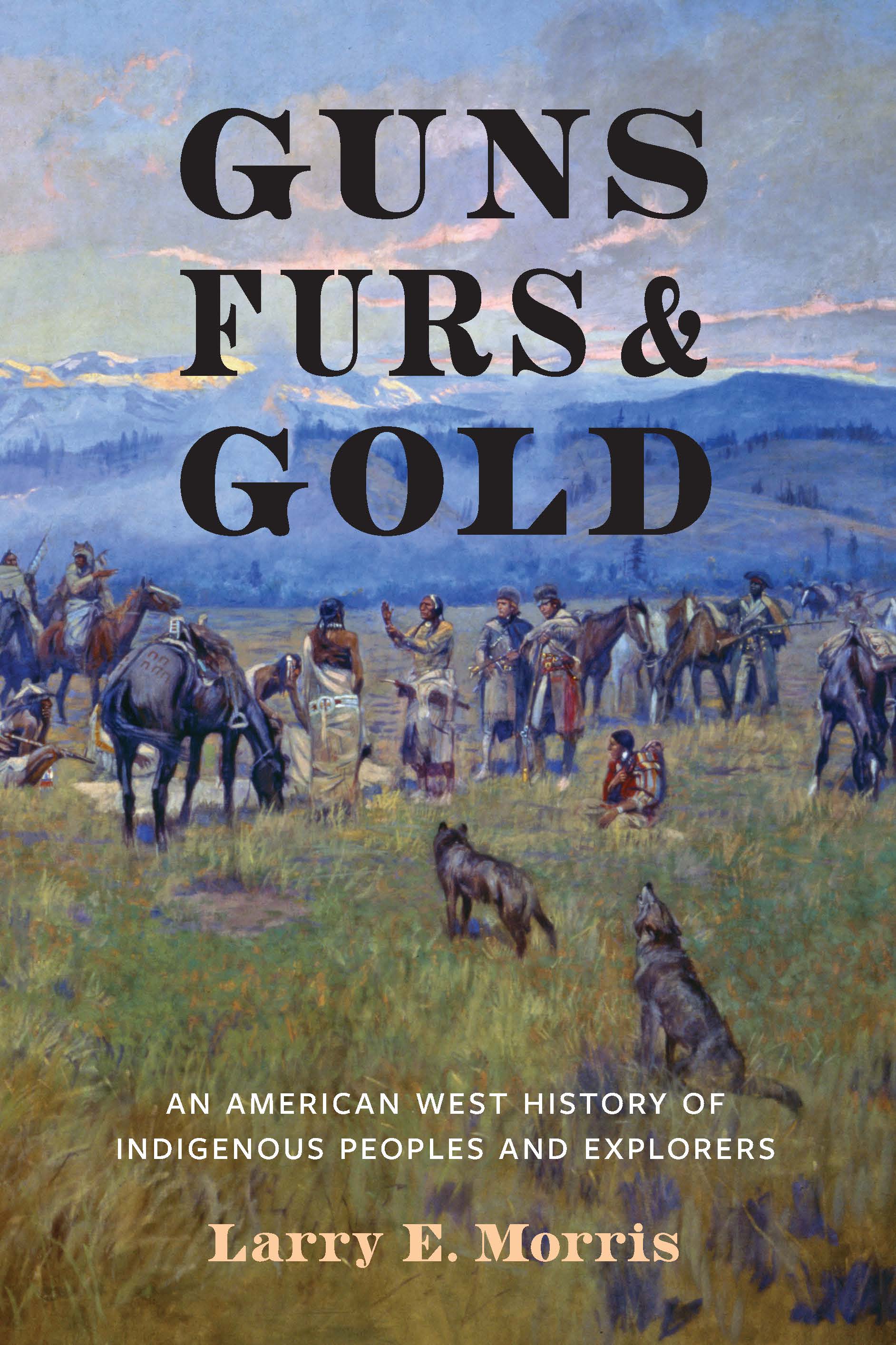
Larry E. Morris is an independent writer and historian. He is the author of numerous books, including The Fate of the Corps: What Became of the Lewis and Clark Explorers After the Expedition, a History Book Club selection; The Perilous West: Seven Amazing Explorers and the Founding of the Oregon Trail; and In the Wake of Lewis and Clark: The Expedition and the Making of Antebellum America. His book Guns, Furs, and Gold: An American West History of Indigenous Peoples and Explorers (Bison Books, 2025) was published in December.
Guns, Furs, and Gold offers a riveting narrative of the American West by exploring the interactions of the Arikaras, Crows, Cheyennes, and Arapahos with each other and with Euro-American traders, explorers, and settlers from 1804, when Meriwether Lewis and William Clark embarked on their voyage of discovery, to 1864, when the U.S. Army attacked both Confederate forces in the South and Native nations in the West.
Larry E. Morris recounts the nineteenth-century experience of these four tribes by detailing their interactions with four legendary survivors of a fight with the Arikaras in 1823. These renowned figures include the remarkable trailblazer blazer Jedediah Smith, the unparalleled interpreter Edward Rose, the premier guide and Indian agent Thomas Fitzpatrick, and the grizzly-bear-mauling survivor Hugh Glass. Their careers illuminate the fate of four Indian nations, revealing how—despite the best efforts of several explorers to treat the Indigenous peoples respectfully—the guns, furs, disease, and gold rushes of the interlopers put the Indians’ way of life, their lands, and their very lives at grave risk. The sixty-year period comes to a close when more than 150 Plains Indians, most of them women, children, and elderly, were ambushed and slaughtered by Colonel John Chivington’s Third Colorado Cavalry on the banks of Sand Creek.
Prologue
“The Lewis and Clark expedition had its origins in the mind of Thomas Jefferson many years before a crowded keelboat was launched into the Missouri River,” writes Gary Moulton, editor of the captains’ journals. Captivated by books and maps—and without traveling west—Jefferson “understood the interior better than any other American of his generation.” Nothing reveals Jefferson’s passion for the West like his long history of proposing expeditions to the region. Late in 1783, just three months after the Treaty of Paris ended the American Revolutionary War, Jefferson, then forty years old and serving as one of Virginia’s delegates to the Congress of the Confederation, wrote to military hero George Rogers Clark (one of William Clark’s elder brothers) and asked if he would like to lead an exploration of “the country from the Mississippi to California.” Embroiled in personal financial problems, Clark politely declined, even though he found the prospect of “a tour to the west and Northwest of the Continent . . . Extremely agreeable.” Clark advised against sending a large party of men because they would alarm the Indians: “Three or four young Men well qualified for the Task might perhaps complete your wishes at a very Trifling Expense.” Those men would have to learn “the Language of the distant Nations they pass through,” and the expedition “would require four or five years.”
Three years later, while serving as U.S. ambassador to France, Jefferson met the American adventurer John Ledyard, “well known in the U.S. for energy of body & mind. He had accompanied Capt. [ James] Cook in his voyage to the Pacific ocean, and distinguished himself on that voyage by his intrepidity. . . . His immediate object at Paris was to engage a mercantile company in the fur-trade of the West coast of America.” When that venture failed, Jefferson wrote, “I then proposed to him to go by land to Kamschatka [the Kamchatka Peninsula, in the Russian Far East], cross in some of the Russian vessels to Nootka sound [on the west coast of present British Columbia’s Vancouver Island], fall down into the latitude of the Missouri, and penetrate to and thro’ that to the U.S.” Although Ledyard “eagerly siesed the idea” and managed to travel within two hundred miles of Kamchatka, he was then arrested by Russian authorities, who deported him to Poland. As Bernard DeVoto writes, Ledyard “came under the scrutiny of Russian fur traders who were developing the Aleutian field and at that moment were preparing to expand southward along the coast to California. They could not let him carry out his plan and they didn’t.”
In 1793, almost ten years after approaching George Rogers Clark, Secretary of State Jefferson wrote to the French botanist and explorer André Michaux on behalf of the American Philosophical Society, offering to fund a journey to “the shortest & most convenient route of communication between the U.S. & the Pacific ocean . . . & to learn such particulars as can be obtained of the country through which it passes.” Michaux was to reach the headwaters of the Missouri River and then find a river flowing to the Pacific—all while avoiding Spanish authorities. When Michaux reached Kentucky, however, the French ambassador ordered him to “relinquish the expedition.”
The patient Jefferson bided his time, however, and in the late 1790s—when he was vice president and in his mid-fifties—one favorable event after another fell into place, setting the stage for an expedition worthy of the vastness and mystery of the West, one that showed how ill-planned and untimely previous attempts had been. First, in 1798, came the posthumous publication of George Vancouver’s monumental A Voyage of Discovery to the North Pacific Ocean and round the World, 1791–1795, invaluable for its detailed maps of the northwestern Pacific coast. (After departing London, sailing around Cape Horn, and wintering in the Hawaiian Islands, Vancouver reached North America about 110 miles north of present San Francisco and followed the coastline all the way to the Alaska Peninsula.)
Next, late in 1800, Jefferson was elected U.S. president. A year later, the preeminent explorer Alexander Mackenzie, the first European to cross North America north of Mexico, published Voyages from Montreal . . . through the Continent of North America, to the Frozen and Pacific Oceans, in the Years 1789 and 1793. In 1802 the British cartographer and geographer Aaron Arrowsmith produced A Map Exhibiting All the New Discoveries in the Interior Parts of North America. With all this crucial information now available—and with Hudson’s Bay Company and the North West Company both champing at the bit to found cross-continent fur-trade operations—Jefferson petitioned Congress in January 1803 to approve an exploration “to the Western ocean” focusing on “conferences with the natives on the subject of commercial intercourse.” Congress agreed a month later, and plans for the expedition were well underway by the time the Louisiana Purchase guaranteed—by pure happenstance—that Meriwether Lewis, William Clark, and their men could travel from St. Louis to the Rocky Mountains without trespassing on foreign territory.
Over a twenty-year period, the persistent Jefferson thus set in motion the first interactions between American explorers and a host of western Indian nations, including those emphasized in this volume—the Crows, Arikaras, Cheyennes, and Arapahos. In his message to Congress, Jefferson became a prophet of sorts by stressing the importance of reaching the Pacific, meeting with Indigenous peoples, and conversing with them on trade—three key elements of the “opening” of the American West that began with the Louisiana Purchase and the Lewis and Clark Expedition (1803–6) and ended with the annexation of Texas, the Oregon Treaty, the Treaty of Guadalupe Hidalgo, and the California Gold Rush (1846–55).
True, the Renaissance-man Jefferson instructed Lewis and Clark to investigate all kinds of topics, from latitude and longitude measurements; the courses of rivers; soil, plants, and animals; weather and climate; mineral productions, metals, limestone, and volcanic appearances, to the names and numbers of Indian nations; the extent of their territories; their language, traditions, and monuments; their occupations in agriculture, fishing, hunting, arts, and war; their food, clothing, and domestic accommodations; the diseases prevalent among them; and their laws, customs, and dispositions. All that notwithstanding, Jefferson clearly reiterated the key objective of the western excursion: “Explore the Missouri river, & such principal stream of it, as, by it’s course and communication with the waters of the Pacific ocean, whether the Columbia, Oregan, Colorado or any other river may offer the most direct & practicable water communication across this continent for the purposes of commerce.” Like James Cook, Alexander Mackenzie, George Vancouver, and a long line of others, Lewis and Clark made their expedition not for the sake of exploration itself but for economic advantage, whether you call that commerce, trade, or filthy lucre. Discovery was always subordinate to business.
 UNP blog