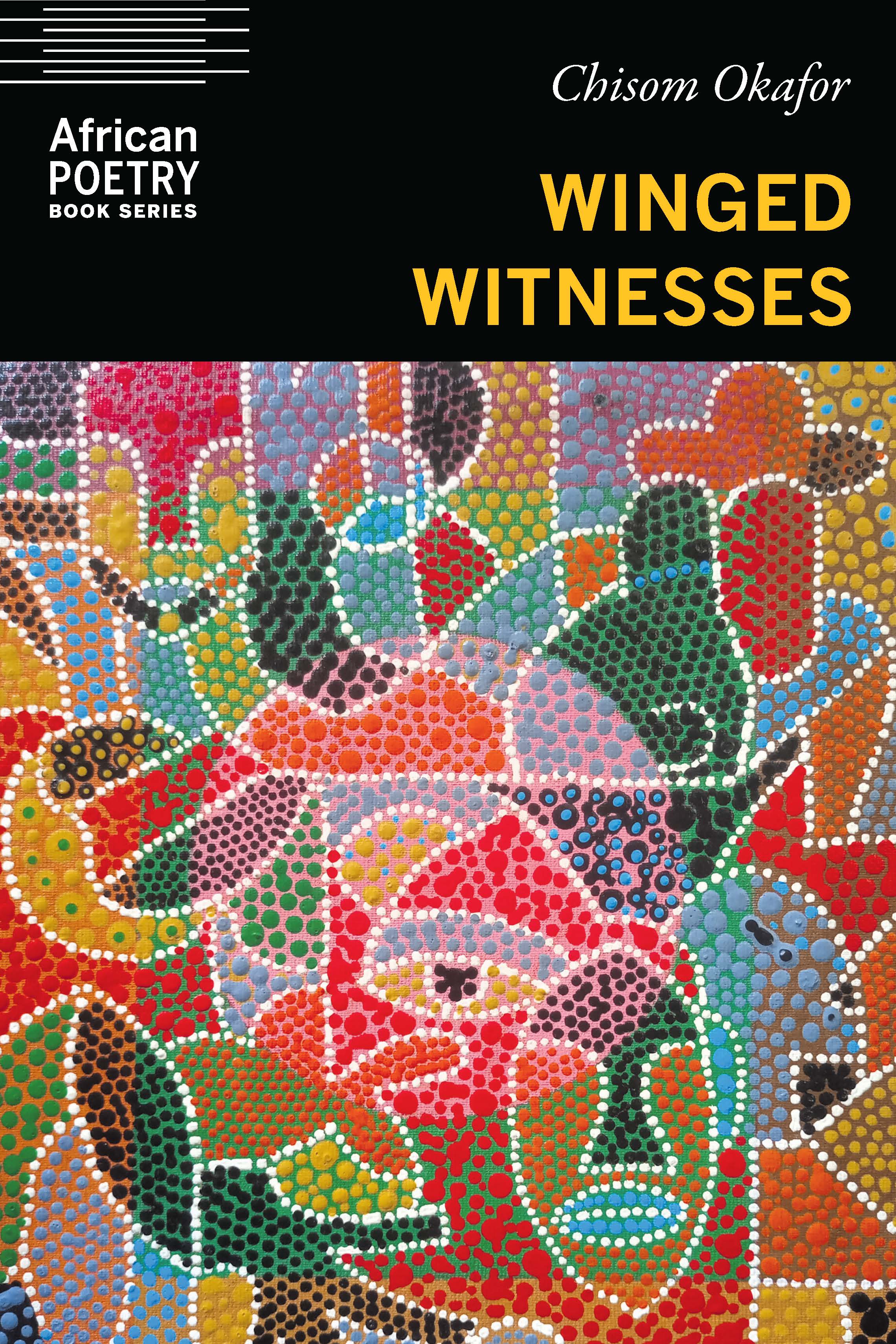
Chisom Okafor is a Nigerian poet and clinical nutritionist. His poems have appeared in Beloit Poetry Journal, Prairie Schooner, the Raven Review, the Hellebore, North Dakota Quarterly, Salt Hill, Sand Journal, the Account, Rattle, and elsewhere. His most recent book Winged Witnesses (Nebraska, 2025) was published in December.
Chisom Okafor offers poems that are intense, gripping, and perfect for pondering. The poems are a force field for questions: When we embody life through disabled, chronically ill, and neurodivergent body-minds, how do we grapple with love, time, and consciousness?
These poems are alive to history and highlight the way poetry’s memorial practices animate the raw intimacy between the seen and unseen. There is trauma in these poems, but also light and salvation, and everything that comes between.
Animalcules
What first greets anyone who enters this room
is not the medication, not my drooping eyes,
tarrying undecided between recovery and relapse,
but the old bible left on the stool, just beside my bed
where my father’s hand can swiftly reach it.
At midnight, he flips it open and for a long while
stares at the vignette of the Last Supper
on the first page, as if to crawl inside it
and save Jesus from imminent death
then I hear him recite his favorite bible verse
into his palms, supple with anointing oil,
his mouth dense with the book of Isaiah:
Ma ndi n’ele anya Chineke . . . ga-agbanwe ike ha
Ha ga-agba ósó, ike agaghi agwukwa ha
Ha ga-eje ije, ghara ida mba.
But those who wait for God . . . will renew their strength
They will run, and not be weary
They will walk, and not faint.
Afterward, he keeps vigil, his breaths
steady and drawn against the long moan
of the night like a snake’s hiss. His head
is bowed in a catnap, the way St. Francis
must have appeared on the night
of his first missionary trip, bent with exhaustion.
I fall into a trance and there is an army of bacteria
invading my body’s defenses
dressed in deceitful clothing.
They populate the islets of Langerhans
slice through the sphincter of Oddi
infiltrate the Bowman’s capsule
graze on the walls of the Cowper’s gland
and curl round the loop of Henle
while I’m left muttering every one of god’s names
I ever committed to memory
Rapha. Jaireh. Sabaoth
which is my most preferred name for god
Sabaoth: a platoon of insurgents
charioting into my body,
an invasion of an already-invaded land.
But it’s hard to think about horses when
my father’s voice stubbornly tickles my ears
and his prayers keep falling like many
little animals on my infected chest
as I pretend to fall asleep.
Petrichor
You invite me to the slow violence of your body.
I could feel your delight, like rain
turbaned around the circumference
of a rain-bathing child’s head,
and just after the entrance
I make a detour, convulsing
with hunger for the things
I have lost from my previous life.
Within the waves of your body
and up to the points where
the spiraling light is first refracted
before it turns impenetrable
like a passage through
a prism of glass
opaque and translucent in equal measure,
I search for a song
that used to be mine
but which has now become a sailor’s talisman lost at sea
and believed to be nestled
between membranes and tissues of your body.
There is a story hidden within the story
of my departure from home.
Peep through, and you’ll see my father
clutching a chest already squeezed out
with angina pains, or an uncle
dying slowly from an affliction
that has refused to grow old.
It is hard to die, he says to me.
It is life we should be afraid of, not death.
Lay me on the shelter of this new knowingness.
Sing me a buffet of vocables,
an à la carte of phosphenes until I’m satiated.
It’s seven years after my drifting
apart, but I still fail at the subtle art
of forging recovery psalms.
Tell me, how do you forgive what has refused
to stop punishing you?
How do you return to the sweet agonies of a previous life?
 UNP blog