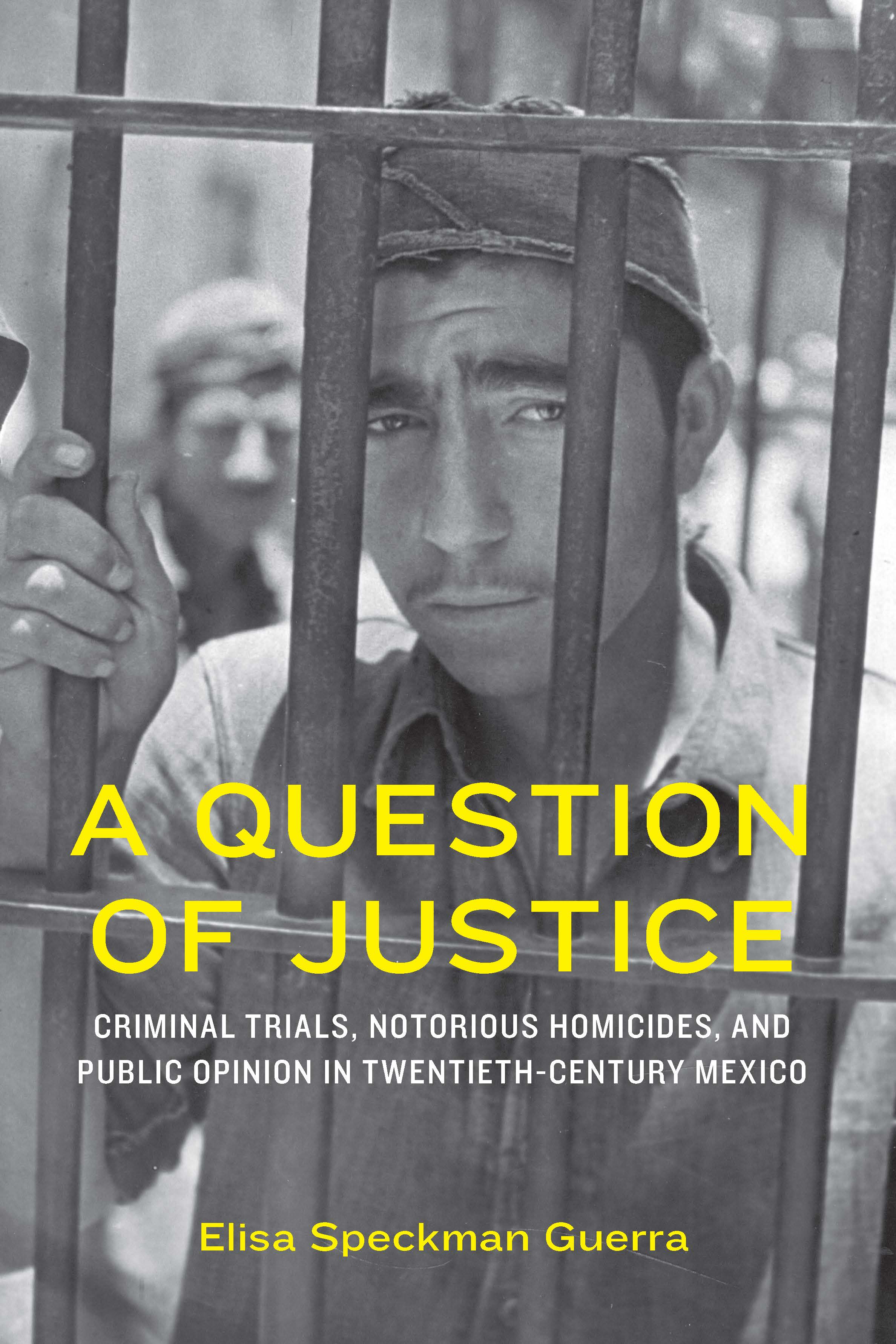
Elisa Speckman Guerra is director and researcher at the Institute of Historical Research at the National Autonomous University of Mexico. She is the author or coauthor of several books in Spanish on law, judicial culture, and criminal justice in Mexico. Her book A Question of Justice: Criminal Trials, Notorious Homicides, and Public Opinion in Twentieth-Century Mexico (Nebraska, 2026) is the latest title in the Confluencias series.
Mexico is a country beset by violence and insecurity, with 98 percent of violent crimes unsolved and 94 percent of crimes unpunished. These staggering statistics illustrate the critical need to understand the history of Mexico’s penal law and justice system, from its evolution and development to its public image and effects on Mexican society.
In A Question of Justice Elisa Speckman Guerra elucidates Mexico’s penal law and justice system in the twentieth century from the disciplinary perspectives of both history and law. Looking at the critical period from 1929 to 1971, Speckman Guerra investigates the democratic rule of law and to what extent it was followed within the justice system, as well as judicial proceedings considering the role of gender, class, and race. For that reason, Speckman Guerra also delves into homicides involving very well-known victims, like the famous singer Guty Cárdenas, and notorious murderers, such as the Olympic medalist Humberto Mariles; the public image of police, judges, defendants, lawyers, and other actors involved in penal processes; and the representations of crime and justice in print and on film. This extensively researched study illuminates the evolution of Mexico’s penal laws, institutions of justice, and sensationalist media and violence, thereby addressing issues that are critically relevant today.
Preface
In this book, I present a history of the criminal justice system in Mexico City in the twentieth century, between 1929 and 1971, when the criminal courts (Cortes Penales) operated and justice in courts of first instance was collegial.
Intertwining two disciplines, law and history, I describe the state and justice models outlined in legislation, comparing them with the aspirations of jurists and theoreticians of the time, assessing the respect for or violation of their fundamental principles in police and judicial practices, and also examining alternative proposals. I analyze the public image of justice and its possible bearing on the actions of legislators, administrative authorities, judges, attorneys, and citizens. I examine judicial processes considering judges’ actions and the subject of judicial discretion (discrecionalidad); the role of attorneys, expert witnesses, investigative actors, and defendants; and the emergence of ideas and values in courts. Finally, I address the impact of journalists on investigations and trials, reconstructing celebrated cases in the press and the array of cultural representations of homicide, murderers, law, justice, punishment, and what was considered prohibited, permitted, legitimate, illegitimate, moral, and amoral.
These pages feature legislators, judges, litigators, jurists, reporters, partic-ipants, and well-known murderers, from “self-made widows” (autoviudas) like “Chole la Ranchera” to Olympic medalists like Humberto Mariles. Their sto-ries help us understand the origin and evolution of major problems in Mexico today. During the period under discussion, criminal behavior and the fear of criminality, violent homicides or robberies, and criminal impunity increased. Furthermore, the breach between legal principles and police and judiciary practices widened. The justice system favored the accusatory system, whereas legislation and judicial precedents placed greater emphasis on the rights of the accused and defendants. However, numerous formal complaints targeted the violation of these maxims in police and judicial proceedings. Sanctions for homicide became harsher, and greater attention was placed on punishing crimes than on preventing them. The image of justice deteriorated, as acts of corruption and influence peddling were uncovered. Talk prevailed of a broken promise (the “revolutionary” government’s commitment to improving justice) and a failed state (one unable to fulfill its essential mission to protect the people’s safety and rights).
This book brings the history of justice to life. It also offers important caveats for the future, because I believe experiences from the past must be considered in designing public policies and legislative reforms in the present.
 UNP blog
A compelling and thoughtful excerpt that raises important questions about justice. Your writing encourages reflection and deep engagement with complex legal and moral themes.