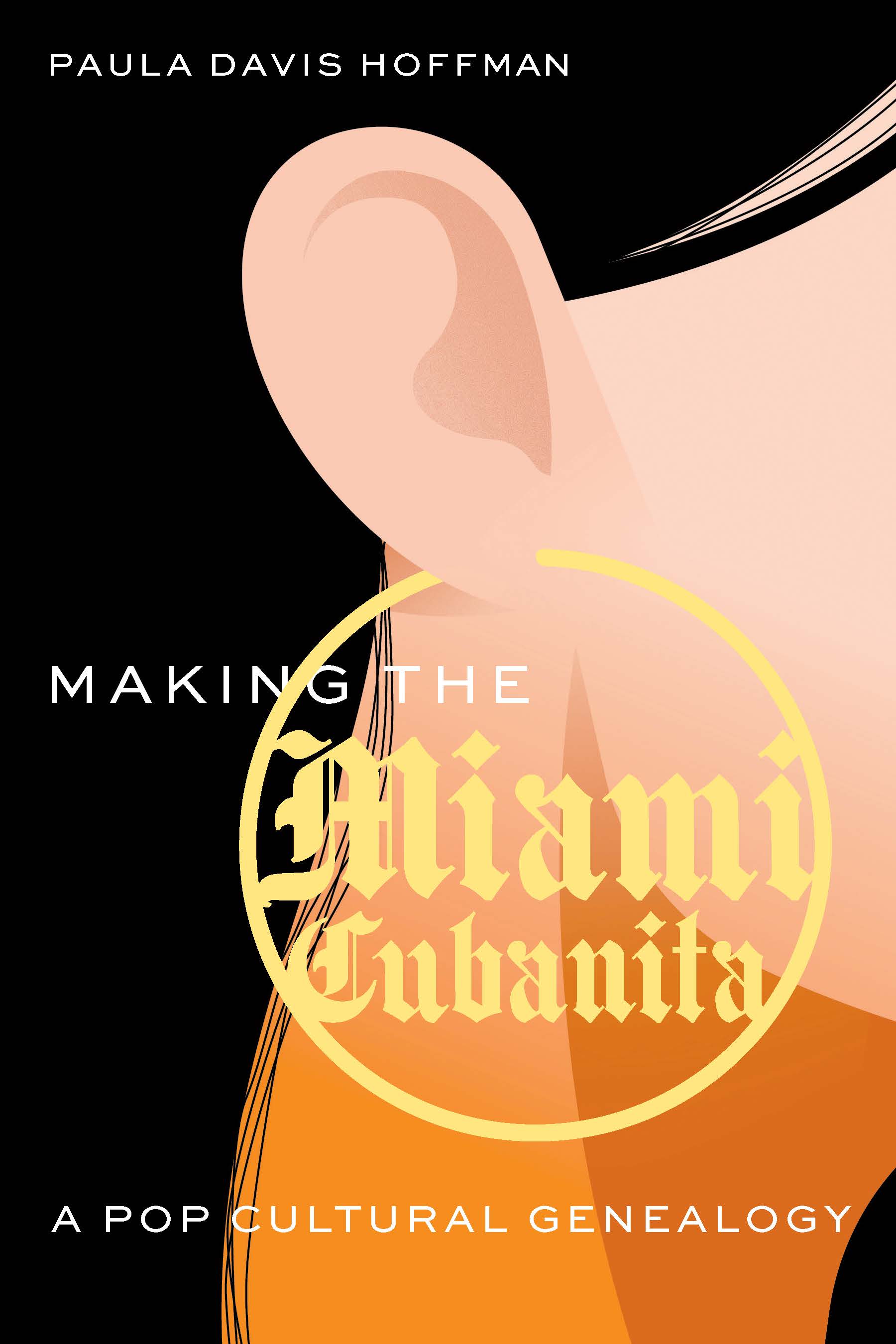
Paula Davis Hoffman is an adjunct professor of history at Houston City College. Her new book Making the Miami Cubanita: A Pop Cultural Genealogy (Nebraska, 2026) was published this month.
At the end of the nineteenth century, William Randolph Hearst’s New York Journal glorified cubanas as “the most feminine and simple women in the world.” Ever since, the stereotype of Cuban femininity as chaste and dutiful has informed Cubans’ racial, social, and ethnic identity in the dominant American imagination, and this gendered and deracialized narrative has taken different forms and served various purposes throughout the Cuban diaspora.
In Making the Miami Cubanita Paula Davis Hoffman examines the cultural precepts and political aims underlying the construction of Cuban femininity in pop culture outlets produced by, for, and about Cuban Americans of the Cuban diaspora. By incorporating academic texts, oral interviews, and elements of popular culture as well as personal accounts of growing up in a first-wave Cuban exile family, Hoffman discusses the historical forces that molded vacillating constructions of Miami Cuban women.
In the Beginning, Hearst Created Cubanas
The Cuban women are the most feminine and simple women in the world. They are almost childish in their love for prettiness and charm. They adore their children and worship their husbands. But their gentleness has turned to bitterness in many of their hearts through the sorrows that have been inflicted upon them.
—Kate Masterson for the New York Journal, 1896
In March 1896 an American journalist named Kate Masterson landed an unusual assignment. Her boss, the owner of the New York Journal, was William Randolph Hearst, a legendary figure hungry for sensationalized details of Cuba’s protracted struggle for independence against Spain. His paper captivated readers with stories written similar to the era’s popular adventure and romance novels, replete with exaggerated—and sometimes fabricated—accounts of danger and bravery. Intent on bolstering Hearst’s mission to valorize Cuban insurgents, Masterson disguised herself as the wife of a prisoner held in a Spanish jail and published a “romantic history of women’s part in the war from Spain” written “with a woman’s sympathy.”
Masterson’s article was an attempt to reconcile predominant American media portrayals of cubanas as docile with Spanish reports of their ferocity in battle. “The Spanish authorities, with their usual cheap acuteness,” Masterson charged, “have endeavored to make capital from the fact that there are women in the field with the Cuban army, and have spread the report that they are ‘Amazons,’ describing them as rough, masculine creatures, devoid of gentleness and modesty.” This, she emphasized, was a lie. They fought because Spanish barbarism had compelled them to fight. They were not, Journal readers were assured, “advanced in the modern women sense.”
Masterson was. Fearless and outspoken, she later traveled back to the island to confront the Spanish governor in Cuba with charges that he treated Cuban women and children unmercifully. Asking to visit battlefields and explaining that she was “willing to take all the danger, if [his] Excellency would allow,” she brushed off his thinly veiled warnings that the Spanish soldiers “are of a very affectionate disposition.” Gen. Valeriano Weyler, “the man most abhorred in all the world by the women of Cuba,” invited her to stay for dinner or breakfast. “‘You must not think it odd that I should invite you,’” she quoted him as saying. “‘I know that American ladies can dine or breakfast with a gentleman without remark.’” Evidently not as vulnerable as the Cuban women she was there to defend, Masterson “assured the general that [she] should be very much honored to accept his kind hospitality.” Her story included descriptions of his “big, brass bed canopied in fine lace” and luxurious marble shower bath.
Readers concerned about a decline in traditional values among American women were captivated by stories that presented Cuba’s fight for independence in language reminiscent of the time’s popular dime novels. Military intervention presented an opportunity to protect Cuban damsels in distress, who were repeatedly described in the American press in ways similar to this excerpt from a popular 1896 book: “The Cuban woman . . . is a chaste spouse and a slave to duty The noble Cuban girl [on the battlefield] remained as pure and unsullied as the painted Virgin immortalized by Murillo.” The New York Tribune joined in this glorification of cubanas. “The ‘New Woman’ is altogether unknown in Havana,” it reported. “There is not even a woman’s club there.” Bombarding the public with idealized gender portrayals disposed white Americans toward intervention on behalf of mixed-race Cuban insurgents against whiter Spaniards. Negative racial stereotypes were over-shadowed by coverage of the Cubans’ chivalric standards.
An apocryphal story holds that at the beginning of the insurrection, a Journal correspondent in Havana cabled that there was no war to cover, and Hearst replied, “You furnish the pictures, and I will furnish the war.” Whether this exchange occurred as reported or not, it is indisputable that Hearst and rival editors hoped to win a newspaper circulation war by starting an international one. Their principal artillery was lurid stories of helpless cubanas, and this made for dramatic and profitable copy.
On February 12, 1897, the front page of the New York Journal alerted its readers: “Refined Young Women Stripped and Searched by Brutal Spaniards While under Our Flag.” An accompanying illustration featured the back of a beautiful nude cubana surrounded by menacing Spanish soldiers. Later that year the Journal published an even bigger bombshell in a torrent of stories and a book-length account of an innocent señorita from a prominent family who had been arrested for fending off a Spanish colonel who had found her “alone and defenceless.” Seventeen-year-old Evangelina Cosio y Cisneros had been thrown into a cell full of prostitutes and would soon be sent to a penal colony in Morocco. “No woman prisoner has ever been sent to this African hell,” they reported. The intensely readable saga was intended to spark the demand for military intervention to rescue “a beautiful maiden, risking all for her country, captured, insulted, persecuted, and cast into a loathsome dungeon. None could be more innocent, constant, and adorable than she. . . . All is right and lovable on the one side, all ugly and hateful on the other.”
This sold papers and inflamed passions, as did the many subsequent Journal accounts covering her imprisonment while highlighting her idealized femininity. The Journal boosted its circulation even further by instigating a women’s letter-writing campaign to demand her release. Author Julia Ward Howe wrote directly to Pope Leo XIII, asking, “How can we think of this pure flower of maidenhood condemned to live with felons and outcasts, without succor, without protection?” Jefferson Davis’s widow appealed to Her Royal Highness Maria Christina, queen regent of Spain.
The letter-writing campaign failed; the Spanish refused to free their captive. Hearst got creative and launched a daring rescue plot that would earn the newspaper adulation from a nation at the edge of its seat. Journal reporter Karl Decker was dispatched to Morocco, tasked with breaking Cisneros out of jail. As he sawed through the prison bars to lay a plank between her cell and an adjacent house, Decker was troubled by a persistent worry: What if he risked his life leading her to safety, and it turned out she wasn’t pretty? What if she did not “come up to the fairy-tale standard”? He needn’t have worried. “No fairy princess could be more lovely than this fairy-like little Cuban maiden,” he assured readers. The country breathed a sigh of relief.
“Voices of the People Raised in Praise of the Cisneros Rescue,” screamed the Journal’s headline of October 17, 1897, above a collage of emotional responses. One typical letter to the editor included emphasized text: “The rescue was a very noteworthy and courageous piece of work. It reminds one of the chivalry of the knights of old, who rescued fair damsels in distress.” The American public viewed Spanish authorities as monstrous rapists, Cuban women as venerated models of femininity in need of protection, and Cuba itself as a fair maiden desperate to be saved by gallant American heroes.
Americans took to the streets, marching and praying and donating money to the Cuban cause. Republicans and Democrats expressed support for Cuban freedom. Both houses of Congress rumbled with outrage. When Congress finally declared war on Spain in 1896, the New York Journal bragged, “How Do You Like the Journal’s War?” It launched celebratory rockets from the building’s roof.
 UNP blog