
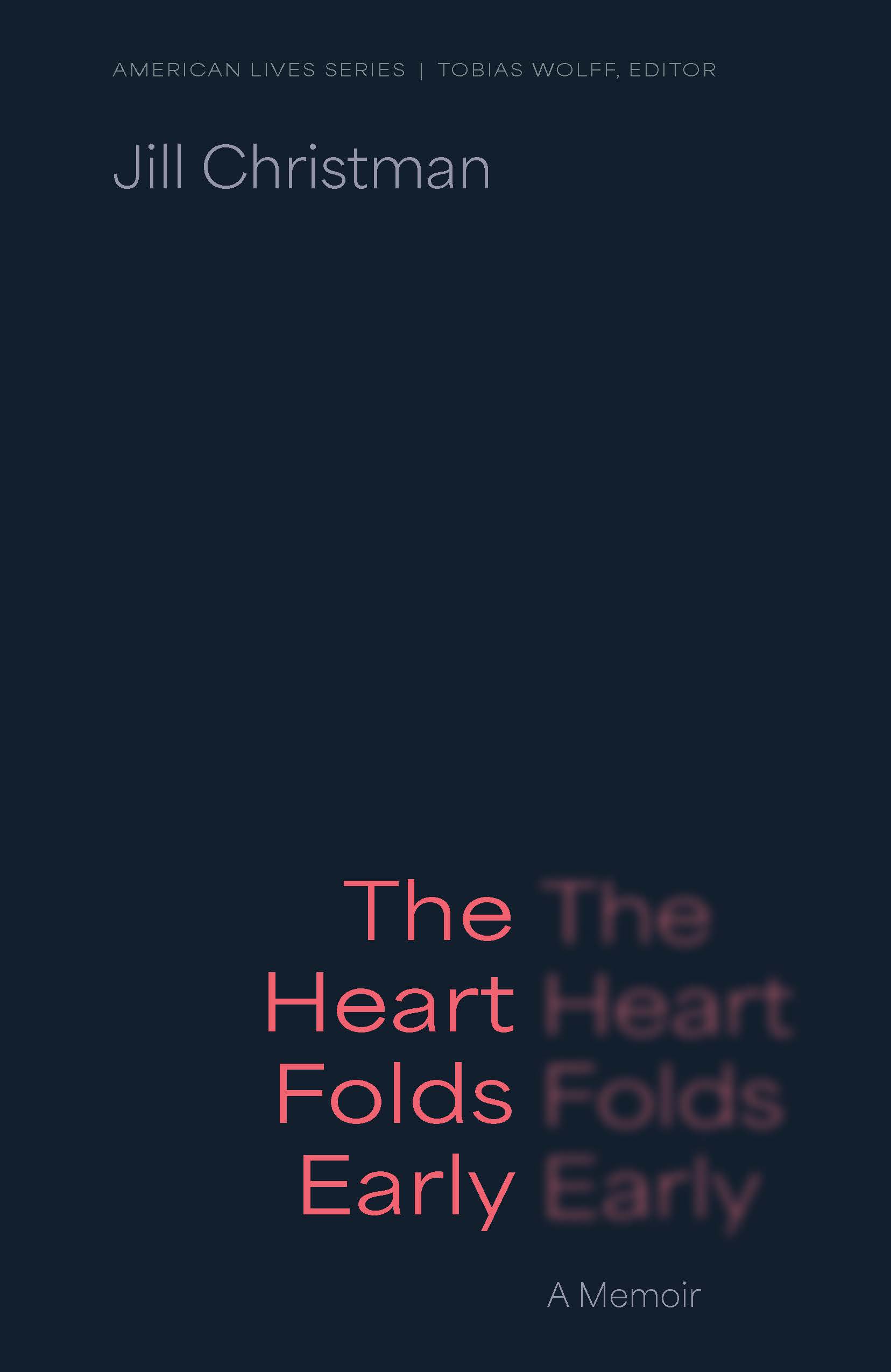
Jill Christman is the author of If This Were Fiction: A Love Story in Essays (Nebraska, 2022), Darkroom: A Family Exposure, and Borrowed Babies: Apprenticing for Motherhood. She is a professor in the Creative Writing Program at Ball State University, where she serves as editor of River Teeth: A Journal of Nonfiction Narrative and Beautiful Things. Her new book The Heart Folds Early: A Memoir (Nebraska, 2026) was published this month.
This book is about what it means to make a choice. As mothers, how do we carry life and death in our bodies and survive with our hearts intact?
The Heart Folds Early is a story of transformation through tragedy, and an examination of the way in which great loss can make us simultaneously fearful and intrepid. Emerging from a childhood that included both devastating sexual abuse and the sustaining joy of being deeply (if imperfectly) loved, Jill Christman’s sights were set on building and protecting her own happy family—until her fiancé was killed in a car accident.
Christman folds the mournful recklessness of the young widow she was against the backdrop of her later marriage and new motherhood, including the choice to end a half-term pregnancy when a routine ultrasound revealed her baby boy had just half a heart. Courageous, clear-eyed, tender, and unexpectedly funny, Christman’s book reflects on her life and asks: What happens when we’re afraid the worst thing will happen and then, sometimes, it does? What does it mean to make and live with a heartrending choice? How do we carry life and death in our bodies and survive with our hearts intact?
Sweet Home Alabama
Before we lost the baby—correction: before we chose to end my pregnancy and let our broken-hearted baby die—Colin’s accident was the grief story at the center of my life on this planet, almost burning me to ashes as he had been burned. Like all stories of grief, this one began with love. One year after we met, Colin dropped to his knee in the sand and asked me to marry him. I can still see his face looking up at me: earnest and in love, but also mischievous, sparkling, confident, pretty sure he had this locked in. There were drops of water in his dark hair catching the last of the day’s soft light. Mist. On the Oregon coast, there is always mist. I said yes, and then, less than a month after Colin’s proposal, the phone rang in the house we shared with his sister. Again, a lifetime later, if I listen, I can hear the phone, the scream, the sound coming out of the dark with the news that Colin was dead.
I know this is how accidents happen: suddenly, randomly, crushingly. In the slow months after Colin’s death, my heart took in this knowledge like a sea change. I could love a breathing someone, and then, like that, he could be gone.
This understanding felt like a rearranging of my cells, a restructuring of molecular code, a rewiring of my brain. There are some people who never leave us. One way or another, we carry them with us, and—if we can, if we choose—we keep going.
After Colin died, what were my choices? On the most basic level, keep living or die, so once I decided against dying—and that took a while—I was in for this life on earth, but this wasn’t a one-time choice and there were many choices nested inside. I could have stopped loving and letting myself be loved. I could have given up on figuring out what I wanted to do. Despite what I had lost, because of what I’d lost, I wanted love and I wanted purpose—which has always felt like some combination of paying attention, staying curious, and attempting to make sense of it all—but I needed a plan. I needed a way through my grief to the other side, and I was tired. So tired. For years, every day felt like reaching my hand down into the writhing nest as a new baby snake punctured the soft egg with its needle tooth, emerging whole but tiny, a new life sliding through my fingers like water, a fresh serpent to be reckoned with. Hello, grief, what do you have for me today?
Follow me through time, space, and choices of every description to eight years post-accident, eight years of Colin dead, thousands of miles away from that misty Oregon coast, way down in Ala-bama now, where I first ignored the bad advice of the classmate in my mfa program who slapped down the first chapter of the true thing I was writing (I didn’t know to call the thing a memoir then), sneered across the seminar table at me, and said, “Who do you think you are? Frank Zappa’s daughter?”
“Moon Unit? No, asshole, I think I’m Frank friggin’ Zappa.”
Okay, so I said nothing. I stayed silent because, because, because those were the rules—of both survival and workshop.
But I found the anger I needed to shake him off. The haters gonna hate—and thus it has always been. I chose, instead, to hear my teacher who shared a smoke with me outside the flapping doors of the English Department building when the class was over. Keep writing, Jilly.
Keep writing, Jilly.
You never know in this world when someone’s going to come along and save your life, or how they’re going to accomplish the job of pulling you up just when you think you’re going down for the last time. This teacher was one of those people at one of those moments. I didn’t know what I was doing, but the pages stacked up on the corner of my ravaged desk—stories about abuse (and art), accidental death (and love), eating disorders (and survival). Somewhere in the last months of writing this first book, I figured out the question I hadn’t even known I was asking: In a crazy, dangerous world where wars are fought, and children are neglected and starving, in a world where six-year-olds are raped and dogs are abandoned in paper bags, in a world where beloved young men ignite on highways and beautiful young women want so desperately to take up less space in a world that has handled them so roughly that they stick their fingers down their throats to purge out all that is wrong and bad—in a world like this, can I really have a baby?
This was a complicated question. Heeding Rilke’s advice to his young poet, I surrendered my need for order and answers and tried to love the questions themselves. Three hundred pages later, I was nowhere near my answer, but I was beginning to understand my questions. Really? After this? And knowing this? But considering this?
Can I really have a baby?
 UNP blog