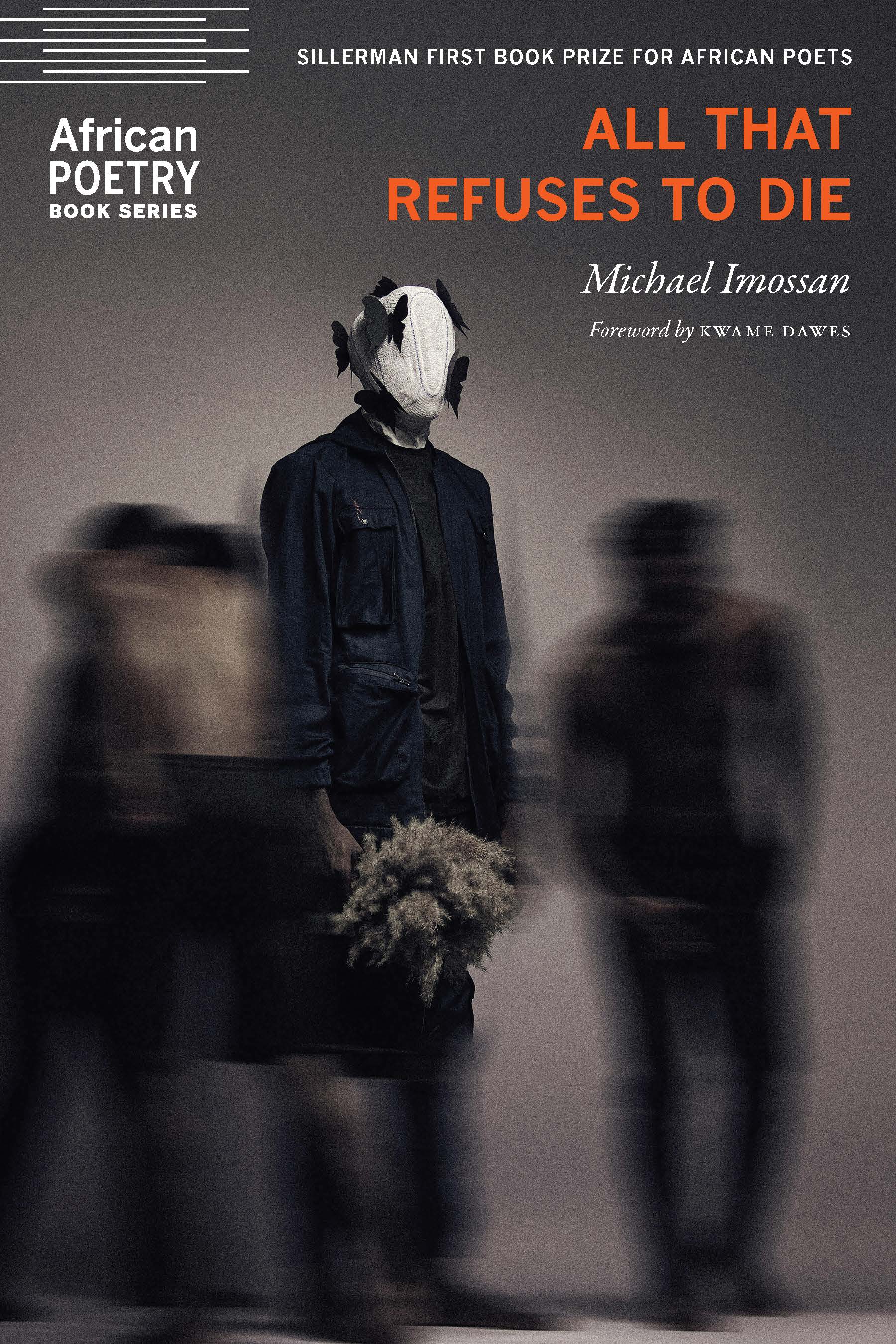
Michael Imossan is a Nigerian poet of Ibibio origin. He is curator of the poetry column for Nigerian NewsDirect, poetry editor for the Chestnut Review, and the author of the award-winning chapbook For the Love of Country and Memory. Imossan’s second chapbook, The Smell of Absence, was selected for inclusion in Kumi Na Moja: New-Generation African Poets: A Chapbook Box Set. He is a recipient of a PEN International writers’ grant. His new book, All that Refuses to Die (Nebraska, 2026), is the winner of the Sillerman First Book Prize for African Poets and was published in March.
All that Refuses to Die is a poetry collection that interrogates the present conditions of Africans through a historical lens. Michael Imossan moves into historical spaces such as museums and sites of enslavement, touching artifacts that hold meaning, and asking, Where was Africa? Where is Africa now? And what has changed? The Biafran War that claimed three million lives, though declared over, still has its lingering effect on Nigeria and Nigerians. Congo, though free of King Leopold and the exploitation of cotton, is still not free of other kinds of exploitation, nor is Uganda. Though the slave trade has ended, African bodies are still found in the Sahara Desert and in the Atlantic Ocean.
All that Refuses to Die is a collection that brims with stories and memories that evoke as well as provoke. As he moves through historical places, the poet compares the past with the present and finds that nothing has really changed.
Stories that I Must Open
Fatima, I see how you touch
the night as though it has stolen something
from you. I have been there once, felt it pull
something from the crevices of my joints
when, at the checkpoint, the police officer kept
searching my pocket as if I hid a country in it,
an AK-47 over his shoulder, swinging back and forth.
At the airport, the immigration
officer waltzed inside my kaftan to see if
somehow there was 9/11 embroidered on it.
Happiness is a door that opens into sorrow.
Even the smile that tiptoed the edge of my lips
was a man stranded at the border of a strange town.
I called the stars a map, a road
and the sky was set on fire.
Whatever joy morning promised is a poem left unfinished;
the sun beaming on a small village in Plateau where the
charred bones of burnt girls becoming one with the sand
have also become stories that I must open.
Naming
Smoking a cigarette and reading
a book of poetry, everything
suddenly becomes slow and meaningful.
The fly buzzing around
a felled tree is not just flapping its
wings in quest for wonder. It is writing
its wish on the broken hands of nature.
The truck and its load are pleading
for the tarmac to help carry their burden.
The earth in its silent vibrations
carries stories beneath its breast;
skulls with axe serrations that could be
translated into hieroglyphs and Nsibidi.
We who are still here must name all these
things. To the fly buzzing around, I
call it miracle. To the truck and its load,
I call them conversation. To the skulls and
their serrations, I call them civilization. Listen
to me, everything will pass away, even
the sacredness of worship. But naming will
stand as testament to a man who, seeing
the namelessness of a thing, called it into beauty.
 UNP blog