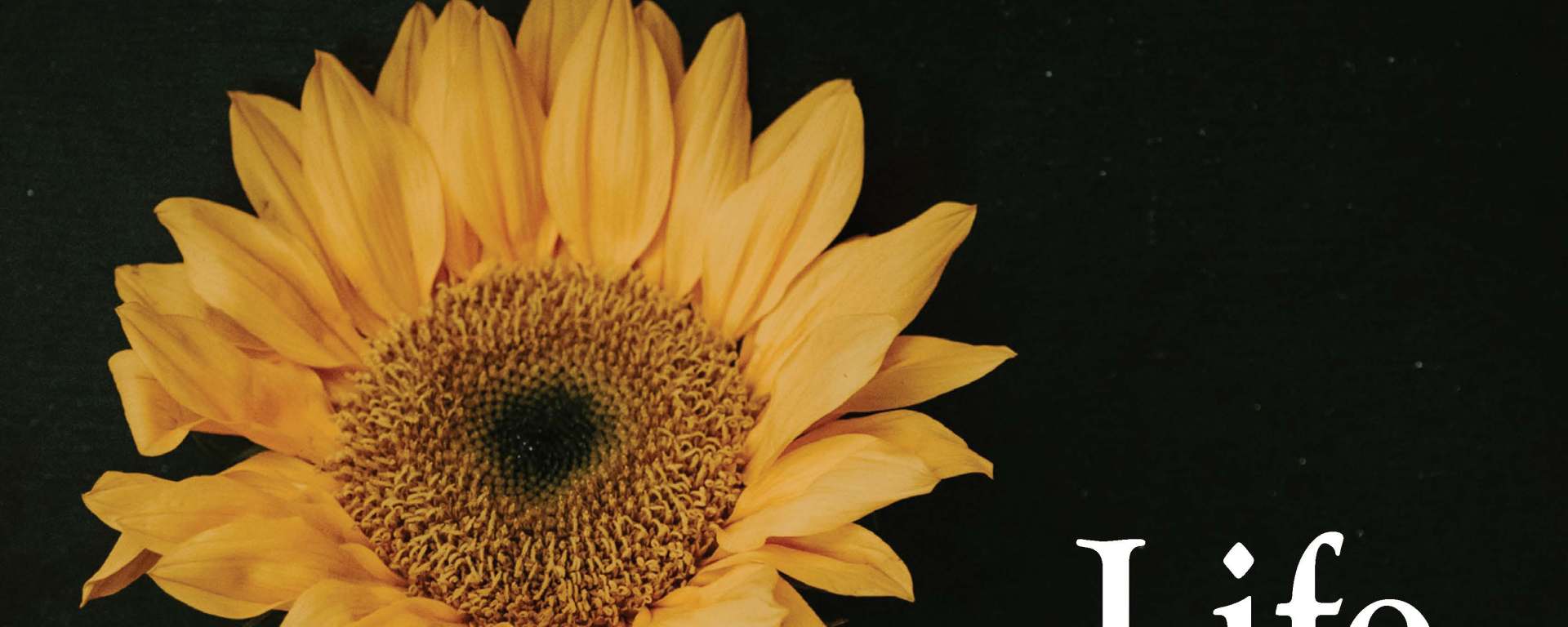
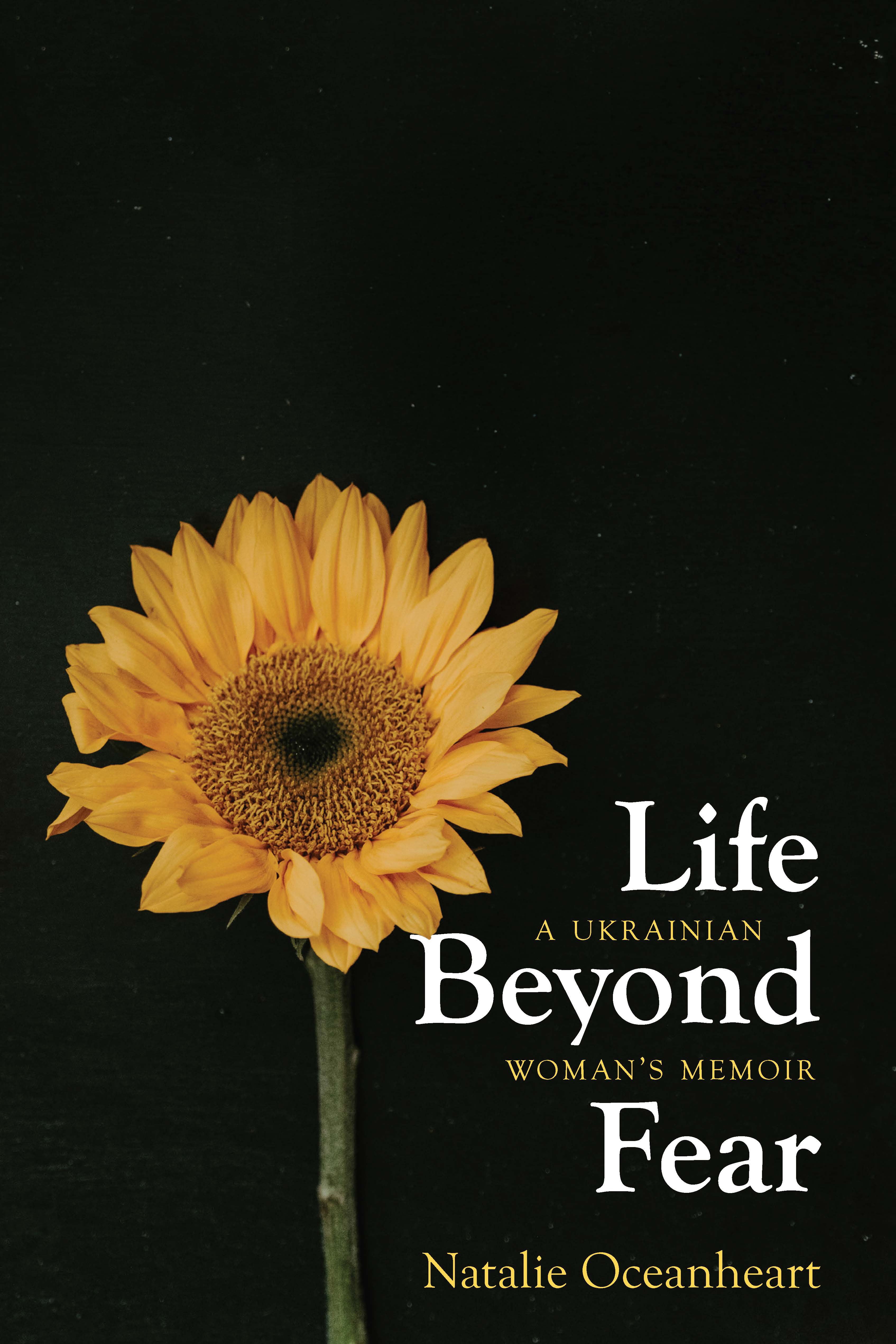
Natalie Oceanheart is a trained psychologist and volunteer counselor. She immigrated to the United States in 2023 after the second Russian invasion of Ukraine. She has been awarded for her volunteer services and leadership by the Red Cross. Her new book Life Beyond Fear: A Ukrainian Woman’s Memoir (Potomac Books, 2026) was published in March.
Life Beyond Fear chronicles the harrowing journey of a Ukrainian woman and her family, forced to flee their war-torn homeland in search of safety, hope, and a new beginning. When Russia invaded Ukraine in 2022, life as Natalie Oceanheart’s family knew it crumbled overnight. Oceanheart woke up her two small children to explain that their city was under attack, moved her elderly parents to safety, and ultimately moved her family to the United States. Yet the war had been shadowing their lives since 2014, with Russia’s first invasion.
Through raw and honest storytelling, Oceanheart traces her family’s path from the bombed streets of Ukraine to the uncertain crossroads of Europe, and finally to the United States, where they navigated an unfamiliar culture and rebuilt their lives as immigrants while carrying the invisible weight of trauma and loss. Oceanheart captures not only the horrors of war but also the small moments of humanity that shine through in the darkest times—the kindness of strangers, the strength of family, and the enduring hope for peace.
Life Beyond Fear is more than a personal story: It is a testament to the resilience of families displaced by war, the complexities of immigration, and the universal human quest for safety, belonging, and freedom.
Awakening to War
Thursday, 5 a.m., February 24, 2022. I am jolted awake by unsettling noises that terrify me, though I can’t quite place them. There’s something deadly about these sounds, a deep, instinctually felt warning that something significant is unfolding. The pale morning light spills through the balcony door, casting a grim glow on my husband’s face, marked by fear and horror—a reflection of my own dread. Explosions chill the blood; their reality is undeniable and horrifying. As we lie in bed, our silent glances acknowledge the unknown trials ahead.
Our thoughts turn to our children, our two daughters aged ten and four, still asleep and dreaming of rainbows and unicorns, blissfully unaware of the stark reality intruding upon their dreams. The scene feels eerily reminiscent of Valentin Papko’s chilling painting “Not Even Dreamed. June 22, 1941,” which depicts the surreal calm before the storm of World War II. I never imagined facing a similar terror, a terror unfolding in the very heart of Ukraine, in the city of Dnipro. A terror that swept across the entire country that morning.
I feel helpless in the face of this looming danger, an ancient fear I can’t protect them from. History, once confined to the pages of books or museum walls, is now painfully present, repeating in a way I could never have imagined, touching ordinary families like ours.
In a protective instinct, I wish to gather my children into our bed, to hold them close despite not understanding the full scope of what’s happening. My husband, Artur, attempting to preserve their peace for a little longer, pleads with me not to wake them. So, I lie down with our younger daughter, Dasha, holding her tight, while he does the same with her sister, Masha. We hold each other as the sounds of chaos eventually fade, but my mind races, trying to piece together the surreal events unfolding outside our home.
About an hour later, I rise to drink some water and, through the kitchen window, I witness a mass exodus. People are hastily packing their cars, an unmistakable sign of a dire situation. My mind races, overwhelmed by the sudden and surreal shift in our world. The silence in our home contrasts with the growing chaos outside, and I feel both an urge to act and a sense of disbelief, as if this can’t possibly be real.
A call to my mother confirms my worst fears—she answers in tears, revealing that a war has started. The notion seems absurd, unimaginable in the twenty-first century, and my mind rebels against reality. War feels like a relic of history or a plot in a movie, not something that could invade our lives today.
And here I am again, grappling with this haunting thought. Just recently, I watched Downton Abbey, where the main character, Lady Mary Crawley, reacts with disbelief and indignation at the onset of war. How could such a thing happen in the early twentieth century? This same terrifying question weighs on me in the twenty-first century, and suddenly I realize how deeply I empathize with my beloved character. A wave of sincere compassion envelops me—I can feel her despair, the foreboding sense of horror that lies ahead. I know what awaits her: War, from which she cannot escape. This inevitable nightmare engulfs me, forcing me to recall the hopelessness Lady Mary once faced when confronted with the horrors of the First World War. The same darkness and despair wash over me again, making me ponder the grim parallels between our fates.
As the shock begins to settle, the grim reality sets in—we must face whatever comes. There’s no hiding from it, and no running away. I stare out the window again at the half-empty parking lot, seeing the stark evidence of people fleeing. We need to comprehend, explain to our children, and adapt, making decisions moment by moment in a newly uncertain world. Thank God for the internet, which allows us to quickly learn from social media and news outlets that war has indeed broken out. The headlines confirm my fears, but seeing the unfolding situation online pushes me into action. No longer just a tragic story far away, this is now personal. I realize we need to prepare, to secure what we can before supplies run out.
Russia has attacked us. Our city’s airport, near where we live, along with all major airports in the country, has been targeted and bombed. Panic is palpable as people clog the roads attempting to escape, while others rush to stores, stockpiling essentials. My husband headed to an ATM, foreseeing the imminent necessity of cash over credit, but found the machines empty, the queues long and fraught with desperation.
It was a Friday morning—a day that was supposed to unfold like any other. Masha was meant to be getting ready for school. But that day, what was meant to be ordinary morphed into a nightmare. I chose not to send her to school. The parents’ chat group was a flurry of confusion, everyone seeking guidance on what steps to take next. Eventually, the school communicated through the teacher that classes were canceled, a small relief amid escalating fears.
Artur, a software developer, worked from home, a blessing under these circumstances. The nursery Dasha attended also canceled its sessions. At that time, my role was managing our home. So, here we were, the four of us, confined to our modest two-bedroom apartment—not due to a pandemic this time, but to a war.
 UNP blog