Krissed Off: The Searchability fetish

In 2006 a colleague at a leading university press told me “searchability is a fad.” His comment has been on my mind ever since. Much of the discussion about electronic publishing, at least in scholarly circles, cycles back to searchability – the idea that our books will be more useful if readers can immediately home in on key words or phrases, either within a book or across many books. I spend a good part of my day with a search engine, so it’s not like I’m opposed to searching and searchability altogether. I’m not against electronic publishing either, although I’ve long … Continue reading Krissed Off: The Searchability fetish

From the desk of Nicole Tonkovich

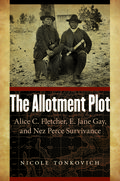
TonkovichNicole Tonkovich is the author of newly released, The Allotment Plot: Alice C. Fletcher, E. Jane Gay, and Nez Perce Survivance. Tonkovich recently began a blog where she will transcribe field diaries kept by Alice Fletcher during
her allotment work. Click here for the first entry. Below she discusses how she discovered her book's topic. 

I became aware of E. Jane Gay and Alice C. Fletcher while
watching Ken Burns’s PBS series The West.
I was immediately intrigued–both by the clarity and beauty of Gay’s
photographs and by the fact that these two women were well into their middle
age when they went West, where Fletcher supervised the allotment of lands to
the Nez Perce Indians from 1889 to 1892.

As I delved into the story I was initially attracted to Gay’s
work. In addition to her photographs, she documented the pair’s adventures in a
series of witty and sometimes-acerbic columns published in reform periodicals
of the era. What she was telling the readers of these newspapers differed in
detail and in intent from the reports her friend Fletcher was sending to the
Indian Bureau. Somewhat reluctantly, I began to read Fletcher’s records, as
well. She was in many ways Gay’s opposite: where Gay was acerbic and witty,
Fletcher was earnest and hectoring. Gay had a lively sense of irony; Fletcher
lacked that sense entirely. Yet together they were part of the conception and
administration of a major federal program that impacted not only the Nez Perces
but nearly every Indian tribe in the nation, decimating their lands and
endeavoring to erase tribal identities altogether.

Continue reading “From the desk of Nicole Tonkovich”

Why University Presses Matter

As a part of the University Press Week blog tour, UNP's Bison Book manager, Tom Swanson, explains why university presses matter to their region. The tour continues today at Syracuse University Press. A complete blog tour schedule is also available here. The University Press is a haven for those authors and books that may be lost in the world of big house publishing.  It’s not that the big houses ignore our region, it’s more a matter of we know what we want and we need outlets to provide it. The University of Nebraska Press came to the idea that while they are … Continue reading Why University Presses Matter

From the desk of Jason C. Anthony

AnthonyJason C. Anthony is the author of Hoosh: Roast Penguin, Scurvy Day, and Other Stories of Antarctic Cuisine, which is now available.

Writing
Hoosh, my first book, was a new way
to articulate my affection for Antarctica, an otherworldly place I called home
for several years. Like so many travelers to the polar regions, I found that the
experience of that strange, vast icescape, under an often ethereal light and marked
by traces of an astonishing history, changed me forever. Between 1994 and 2004,
I returned and returned to Antarctica to enjoy the hell out of a job that took
me by plane to the South Pole, across McMurdo Sound in an icebreaker, or into
small tent camps at –35°F in the middle of the polar ice cap. I’ve written
about Antarctica for years, publishing nearly two dozen essays and articles
about the place (many available to read at Albedo Images). 

Writing
Hoosh has been a real joy because it
allowed me to step away from my usual descriptions of landscape and experience
and instead focus on the history of Antarctic exploration and settlement. More
specifically, it allowed me to have some fun exploring the idea of food as a
window onto Antarctic history and culture. Writing about Antarctic cuisine is an
ideal way to measure the tenous relationship Antarcticans have had with their
lifeless home over the last century. It provided great opportunities to sketch many
of the great characters in Antarctic history – the well-known expedition
leaders, their little-known cooks, and other expedition members – and to
highlight the various writers – known and unknown, historical and contemporary
– who have told such great stories about dining at the bottom of the Earth.

Continue reading “From the desk of Jason C. Anthony”

Krissed Off: Spot the dissertation

Can you guess which of the following award-winning, widely reviewed books from the past couple of years originated as a dissertation? Bethany Moreton, To Serve God and Wal-Mart Pekka Hamalainen, Comanche Empire Brian DeLay, War of a Thousand Deserts Aaron Sachs, The Humboldt Current Danielle McGuire, At the Dark End of the Street Sarah Igo, The Averaged American It’s a trick question; they all did. First books – often dissertations revised with the help of editors and peer reviewers – are among the most important scholarship published by university presses. The best revised dissertations are field-defining buzz books that generate … Continue reading Krissed Off: Spot the dissertation

The Director Dish: From the playbook to print

The Nebraska-Northwestern game on
Saturday was a thriller. Except for the Huskers themselves, I don’t think
anyone cared more about a Nebraska win than I. After all, I spent nearly ten
years at Northwestern University Press and last year, hosted three of my former
colleagues at Memorial Stadium, only to see the Wildcats beat us. This year, I
opted to stay home rather than fly to Evanston for the game. I was certain we’d
beat them—but boy was my resolve tested! Alas, the team came through for me.

Those of you who know our Press
know we publish a wide range of sports history, from golf to running to
hiking to professional and collegiate sports such as baseball, basketball, and
football. In fact, we are becoming so well known for our sports books that we
received a surprise visit from Orlando Magic senior VP Pat Williams yesterday.
He was in town for a speech but wanted to stop by and meet the folks at UNP
because he loves our books. We loved meeting him. Thanks, Pat!

Sadly, though, it doesn’t take
someone who follows college or pro sports to know the troubles that have beset
individuals and teams in a culture singularly dedicated to winning. In a book
we published in 2010, Scoreboard, Baby,
Ken Armstrong and Nick Perry go behind the scenes of the University of
Washington’s 2000 football season to uncover a tale of corruption, complicity,
and crime. Buzz Bissinger said it was “the most harrowing book I have ever read
about college sports.” Of course, there are even more harrowing tales about
college football these days—we read about them in the paper every day, it
seems. But college football doesn’t have a monopoly on these tales.

Continue reading “The Director Dish: From the playbook to print”

Hometown: Petaluma, CA

Bluegrass BaseballBelow is a guest blog from Katya Cengel, author of Bluegrass Baseball. She writes about one of her "many" hometowns and what it did for its little league team that made it to the World Series.

One of the good
things about having moved around a lot in my formative years is that I can
claim many places as my “hometown”. 
Petaluma, California is one of them. My first newspaper internship was
in Petaluma and this summer around the same time my first book was released the
city sent their first little league team to the World Series.

The timing
couldn’t have been better.

Continue reading “Hometown: Petaluma, CA”

From the desk of Katya Cengel


Bluegrass BaseballKayta Cengel is the author of
Bluegrass
Baseball, which describes a year in the life
of four minor league baseball teams in Kentucky that tell a larger story about
the culture atmosphere of today's minor leagues. Below
she describes meeting her youngest fan.

Although Bluegrass Baseball is an
adult book, it is about baseball, so I figured I would have some young baseball
playing fans. But I wasn’t quite prepared for the ones I came across while on
tour in Kentucky. Most of them were middle school age boys who hoped one day to
be playing in the minor leagues, like the subjects of Bluegrass Baseball. In
Louisville a ten-year-old with a shy smile thanked me personally for signing
the book his father had bought him. Then he bashfully asked if he could take a
picture with me. A few minutes later he returned with a baseball he wanted me
to sign. Watching him inspect his ball as he walked away is a memory I will not
soon forget. But it was another young Kentucky fan that stole my heart.

Continue reading “From the desk of Katya Cengel”

From the desk of Nancy Plain


Light on the PrairieBelow is a guest blog from Nancy Plain. Her new book,
Light on the Prairie, is the biography and photographic works of Solomon D. Butcher. Here, we get an inside peek as to why she chose Solomon as her newest book subject.  

I can’t remember when I first saw a photograph by Solomon Butcher.  But around the time I was searching for a new book project, I found myself scrolling through his remarkable photos on the “Prairie Settlement” website of the Library of Congress.  I was hooked.  They look straight at the camera, Solomon’s pioneers, and they stand up straight amidst their families and possessions, against a background of infinite prairie.  If you peer really closely, you can find little secrets in the pictures—a shy child peeking out from a window, a dog half hidden in a shadowed doorway.  During the course of my research, I learned about individual sodbusters.  One of my favorite photographs is that of the four beautiful Chrisman sisters, known by their nicknames—Hattie, Lizzie, Lutie, and Babe.  Babe didn’t like how she looked in the photo, though.  She thought it made her look like a “horse thief!”

Continue reading “From the desk of Nancy Plain”

From the desk of Kate Buford

Native American SonKate Buford is the author of Native American Son. In light of the Olympics beginning tomorrow, she writes of an Olympic past legend, Jim Thorpe, and today's Olympic excitement.

As the world gears up for Opening Day of the XXX Olympiad, media outlets are pumping out new alarming stories of security snafus in London along with the usual poignant tales of athletes’ life obstacles overcome.

The hype and frenzy are taken for granted now, but when did they begin? When did the world first realize the potential thrill the Games dangle in front of us every four years? That an athlete will come out of nowhere and astonish us with feats of bodily skill we have never seen before.

Though the first Games of the modern Olympic movement were held in 1896 in Athens, it wasn’t until the Fifth Olympiad in Stockholm in 1912 that one athlete – Jim Thorpe – created the model of the Olympic super-star. First he won the classic five-event track and field pentathlon by a huge margin – and then he did the same thing in the new ten-event decathlon.

Continue reading “From the desk of Kate Buford”