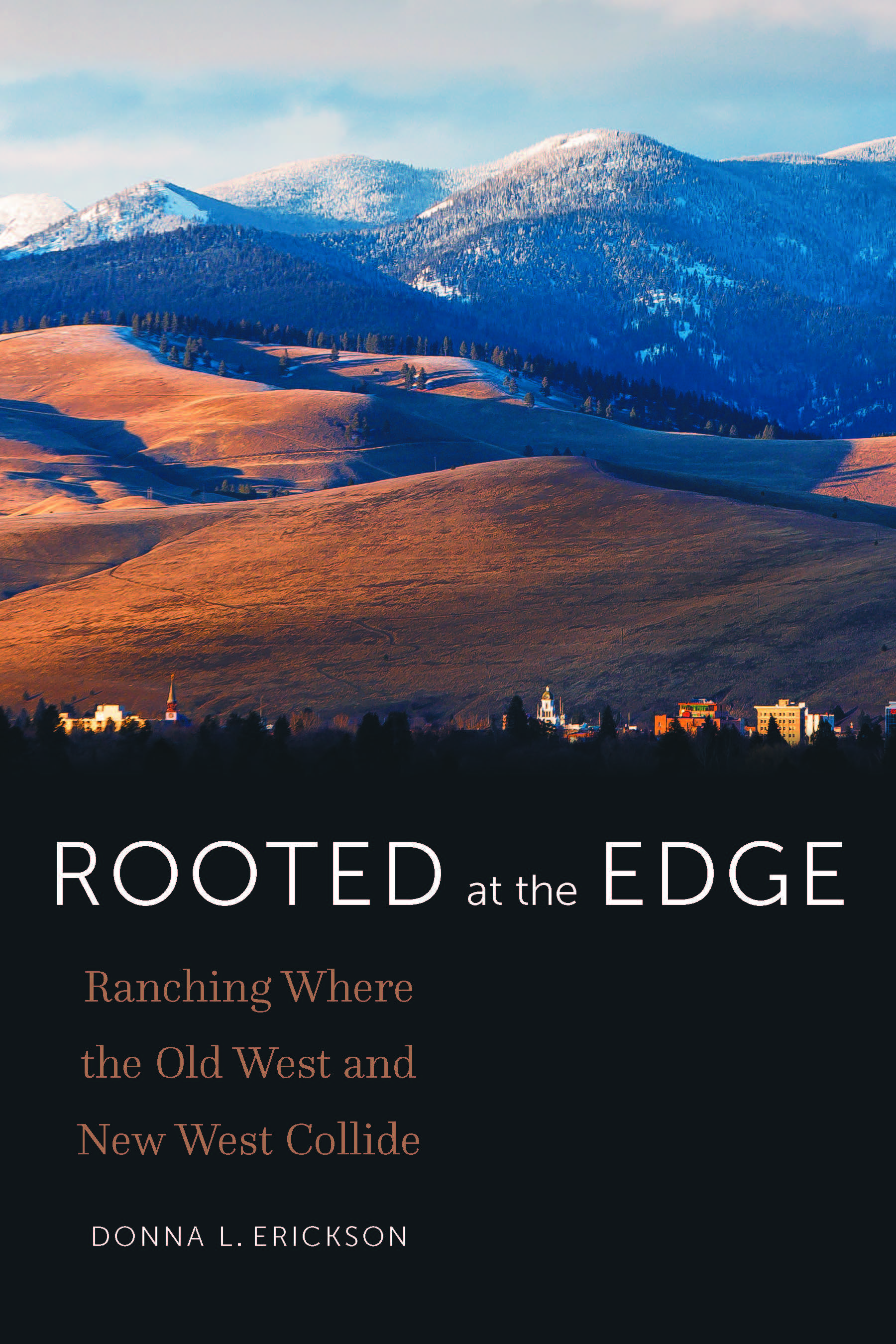
Book Birthdays celebrate one year of a book’s life in social media posts, reviews, and more. This month we’re saying Happy First Book Birthday to Rooted at the Edge: Ranching Where the Old West and New West Collide (Bison Books, 2025) by Donna L. Erickson.
About the Book:
Rooted at the Edge paints a portrait of a ranching community in a threatened landscape steeped in history, conflict, and beauty. In this narrative nonfiction work, Donna L. Erickson explores the hilly skirt of ground at the northern boundary of Missoula, Montana, separating the town from the wilderness beyond. The North Hills region represents the critical—and often highly personal—issues at play at the edge of many western towns.
The urban-rural fringe is both valuable and vulnerable. Across the West rural lifestyles are increasingly compromised by suburbanization, economic hardship, and family dynamics; a way of life and a way of work are vanishing. Ranchland may be simultaneously cherished by a family for the life its members have made there and coveted by urban neighbors for open space. Community residents may love a place for its scenery and wildlife habitat while others wish it converted to a commercial parking lot. Complex ecological relationships can be bulldozed in a single afternoon. And the threats of climate change and shifting populations compromise the edge even more.
In the tension between love and loss, Erickson wrote this story of a landscape’s soft contours, piney ridges, shady draws, and grassy slopes, and its potential disappearance under an expanding city. Rooted at the Edge conveys, in a way that statistics cannot, what’s at stake when ranches at the urban fringe are threatened.
A Word from the Author:
My year getting Rooted at the Edge into the world feels like the ludicrous to the marvelous.
It is twenty minutes before my book event is to start at the Big Sky, Montana public library on the last day of July, 2025. The sky blackens and ping pong ball-sized hail pounds from the sky. The wind throws the white balls sideways into my windshield, and by the time I arrive at the library, hail is replaced by an epic rain and windstorm. The librarian and I prepare the reading; she has a plate of cookies. Nobody else is in the building. The lights flicker in the library common room: it is dark outside at 5pm. It is still storming as I leave the library an hour later; not a soul has braved the weather to hear about my book.
At an event two weeks earlier, the scene could not be different. Our local land trust is hosting a reading and dinner in the open-sided hay barn of a South Hills ranch overlooking the Missoula valley. Two hundred people show up, find a seat, and join the food line! It is a gorgeous summer day. Although there is a breeze, it’s just enough to ruffle the tablecloths and annoy the caterer. A podcaster is interviewing three authors about their 2025 nonfiction books; all three books address changing western landscapes. This is the best view of the North Hills across the valley—the land my book explores. The podcaster moderates a lively Q & A period, and the audience speaks up with excellent comments and questions. Two hours in, people are still mingling, talking, and buying books from a local book store’s table, where the three of us station ourselves to sign books.
I attended 32 book events in 2025; almost all were prosaic compared with the two described above. Most venues brought out 20-50 people to hear a reading and discuss themes from my book. It has been a true joy to speak with dozens of engaged readers and to meet brilliant bookstore owners, librarians, and fellow authors. I put thousands of miles on my car, driving around Montana and into Washington and Idaho. Even traveling to Big Sky, I saw magnificent scenery and I know the librarian will encourage readers to pick up my book.
Awards
Spur Award finalist in the Best Western Contemporary Nonfiction category
Longlisted for the Reading the West Award in Nonfiction
Reviews:
“The relationship at the border of city and country continues to evolve. Erickson’s vision for the future is one grounded in cooperation and mutual respect.”—Amy Roach, Montana Quarterly
“With sensitivity and insight, she captures what’s at stake when open land is lost, offering a heartfelt narrative that underscores the human and ecological consequences of unchecked development.”—Montana State of the Arts Quarterly
“Invitingly written, the book adds to Montana’s rich literary tradition of historically meaningful memoirs.”—Charles E. Rankin, Roundup Magazine
“A very thoughtful reflection on today’s West.”—Stuart Rosebrook, True West Magazine
“In the end the book is a plea to remember what is at stake when the urban/country fringe—and the rancher who lives and works there—are under dire threat. Thankfully, the book ends on an almost hopeful note, and the reader concludes that all is not yet lost.”—Distinctly Montana
In the Media:
Butte-Silver Bow Public Archive
Rockin’ R: A Tribute to Writing Groups

