
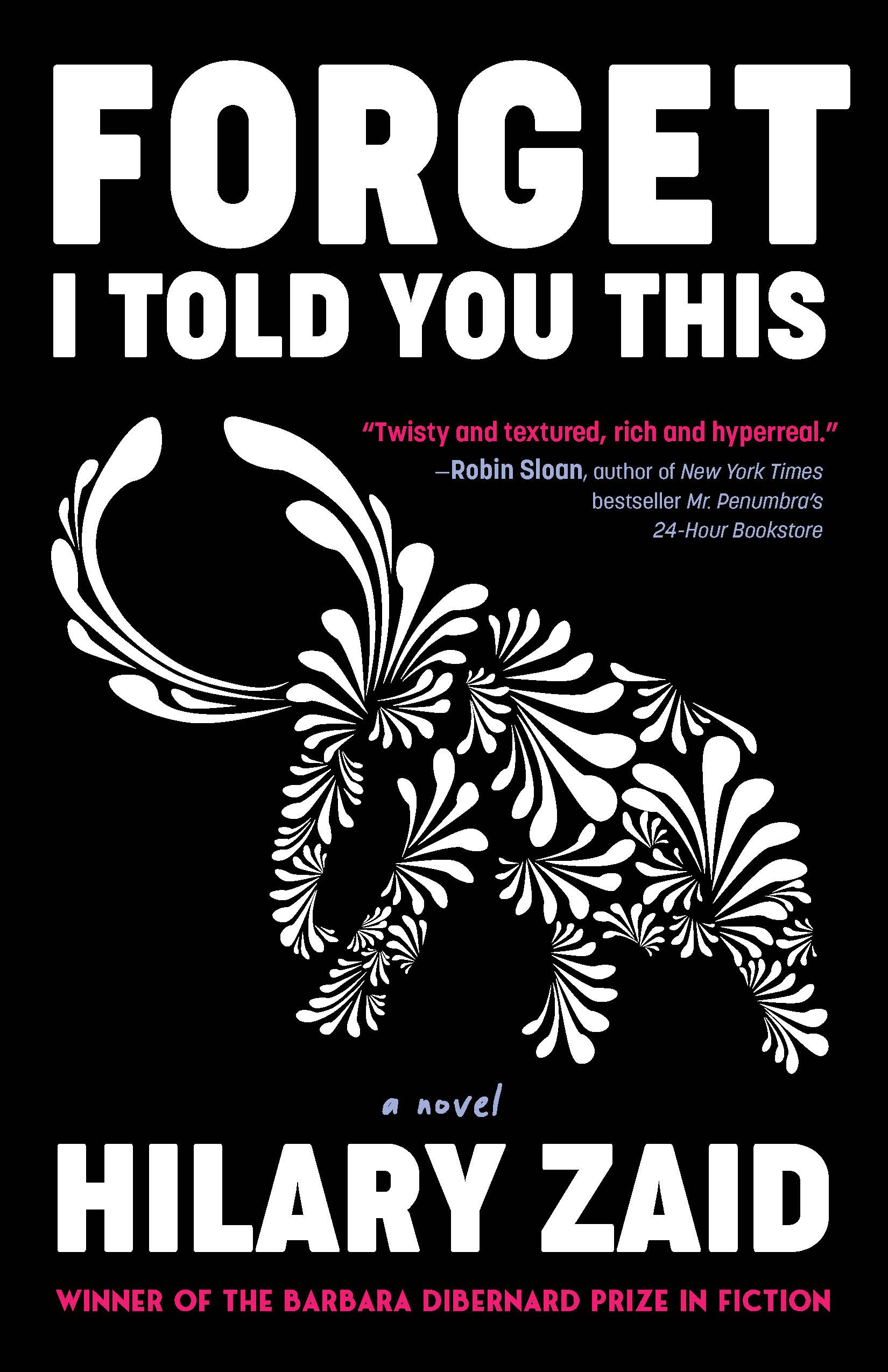
Book Birthdays celebrate one year of a book’s life in social media posts, reviews, and more. This month we’re saying Happy First Book Birthday to Forget I Told You This: A Novel (Nebraska, 2023) by Hilary Zaid.
About the Book:
Amy Black, a queer single mother and an aspiring artist in love with calligraphy, dreams of a coveted artist’s residency at the world’s largest social media company, Q. One ink-black October night, when the power is out in the hills of Oakland, California, a stranger asks Amy to transcribe a love letter for him. When the stranger suddenly disappears, Amy’s search for the letter’s recipient leads her straight to Q and the most beautiful illuminated manuscript she has ever seen, the Codex Argentus, hidden away in Q’s Library of Books That Don’t Exist—and to a group of data privacy vigilantes who want her to burn Q to the ground.
Amy’s curiosity becomes her salvation, as she’s drawn closer and closer to the secret societies and crackpot philosophers that haunt the city’s abandoned warehouses and defunct train depots. All of it leads to an opportunity of a lifetime: an artist’s residency deep in the holographic halls of Q headquarters. It’s a dream come true—so long as she follows Q’s rules.
A Word from the Author:
A year is an in-between increment for a novel that considers the place of art both in “long time” (eons) and against the constantly fleeting edge of the now. In Forget I Told You This, these are the two scales narrator Amy Black has to balance as she tries to navigate living as a book artist in the time of social media.
Writing this novel, I was intrigued by the juxtaposition between really ancient texts (like the historic Codex Argentus, a real-life, sixth-century illuminated manuscript scribed in silver ink on brilliant purple pages), and twenty-first-century media (like the sonification of climate change or the stripping of user data on social media platforms to make predictive portraits of who we are and will become). Over the past year, readers have taken both ends of the timeline as fantastical, however, almost none of the book (except for the characters and plot) is made up. The descriptions of surveillance capitalism and the world of Q, the book’s fictive social media giant, in particular, have been described as “speculative” or even “science fiction” when, in fact, these are well-established elements of our current reality.
Writing the current moment always means riding the knife’s edge between what is now, what is soon to be past, and what will be. Maybe, in that sense, contemporary fiction is always speculative. At least, that’s a topic I hope to discuss in November when I participate in the Ann Arbor Jewish Book Festival’s Zoom panel on New Works in Speculative Fiction, featuring myself, Benjamin Resnik, and Zachary C. Solomon.
It’s been a great year for Forget I Told You This, with events around the country, an audiobook release and, most recently, being short-listed for the Northern California Book Award. I look forward to seeing how much the future bears out the events imagined in the book, whether things will change radically, or whether what feels “speculative” today will eventually become more readily acknowledged as the way things are.
Reviews:
“Confronting timely questions such as how to preserve free will in a data-driven society while also telling a humane tale about rising above tragedy and disappointment, Forget I Told You This is a memorable novel—an adventure through words and emotions.” —Ho Lin, Foreword Reviews
“Call it what you will, this is a novel about art, about making it and sharing it, a love letter to art in a world that has forgotten how much we need it.”—Rachel Hall, Lilith Magazine
“I appreciate how Zaid—in addition to delivering a smart, surreal, and sexy thriller with a perfect ending—gets at the tensions between my generation’s love of things we can hold in our hands and the increasingly overwhelming universe of digital media, Big Data, consumer surveillance, and AI—wherein we are fed things more often than we discover them.” —Michael Mechanic, Mother Jones
“The book’s not about Torah, exactly—although Amy reflects that ‘on calfskin curled around two wooden rollers had been tattooed the history of the world’—but anyone who resonates to the sacredness of text and the fragility of memory will feel those ideas being delicately and elaborately explored.”—Amy E. Schwartz, moment
Interviews:
Barbara DiBernard Prize in Fiction Winner
 UNP blog