
Terrence C. Petty is a writer and retired journalist. He worked for the Associated Press for thirty-five years. Based in Bonn, Germany, from 1987 to 1997, he covered German and European affairs, the pro-democracy movement that toppled the Berlin Wall, the reunification of Germany, neo-Nazi violence, and the fiftieth-anniversary ceremonies at Dachau, Buchenwald, and other former concentration camps. From 1999 to 2017 he managed the AP’s news operation in Oregon. He is the author of Enemy of the People: The Munich Post and the Journalists Who Opposed Hitler. His latest book is Nazis at the Watercooler: War Criminals in Postwar German Government Agencies (Potomac Books, 2024).

Yet another book about Nazis. Just what the world needs, right?
When I did a search on Amazon for in-print books about Nazi Germany, Hitler and the Holocaust, I got the following hits:
Nazi Germany: 30,000
Hitler: 20,000
The Holocaust: 30,000
A lot of the books in those three categories are likely duplicate titles. Still, these are head-spinning numbers. And they are just English-language books. More than 26,000 German-language tomes have been published in the twenty-first century alone. The whole world is captivated, maybe obsessed is a better word, with a dictatorship that was vanquished nearly eighty years ago. I am among the obsessed, and thus my new book, Nazis At The Watercooler: War Criminals In Postwar German Government Agencies.
The German Interior Ministry said in a 2012 government response to a parliamentary query that “the National Socialist dictatorship is generally the best-researched period in twentieth-century history.”
While there may be some in the Stalin-Was-Just-As-Bad camp, there can be no denying that Adolf Hitler has become the metric by which the world measures the depth of depravity of budding and de facto authoritarians.
These are all well-established facts. And they raise the question: what is to be gained by dwelling on the Third Reich? What more can be said about it?
I was a Bonn-based correspondent for The Associated Press from 1987-97. My office was at Pressehaus I, within the government quarter. The Bundestag was just down the street. The Chancellor’s Office was two blocks away. Federal ministries were a few minutes’ walking distance. Pressehaus I was among several buildings that had been designated as office space for journalists, foreign and domestic, assigned to cover the goings-on in the federal capital. My tiny nook in Pressehaus I was part of a larger suite, shared with about a dozen colleagues who wrote for the AP’s German language service.

My German comrades and I were on somewhat different wavelengths. Each of them had a distinct beat to cover: the ministries of Interior, Defense, Justice, Foreign, Economics, etc. One day one of my German colleagues cornered me with this question: “Why do you Amis (Americans) write just about Nazis?” That was a little unfair. We didn’t write just about Nazis. We wrote about the German economy, culture, politics, and Germany’s place in European and international affairs. But my German colleague was right; nearly always in the background of my journalism—and that of all other foreign correspondents working in Germany—was the Third Reich. When I wrote a story about growing joblessness, for example, I explained that Germans are especially jumpy about this because soaring unemployment helped Hitler’s rise to power. During a national debate about reunited Germany taking on more responsibilities for global peacekeeping, I explained that hesitancy to do so sprang from Nazi Germany’s brutal occupation of foreign lands. During my first year in Germany, one of my editors jokingly told me: “Get Hitler in the lede and you’ll have the day’s top story.” This was not a particularly difficult thing to do.
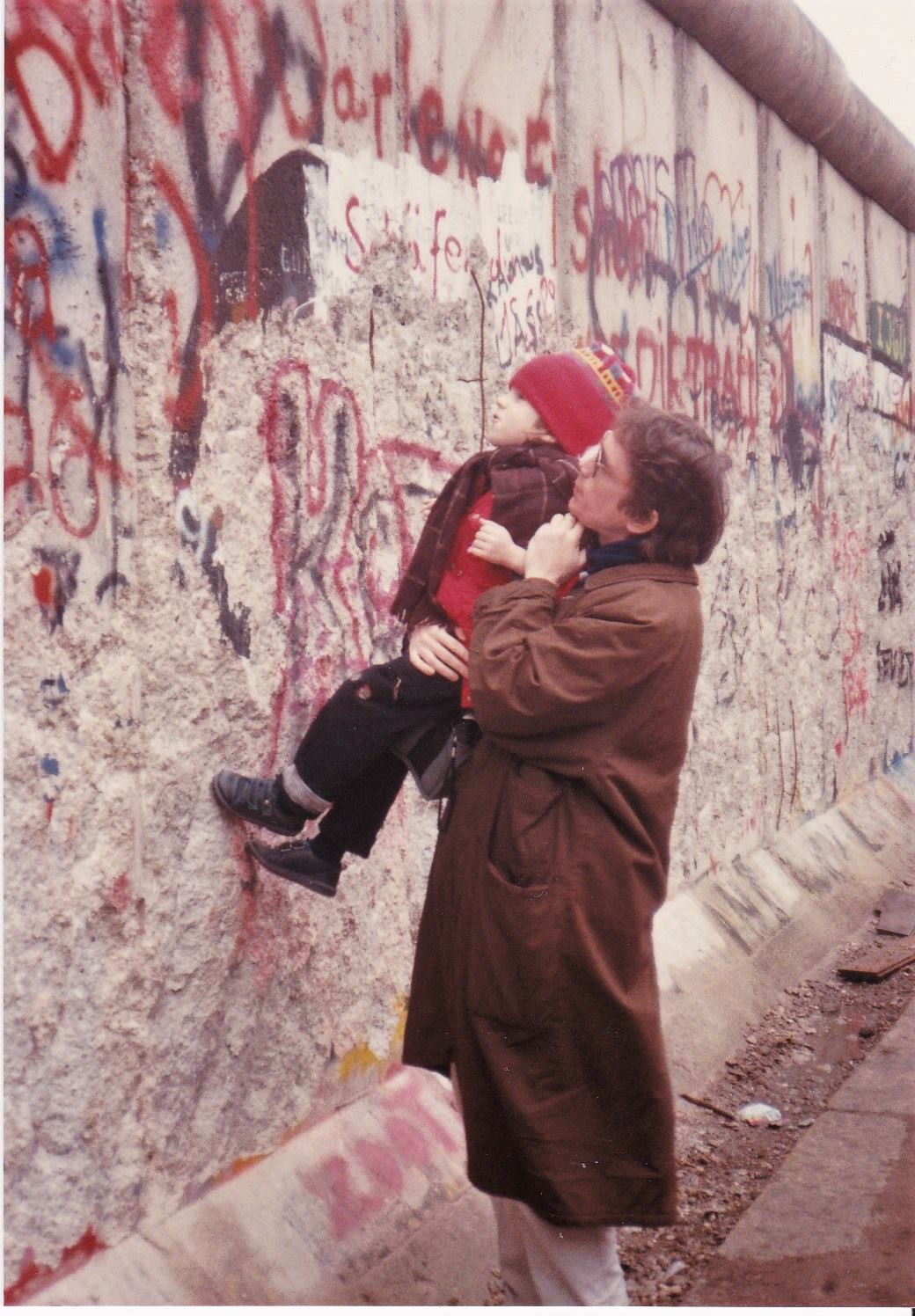
After the Berlin Wall came down, and after German reunification, it felt like Germany was about to step out of the shadows of the past—that the future would be about something other than looking back, as if Germany’s prolonged division had sealed in a spirit that was waiting to be liberated. But that’s not what happened.
On an afternoon in November 1992, in the city of Mölln, I gazed through the shattered window of a home that two days earlier had been firebombed by neo-Nazis, killing two little girls and their grandmother. Amid the scorched furniture was a doll. The toy had been somehow untouched by the flames. The attack was part of an explosion of radical-right crimes that began soon after German reunification in 1990 and has lasted to this day. By my count, somewhere around 60 people, most of them foreign-born, have died in the violence. Thousands more have been injured. Property damage would be incalculable.
After I returned to the states in 1997, I continued to keep an eye on Germany’s post-reunification development. In 2015 I noticed that German government agencies had been commissioning historians to examine old personnel files that for decades had been kept under lock and key. The purpose of the effort was to expose incriminated ex-Nazis who worked in government jobs during the Adenauer era. These self-examinations marked the first time that German government agencies had launched comprehensive inquiries into the Nazi taint within the postwar civil service. A few years before the German inquiries began, the CIA started releasing its files on Nazi war criminals. I began reading the CIA files and the published findings of historians who conducted the German inquiries. Using these two primary sources, along with interviews with historians and others, my book Nazis At The Watercooler exposes the networks of former Nazis who helped each other get postwar government jobs, documents their Third Reich misdeeds, describes the erasure of Hitler-era memories by a generation of Germans, and American complicity in protecting the secrets of civil servants with incriminating pasts.
It’s not just non-Germans who are obsessed with the Third Reich, as shown by the work of German historians who are continuing to sift through moldy documents, peeling away layers of obfuscation whose origins go back decades. And it’s not just German academicians who continue to dig into the dark past. German journalists, TV and movie studios, book authors and artists are also part of the pursuit.

In Günter Grass’s novel Crabwalk, the narrator says this:
“History, or, to be more precise, the history we Germans have repeatedly mucked up, is a clogged toilet. We flush and flush, but the shit keeps rising.”
 UNP blog
Excellent background essay on your book, Terry. I too got the same “Why do you just write …?” from Germans anxious to move on. Unfortunately, the more things change, etc. By extension, the events you recount are relevant in the U.S. now that an avowed authoritarian is running the federal government. It seems the lessons of German history were not learned, or not taken seriously, by too many Americans.
It is easy enough to understand the German fascination/introspection that leads them to return again and again to an analysis of the Third Reich. The wider, world-wide fascination is probably due to the enormity of the Second World War, the depravity of the Holocaust and the inexplicable fact that it occurred in a Germany -the Germany of Goethe, Schiller, Mann, Beethoven, etc.- that by all accounts should have been among the most cultured, educated countries in the world.Continuing to study Nazi Germany still offers insights into the dark side of humanity, still yields lessons we need to learn even in the present day.Thanks, Terry, for this background on your great book.
Mr. Petty, in your article in The Forward on Gleichschaltung you are spot on with the comparison of the rise, methods and aims of Hitler with those of #45 and #47. (I never use his name because that’s what he wants). He is That Name, and it would be nice if everyone started to refer to him as That Name. He doesn’t like it when people don’t use his name. Your article and books are chilling and I have forwarded the article to others. Thank you for speaking out when spineless cowards in government and elsewhere will not.