
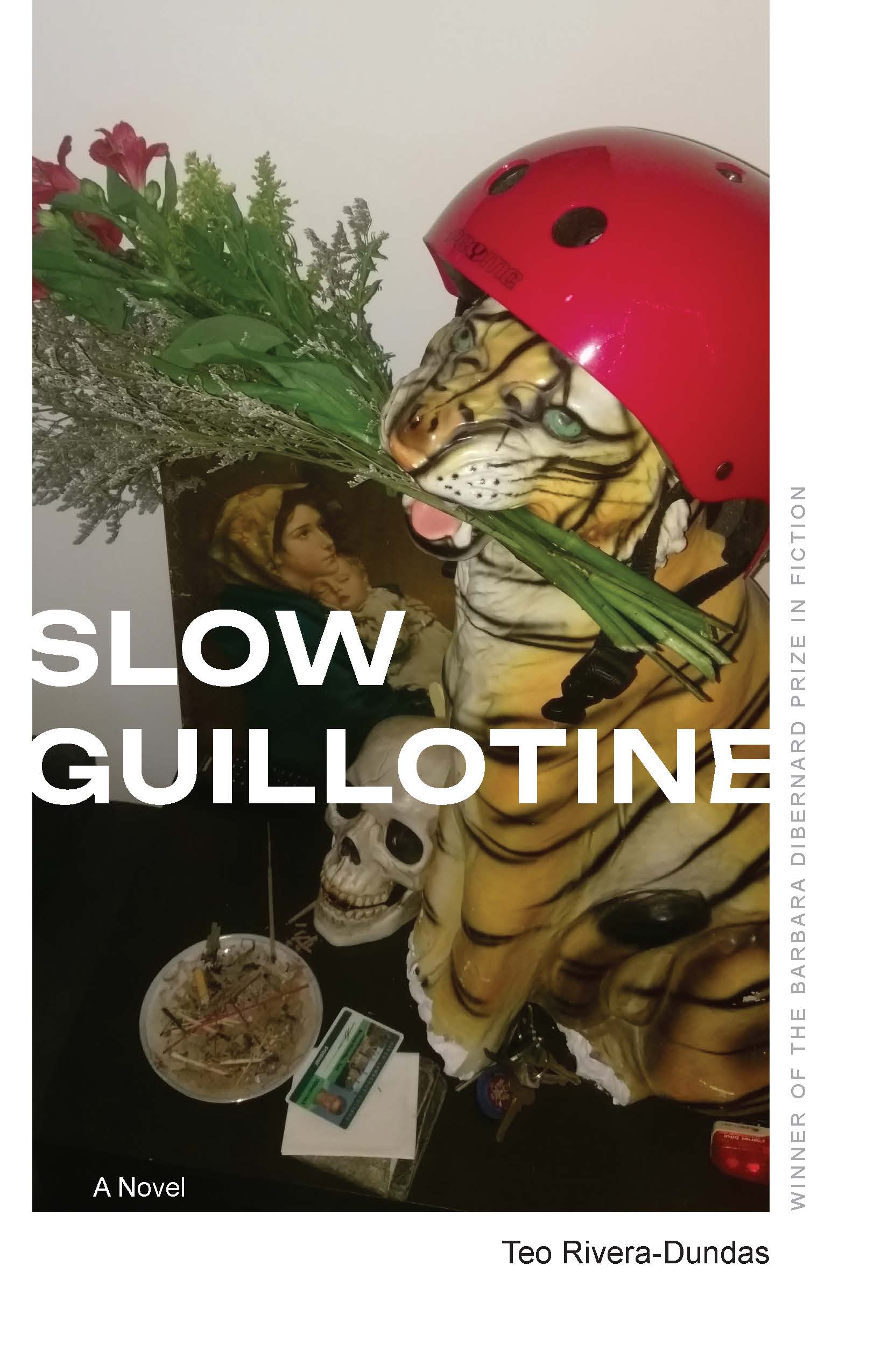
Teo Rivera-Dundas is a writer in western Massachusetts. His work has received support from the Wassaic Project, Anderson Center at Tower View, California Institute of the Arts, and the University of California, San Diego. His writing has appeared in Gulf Coast, Meridian, Tupelo Quarterly, and Desperate Literature’s annual Eleven Stories anthology, among other publications. His new book Slow Guillotine: A Novel (Nebraska, 2026) was published in March.
Slow Guillotine follows three broke weirdos whose collective desire to make and think about art is constantly interrupted by their art-industry-adjacent minimum-wage jobs. Throughout the novel, the three friends’ day jobs in a failing independent bookstore, a sterile gallery in downtown Manhattan, and miscellaneous living rooms across the Long Island birthday-party-clown circuit interweave with their attempts to come to terms with their precarity, gender-dysphoric embodiment, and the floating dream of collective liberation.
Spanning one year and told through an obsessive first-person present tense, Slow Guillotine brings the bildungsroman structure through the autofictional looking glass, questioning how “coming of age” could be feasible in a society of debtors, wage laborers, and renters.
In the Summer We Are Inside Preparing Food
Actually, I do think our building might turn the gas on soon. Precious and I have been fighting about this. He says no way. I think I’m right.
It’s not just the endless construction downstairs. There have been memos. Every few weeks, for the past maybe three months, Precious and I have woken up to another memo from the building management company taped to our front door, stating in massive Comic Sans that they’re aware of the issue and are closely tracking new developments, like it’s a court case or something. Maybe it’s the diligence of these memos that has me optimistic.
And then there’s the construction. Just this week, the stairwell one floor under ours got a fresh coat of beige paint, along with signs everywhere threatening WET PAIN in the big Comic Sans. And that’s just this week.
“I mean, if they weren’t working on it,” I call to Precious from the kitchen, biting into a bagel he made from scratch, “why take the time to write so many memos?” And why then tape each memo to the doors of every inhabited unit, six floors all the way up?
Yesterday Precious told me he saw a new memo, this one affixed to the building’s front door with some kind of official-seeming saran wrap tape. “From the city,” he said, and according to this latest memo the gas was turned off because its piping was never permitted in the first place, something about the amount of piping per square foot or the density of the pipes themselves, and that either way the city shut it off over a year ago, before we moved in. Precious told me this as though he was winning some argument.
The city’s memo was gone by the time I got home from the bookstore; I never saw it.
“And what about the construction?” I said. “They’re going crazy down there.”
He said the memo also mentioned something about how our landlords had failed to make payments to the city for several years, and there was a section about what we as tenants were entitled to given that the lack of gas wasn’t our fault, but he didn’t completely understand this part and forgot to take a picture of it, and anyway his hands were full of groceries.
“What do you think of the bagels,” says Precious now, wandering into the kitchen, chewing. “Kind of doughy?”
“The construction, though,” I say. “The memos.”
Final data point. Earlier today someone cut a hole in our hallway ceiling. I didn’t see it until Precious pointed it out, but then there it was: a body-sized, papered-over rectangle hovering directly above me. I could feel it in my butt.
“They came right after you left,” he said, “and worked for like five hours.”
“Doing the gas?”
“Maybe, I don’t know,” said Precious, “because look, they cut another hole in the kitchen.” He pawed for his phone and held it up to me, playing a blue video of a couple workers sawing into and then papering over our ceiling. “I think they have to give us at least a day’s warning.”
Back and forth, back and forth. “I like the bagels,” I say now.
“But you’re making rice.”
I am making rice. I measure a cup of rice to a cup and a half of water and pour both into a pot. The pot goes on the hot plate we found in the dumpsters behind our building. Only one of the hot plate’s burner coils works, and it’s small, and it takes much lo-ger than the stove to my immediate left would to cook anything, but it was free. Precious and I have outfitted our entire kitchen through dumpsters—the standard microwave, but also a toaster oven, an electric kettle, a plug-in panini press. People will throw away fully functional machines, I learn, or basically functional. It’s like a magic trick.
The water in the pot on the hot plate considers its composition but fails to boil. My dream is for someone in our neighborhood to throw out a rice cooker. Hopefully this happens soon.
Precious flings his big body onto our tiny couch. I hear the sound of fifteen-second videos.
Our kitchen window looks directly into our neighbor’s kitchen, which is probably twenty feet away but in a separate building from ours, a whole other microcosm. A long, buttery light fills this other kitchen, which seems to have been laid out as a mirror version of our own. There’s a black cat on the mirror stove, staring back at me, or staring into its own window reflection. Otherwise the room is empty. Precious and I have watched the person who lives in this apartment across the gap smoke on his fire escape, and we’ve heard him scream on the phone and listen to Radiohead at weird hours, and we’ve seen him walk naked through his kitchen a few times, but neither of us have ever seen him cook, not once.

