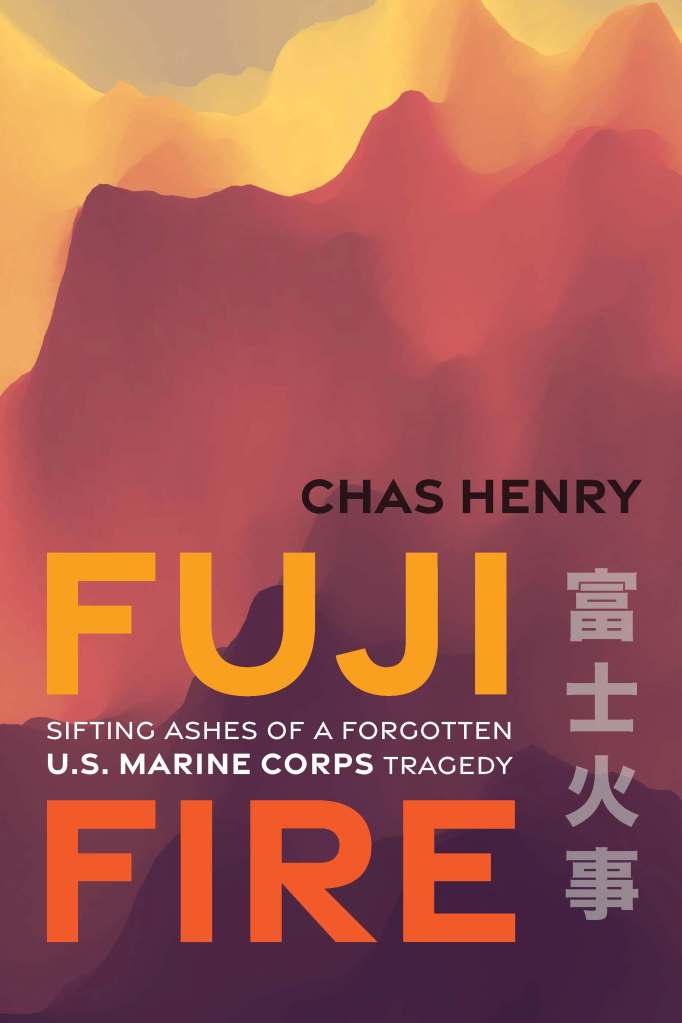
Book Birthdays celebrate one year of a book’s life in social media posts, reviews, and more. This month we’re saying Happy First Book Birthday to Fuji Fire: Sifting Ashes of a Forgotten U.S. Marine Corps Tragedy (Potomac Books, 2025) by Chas Henry.
About the Book:
On October 19, 1979, the largest, most intense tropical cyclone ever recorded propelled 5,500 gallons of gasoline into corrugated steel huts filled with U.S. Marines. The gas ignited, injuring seventy-three people, thirteen of them fatally. The Marine Corps commandant, a veteran of combat in World War II, Korea, and Vietnam, was stunned as he met scores of horribly burned survivors. “Having witnessed a lot of bad things, ugly things,” the general declared, “none can compare to that experience.” And yet this 1979 catastrophe on the slopes of Japan’s iconic Mount Fuji remains all but forgotten except by those directly affected.
Now, the fruits of Chas Henry’s exhaustive four-year, two-continent investigation provide insight into what many have called the U.S. Marine Corps’ worst-ever peacetime disaster. Fuji Fire shares the compelling and intimate stories of heartbreak and inspiration forged by these events while bringing to light new, critical analyses of the incident’s causes and effects.
A Word from the Author:
A year after the release of Fuji Fire, it is astounding to imagine that—had it not been for having too much time on my hands when COVID-19 led to work shutdowns—I might have missed out on what has become the most meaningful project of my professional life.
As life slowed during the pandemic, a chance social media exchange led me to begin online research into a little-recalled mass casualty incident: an October 1979 typhoon, fuel spill, and fire at a U. S. Marine Corps camp in Japan. It had left 73 injured, of whom 54 suffered burns and 13 died. Why did so few Americans remember? By the time COVID restrictions began to lift, I could not turn away from the topic. Over four years, I scoured every relevant archive in the U. S. and Japan—and interviewed 130 individuals directly impacted.
My thought was that I would be combining documents and recollections into a book for people completely unaware of the devastating events. While the book has served that purpose, I underestimated the value a detailed chronology would provide to men and women who had lived through the horror. Their experiences had been intense, it turned out—but quite narrow. In a pre-Internet era, few had been able to learn what had happened before or after their direct experience—or at sites beyond their personal horizon.
Another unforeseen reward has been the opportunity to reconnect people. Many were thrown together in the maelstrom of trauma, then immediately separated by circumstances of the crisis. Facilitating reunions of these individuals—most who had not spoken with each other for 40-plus years—has been gratifying in ways I could never have imagined. In one instance, I was able to arrange a Zoom chat between the worst-injured survivor of the fire and the former Army surgeon who saved his life.
Then there has been the good fortune of being able to help a number of Fuji Fire survivors secure fair disability benefits from the Department of Veterans Affairs. The fact that very few military histories mention the fire has created difficulty for some in validating what they experienced. The book has offered information useful to VA examiners; in addition, documents unearthed as I investigated the events have supported some Marines’ and Sailors’ claims.
As Fuji Fire enters its second year of release, I hope it will continue to spread understanding of what some 1,300 Americans endured at Camp Fuji; perhaps encourage U. S. military leaders to somehow acknowledge the tragedy in displays at the National Museum of the Marine Corps; and prompt conversations about lessons the disaster can teach us about safety, leadership, and accountability.
Reviews:
“Henry’s greatest service is returning these young men and their suffering to history, ensuring they are not forgotten. Yet, by vividly reconstructing the event, he inadvertently exposes the very institutional amnesia that buried it. The book becomes more than a record of a fire. Rather, it is a case study in the moral responsibility of command and the hidden dangers of peacetime service.”—Thomas C. Rust, H-Net Reviews
“A Marine public affairs officer and combat correspondent, Henry has carefully and diligently crafted a detailed chronology and nearly minute-by-minute account of the events that occurred on that fateful October day, and he painstakingly follows the subsequent days, months and years.”—Maj Fred C. Lash, Leatherneck
“Henry highlights acts of selflessness—Marines looking after fellow marines, and members of the public stepping up to help those in need.”—Bill Harlow, The Cipher Brief
“From a reporting standpoint, Fuji Fire is top-tier.”—Issac Cubillos, The Military Report
“As the Marine Corps celebrates the 250th anniversary of its founding this November, Fuji Fire stays faithful to the history. For its author, there could be no higher praise than semper fidelis.”—Jonathan Horn, The Washington Free Beacon
“The complexity of this story makes it exceedingly difficult to tell. Till now it has been little remembered and infrequently taught in our military academics. Mr. Henry’s scholarly rigor, knowledge of the military and storytelling skill may at last change that.”—James Webb, Wall Street Journal
“It’s compelling reading and fascinating storytelling by a man who understands both the action and emotions involved.”—Dale Dye, Warriors Publishing Group
“Fuji Fire is a first-class book about a little-known yet terrible event. It is also a heartwarming story of people coming together across cultures, nations, and institutions to help each other in a time of need.”—James Pekoll, Booklist
In the Media:
Disabled American Veterans Podcast

