
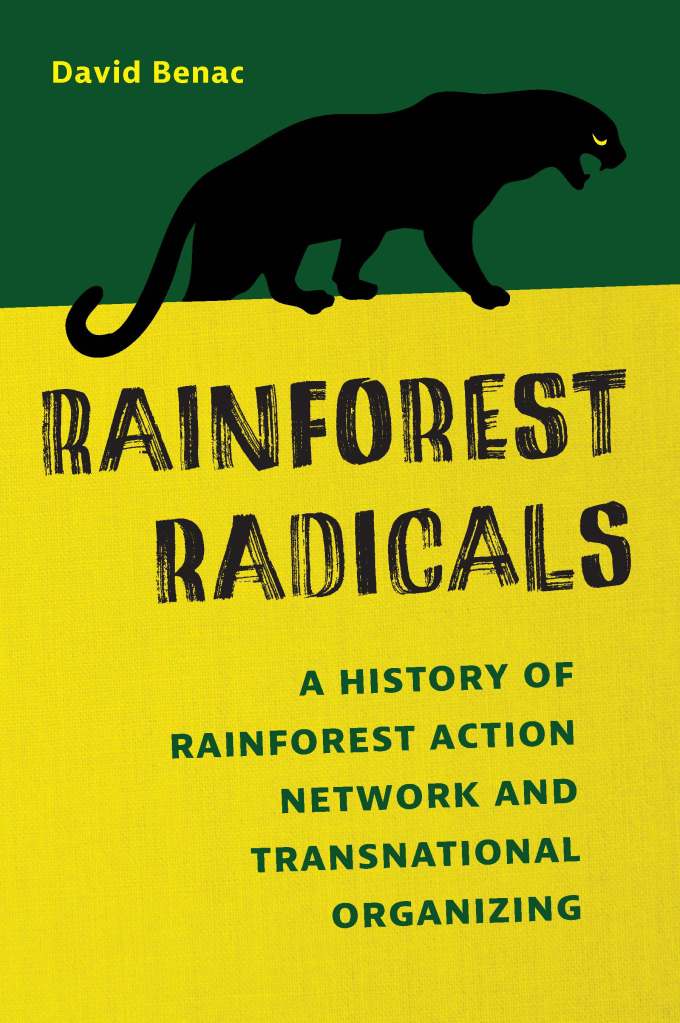
David Benac is Chair of the Department of History and associate professor at Western Michigan University. He is the author of Conflict in the Ozarks: Hill Folk, Industrialists, and Government in the Courtois Hills. His new book Rainforest Radicals: A History of Rainforest Action Network and Transnational Organizing (Nebraska, 2026) was published in June.
Why write a history of Rainforest Action Network? RAN had few staffers, operated with a small budget, eschewed satellite offices, had no privileged access to politicians, engaged an issue foreign to most Americans, and positioned themselves near the radical end of the environmental movement. Yet, there’s a strong case to argue that during its first two decades RAN put together one of the most successful records within the environmental movement.
Locating historical significance in success is an appealingly simple metric that leaves much to be desired. Equally, the underdog story is a powerful narrative that is not an ideal vehicle for deep analysis. At the risk of spawning controversy, an investigation of RAN’s first two decades reveals an entity that was unique and significant. RAN was truly grassroots, embraced civil disobedience (without property destruction), introduced the American public to rainforest conservation in tandem with Indigenous self-determination, identified systemic problems, and named the individual corporations, politicians, and institutions responsible. All of those attributes exist, to some degree, within the environmental movement of the early twenty-first century, but the combination was novel in the 1980s and early 1990s.
The roster of radical environmental organizations operating beyond local concerns was limited when RAN appeared in 1985. The only undeniably radical forces were Earth First! and Sea Shepherd Conservation Society. In some ways and in some cases, Greenpeace and Friends of the Earth waded into that territory. Only EF! was radical and grassroots. RAN emerged within an EF! campaign and the two organizations remained closely affiliated. The glaring distinction between the two was that RAN refused to take up EF!’s signature monkeywrenching.
The identification, by other environmental groups and the public, of RAN as occupying space near the radical fringe of the movement despite the lack of monkeywrenching encourages reflection on the meaning of the label. The result is the recognition of tactics and strategy as two nonexclusive paths to radicalism. EF!’s monkeywrenching and Sea Shepherd’s vigilantism are tactics that place the organizations inside any definition of radicalism. RAN’s use of lockdowns and other forms of nonviolent civil disobedience were on the radical side of the continuum, but well short of its furthest edge. The true radicalism of RAN was in its strategy. RAN sought nothing less than a revolution in the economic, political, and ethical systems of the entire planet. In RAN’s world, all humans would enjoy self-determination and freedom from want, but not at the expense of other humans or any other form of life. Greed would be replaced by respect. In a movement dominated by organizations that campaigned for mitigations that put corporate profit and the accumulation of wealth on par with or above ecological integrity and human dignity, RAN was radical.
For two decades, RAN maintained an international, distributed grassroots network that included some of the planet’s most passionate advocates for environmental protections and Indigenous self-determination. The distributed, grassroots structure of that network made RAN disproportionately powerful. With a peak of at least 250 Rainforest Action Groups operating at once, RAN could exert pressure on its opponents during coordinated days-of-action on a scale that made the issue appear to be a concern in every community in the nation. Most RAGs remained small, but the network was a prime example of the whole being greater than the sum of its parts.
Physicists label centrifugal force as fictitious, but organizers of leftist grassroots organizations beg to differ. Maintaining a coalition of radical leftists is somewhere between grasping a handful of PFAS-coated eels and getting a family to agree on pizza toppings. RAN’s ability to pull off this near-impossible organizational feat is worthy of study. The details matter, but the broad strokes are instructive. The network was built to inspire the formation of a community of purpose. Every RAG enjoyed the freedom to join the campaigns and employ the tactics that inspired its members. RAGs gathered annually in camping collectives to bond over food and camaraderie, debate tactics and campaigns, share lessons from past actions, and exert ownership over the future of the organization. The whole cohered around a vision shaped by co-founder Randy Hayes and his leadership team of direct action, radical demands, and the alignment of environmental with Indigenous rights causes.
The complexity and adaptability of that vision were some of the elements that made RAN’s early decades significant. The destruction of some of the planet’s most critical ecosystems, the inhumane treatment of Indigenous people, and the planetary scale of the corruption of governments and institutions by powerful multinational corporations were heavy topics that could easily produce rage or apathetic retreat. RAN kept RAGs motivated and the message accessible by emphasizing themes of good and evil and by imbuing actions with humor and creativity wherever possible. To challenge such large-scale bad actors and issues, RAN worked to bring every potential ally into the work and let them take credit beyond the scope of their contributions. The issue rather than the organization was the reason for RAN’s existence. RAN’s history shows the effectiveness of making global issues significant to the daily lives of individuals, the effectiveness of boycotts and civil disobedience, and that the productive space is at the edge of the envelope.

