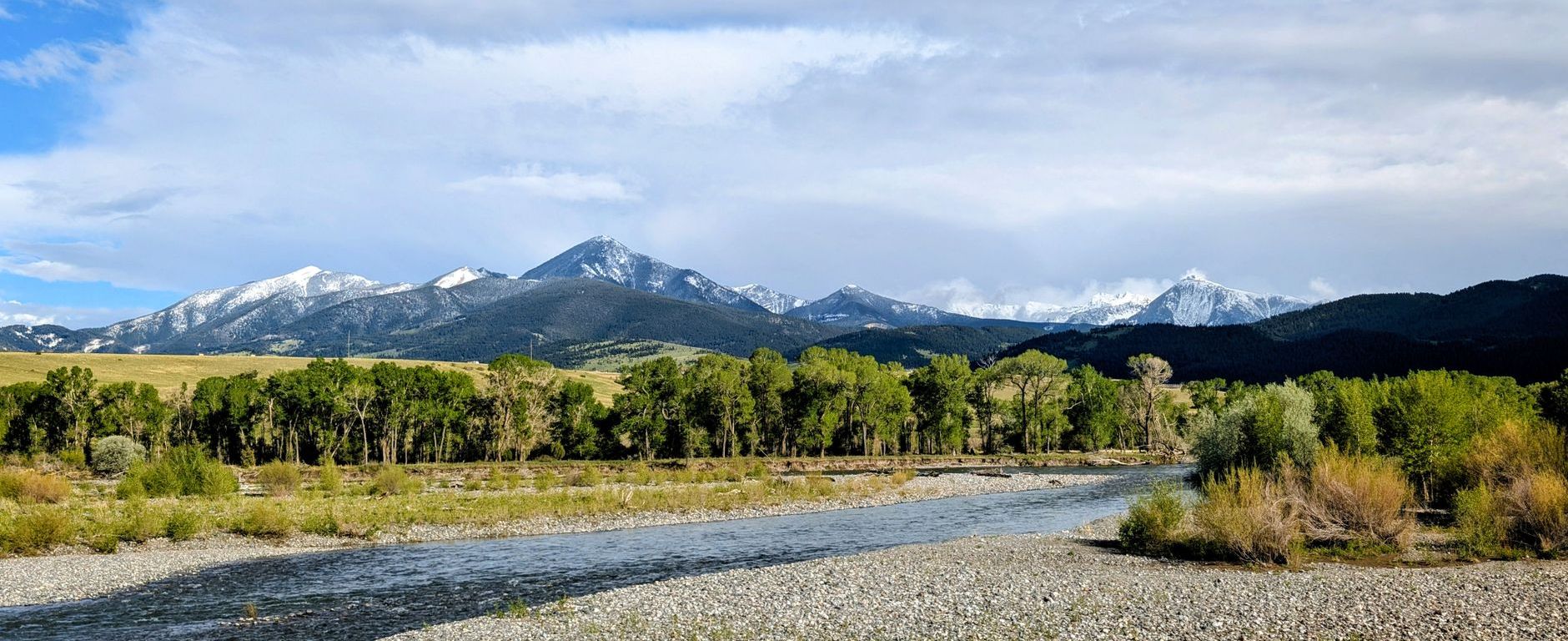
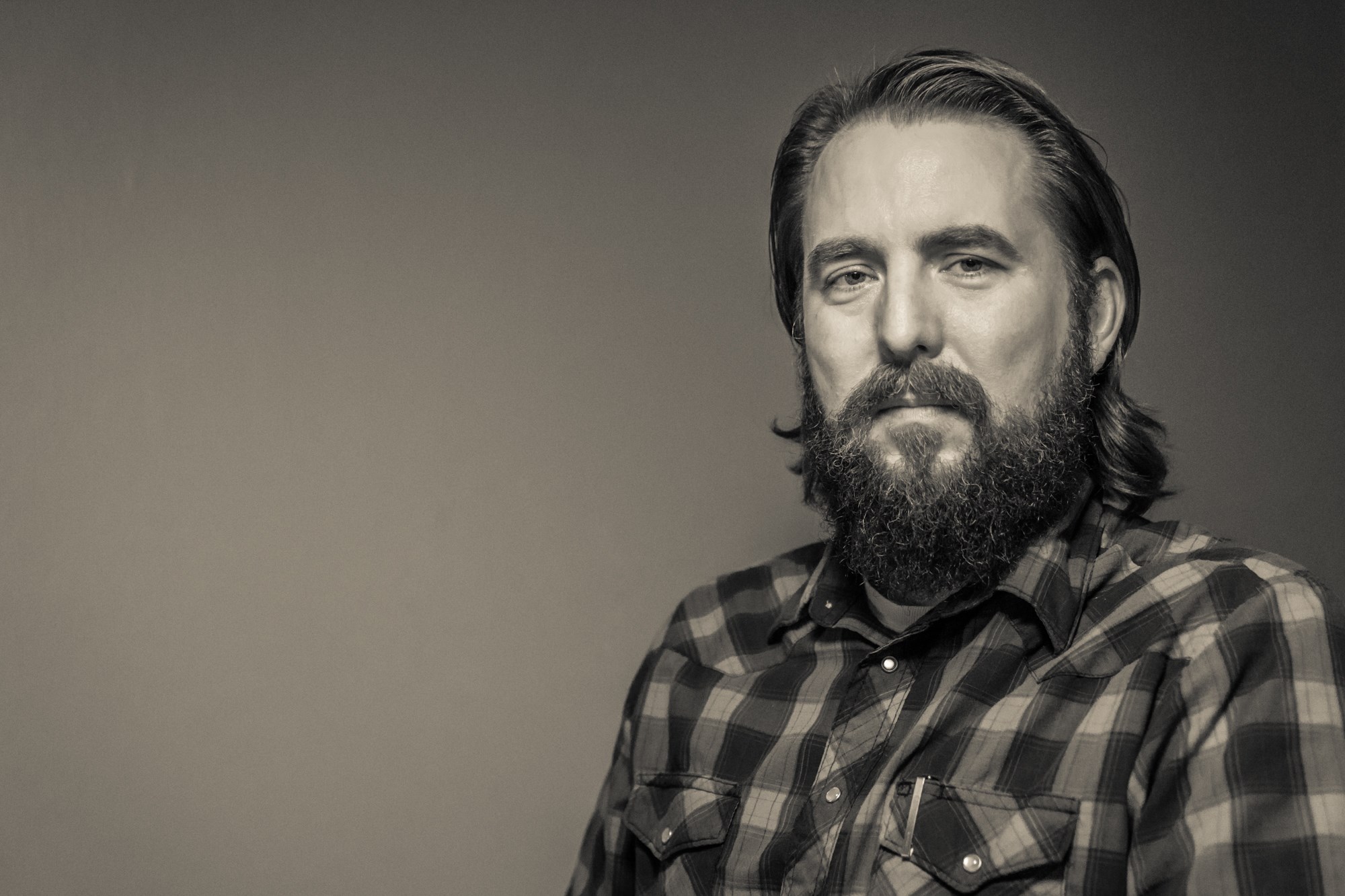
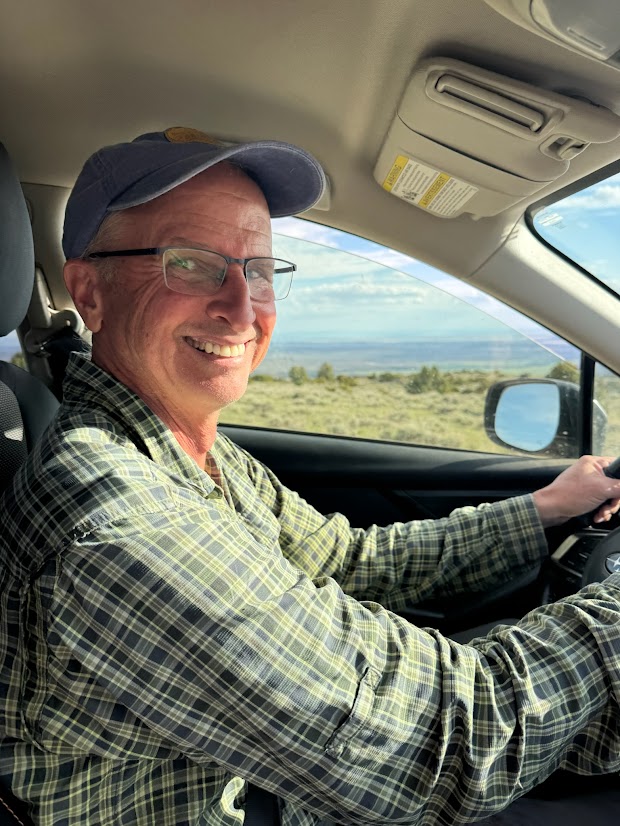
Below is a conversation between authors Joe Wilkins and John Clayton. Wilkins has published award-winning poetry, memoir, and fiction, and is perhaps best known for his extraordinary recent novel The Entire Sky. His nonfiction book, Every Sky at Home: Essays on Landscape and Family (Bison Books, 2026), is now available.
John: Several of these essays are set in what your fans will find familiar territory: your hardscrabble childhood in eastern Montana’s Big Dry high desert. In “On Edges” you write that it is “a country that has never not been true frontier.” What makes a frontier?
Joe: A frontier is, simply, a far and lonesome place. Various governmental agencies and nonprofits define frontier country as having less than six people per square mile and being thirty minutes or more from necessary services, and I think those are pretty good numeric markers. But frontier connotates, too, a wildness and a sense of being on one’s own. This frontier mentality can be thrilling and bracing—which is one reason I continue to find myself seeking out such places, wanting to continue to learn from such places—but a blind adherence to this mentality can keep us, in the far places, from understanding our bonds with one another and building community, which we all need, no matter how far and lonesome the place we call home.
John: “We need a new mythology,” you write in an essay titled “Not the Cowboy but the Shepherd.” I have friends who’ve been saying this for years. But it feels more compelling coming from someone who a) has the language and storytelling chops to aspire to mythmaking, and b) once lived on an actual sheep ranch.
Joe: I’m definitely joining a chorus of writers and thinkers—William Kittredge, Mark Spragg, and Kim Barnes leap to mind immediately—with this call. And I’m indebted to them for helping me rewrite my own personal mythologies, which is where, of course, this work begins—in our own selves. We always need to be reminded; we need to hear the good news that true, challenging stories bring us; and we then need to be rigorous and honest with our own values and the decisions we make.
I know, too, as I’m trying to raise a teenage boy of my own, as I encounter young men in my classrooms, that at this very moment we are in deep need of new mythologies surrounding masculinity and what it means to be a man. We have, as a culture, begun to take apart the old mythologies, which is good, but we need truer, more capacious stories to step in and do that necessary mythological undergirding. Without it, we’re trying to build on Jello; we’re at the mercy of the flawed, destructive stories spouted by various podcasters and influencers and way too many of our national leaders.
John: A shorter essay that moved me was “Shimmer,” in which two strands eventually converge. Even more than its ideas or themes, I was struck that its innovation—and thus its beauty and power—arose from its poem-like structure. Do you consciously cross-pollinate genres?
Joe: Perhaps since I began scribbling as a poet, form feels to generative to me—where you break a line allows and disallows all kinds of associations and possible meanings. It’s a little different in prose, but the shape of a sentence, and the sentence that follows that one, or the paragraph break and what comes next —these formal gestures are always bringing a force to bear on me as a writer. With “Shimmer,” I thought perhaps the threads would be more tightly intertwined, but the language and the subject/narrative kept pushing me towards the more distinct back and forth that became the essay’s final form. So, yes, I guess I do!
For me, whether poem, essay, or story, language is language, and you’re always trying to follow it, to see where the next line or sentence might lead.
John: Some of the essays are set in the other places you’ve lived as an adult: Mississippi, Idaho, Iowa, Oregon. I found several of these quite compelling, and realized that you’re not necessarily a Montana writer, but a great writer of place who happened to be raised in Montana. Do you see yourself that way?
Joe: I’m absolutely a writer of place. One of the first questions I ask myself—whether I’m at work on a lyric poem or a sprawling novel—is where am I. If I can’t answer that, well, I pretty much can’t keep writing. The same is true for me as a reader; if I don’t have a strong sense of where I am, I’m going to put the book down.
That said, I don’t think I’m the writer of place I am without my Montana boyhood, which allowed and asked of me a deep immersion in the everyday facts of landscape. As a farm and ranch family, we lived a deeply placed life. Though I don’t do that work anymore, the lessons of it are still with me. I can’t help but find and understand myself in place.
John: Several of the essays are set at an incredibly remote spot on Oregon’s Rogue River where you were a Boyden Writing Resident. Most writers’ retreats I know won’t even accept a dog. But you brought your whole family, including your four- and six-year-old kids. Indeed their encounter with the wilderness becomes one of your central subjects, yes?
Joe: Though the essays in Every Sky at Home traverse many landscapes, the book as a whole takes root in that singular experience, in the astonishing gift it was to watch my children come to know the mountain meadow and the forest trail and the river itself as kith, as each day’s measure. In watching them learn that far place, I saw myself as a boy learning my own far place. I began to see as well the very reasons my parents chose to farm and ranch in eastern Montana, just as my wife and I chose those months on the Rogue for our family.
I’ve found one of the great joys and mysteries of parenting is how time begins to circle and get all mixed-up. In an instant we’re both parent and child, and we see how it must have been the same for our parents and our grandparents, and these swirling moments have helped me give grace to those relatively young folks my parents were, to myself and my wife as we try to get it right, to my children as they grow and change and continually become themselves.
Joe Wilkins is the author of two novels, The Entire Sky and Fall Back Down When I Die; a memoir, The Mountain and the Fathers, and five collections of poetry. His latest, Every Sky at Home: Essays on Landscape and Family, will be available from Bison Books. Born and raised on a sheep ranch north of the Bull Mountains of eastern Montana, he lives with his family in the foothills of the Coast Range of Oregon. You can find him online at https://joewilkins.org/ and https://joewilkinswriter.substack.com/ (where this interview was previously published).
John Clayton is the author of nonfiction books including Natural Rivals, Wonderlandscape, and Stories from Montana’s Enduring Frontier. His biography of novelist Caroline Lockhart, The Cowboy Girl, was published by Bison Books in 2007. His latest, The Auto-Biography of Yellowstone: How Cars Continually Transform America’s Natural Treasure, is forthcoming from Bison Books in the summer of 2027. Raised in Massachusetts, he has lived in Montana on the outskirts of Yellowstone for the past 36 years. You can find him online at www.johnclaytonbooks.com and https://naturalstories.substack.com/ (where this interview was also previously published).

