Dr. Autumn Lorimer Linford is an Assistant Professor at Auburn University. Her decades-long journalistic career spanned the United States from Wyoming to North Carolina and her award-winning historical research has appeared in top academic journals like American Journalism. Her book, Extra! Extra! A History of America’s Girl Newsies (University of Nebraska Press, 2026), was published in September.
“Huh.” The word escaped me in a single puff of confused breath.
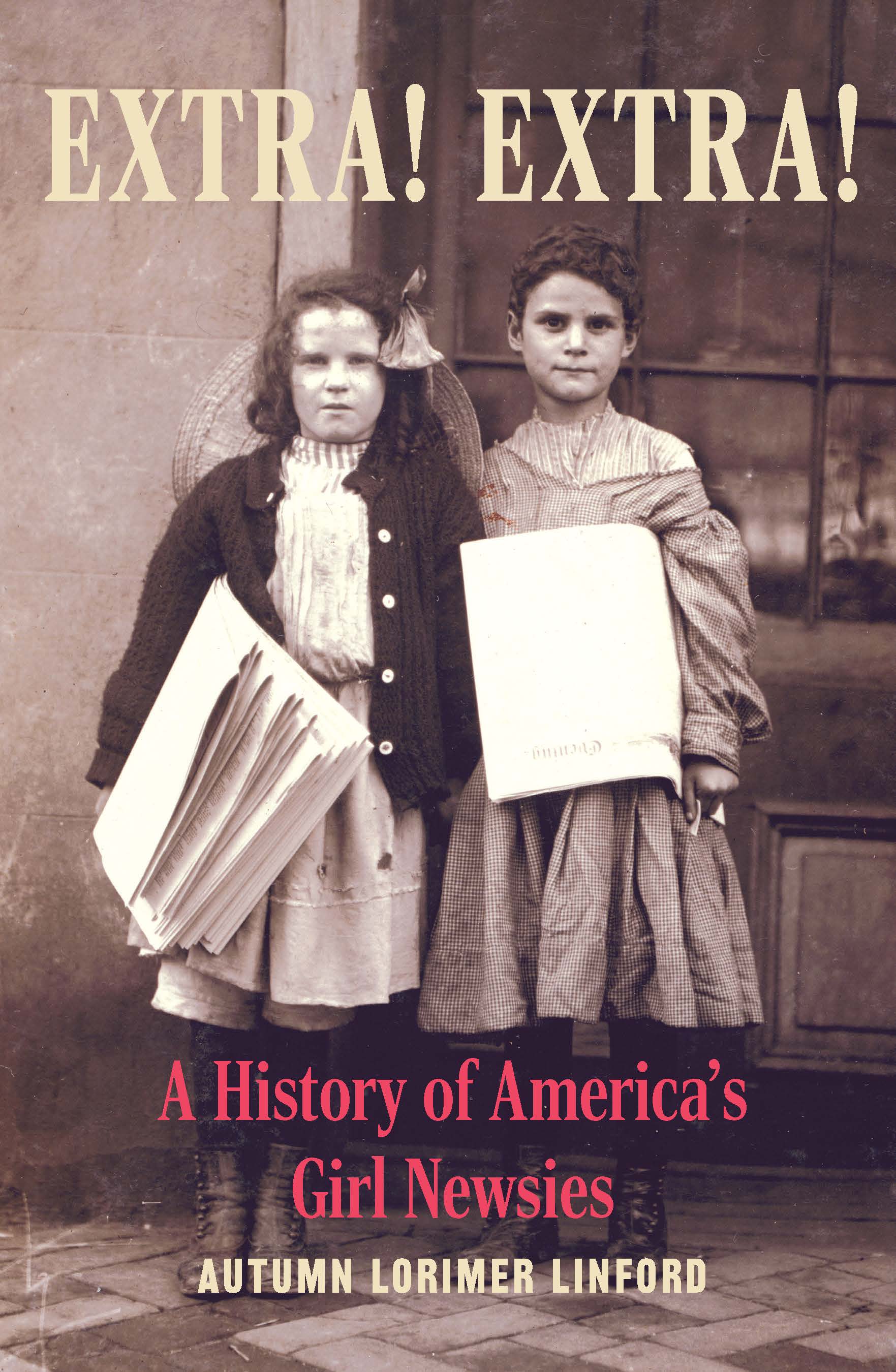
It was 2020, before the pandemic shutdown, and I was standing in my PhD advisor’s office. As I waited for her to finish writing an email, I idly flipped through a few old journalism history syllabuses lying on her desk. In one, she’d included a handful of historic photographs from the Library of Congress. The photos showed newsies, but not the kind I’d seen in the Disney musical. They were street kids holding armfuls of newspapers, sure—but these newsies were girls. The images showed Alice Goldman, who according to the photo’s caption, used “viler language” than the newsboys. There was Rebecca Kirwin, sticking out her tongue at the photographer, and Myrtle Mallick with mischief written all over her face. I instantly adored these girls, but I’d never heard of them. In all my time as a journalist or as a historian, I’d never heard of newsies who were girls.
When my first searches through academic histories failed to produce more than a mention or two of newsgirls, I hoped maybe I’d be able to find enough archival information to write a short conference paper or journal article. After all, the paper trails of upper- and middle-class women is thin enough. I doubted I had much of a chance to find anything left behind by working-class girls.
I was wrong. I found a glut of notebooks and letters and scrapbooks of newsgirls. I found even more newspaper columns, legislative notes, speeches, and arguments written about the girls by the adults around them. Once I began looking, newsgirls seemed to shout at me from everywhere. Extra! Extra! is the result.
Girls had all the same reasons as boys to sell newspapers. Both needed money for food. Both needed a safe place to stay the night. Both girls and boys helped support their families or needed cash to support themselves. While there were more newsboys, reports at the turn of the twentieth century claimed every city and town in America had “hordes of small girls” running around selling papers.
Newsgirls consistently outsold the boys in competitions and were highly sought after by newspaper circulation departments, but society judged them more harshly than newsboys. Brothers and sisters ran scams together, but when they were caught adults usually labeled the brother “scrappy” or “street savvy,” and the sister “scheming” and “bad.” The public worried about boys smoking and gambling in alleyways but claimed girls who sold newspapers would inevitably wind up as women who sold themselves as sex workers.
Newsboys became a symbol of the American Dream—the belief that anybody can become somebody in America. Here, even a street kid with enough grit and gumption can pull himself up by his bootstraps and become a titan of industry or legendary athlete or Hollywood star. A Newsboy Hall of Fame was created and statues of newsboys erected.
Newsgirls, on the other hand, were first federally banned and then forgotten. Later, at the height of the Women’s Liberation movement of the 1970s, girls fought to sell newspapers as papergirls, but their resulting victory brought its own mixed bag of gender equality and unsafe labor conditions.
I discovered the story of newsgirls all over the country in grand, high-ceilinged archives and dark attics, legislative records rooms and basements with exposed wiring and leaky pipes. Notes of their lives were sometimes jotted down on the backs of used envelopes, at times taken down by meticulous court reporters, and at other times shoved haphazardly between scrapbook pages. And yet they were there, waiting impatiently for someone to see them among the throng of newsboys.
The book begins and ends with the experience of newsgirl Evelyn Patton, who during an oral history taken on her 100th birthday, wanted it known she’d been a top newsie for the Cleveland Call & Post. A photograph of the newspaper’s newsies hung in the paper’s office for decades mislabeled as showing only newsboys. “Hey, I am a girl, and there I am!” she said in the oral history, remembering her exasperation at finding the photo misgendering her at a museum. When the Call & Post corrected their error and correctly identified her as a newsgirl in their 95th Anniversary edition in 2011, editor Kevin Heard was there to capture her reaction. “I found myself! That’s me!” she cried, waving the newspaper copy at him before he could even enter that house.
A historian’s goal is always to record the past in such a way that the people they study would see themselves in the work if they were present—that the representation of history would feel true to those who lived it. With newsgirls reincorporated into the story of newsies inside the pages of Extra! Extra!, it’s my hope that all the girls who sold newspapers can finally say along with Patton, “That’s me!”

