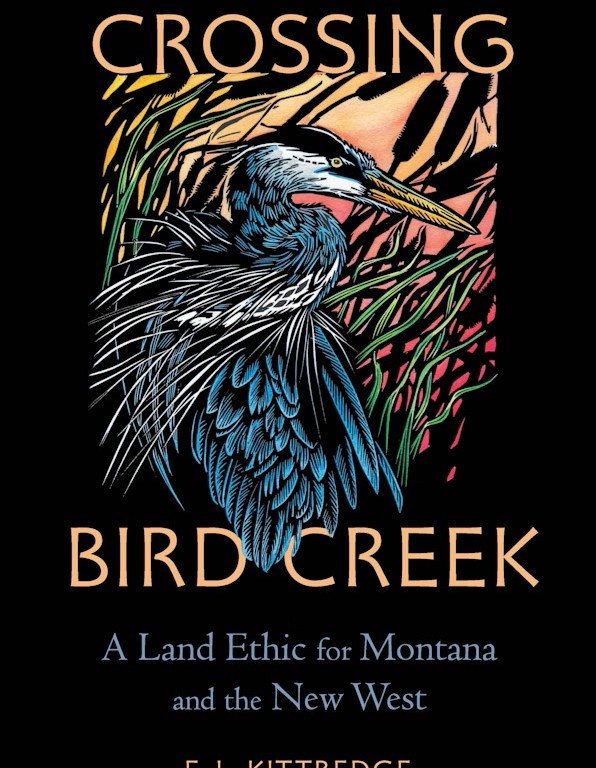
Born and raised where the Great Plains rise up to the Rocky Mountains, E. L. Kittredge lives and works on her family ranch in Montana. After living and working in major US cities, she founded My Artrepreneur Program, which, over two decades, has helped artists across the nation build sustainable businesses in art. Kittredge continues to advocate for the folk arts, cultural awareness and historic preservation. Besides her recently published book Crossing Bird Creek: A Land Ethic for Montana and the New West (Bison Books, 2026), she is the author of Artrepreneurship: Sustaining the Creative Life.
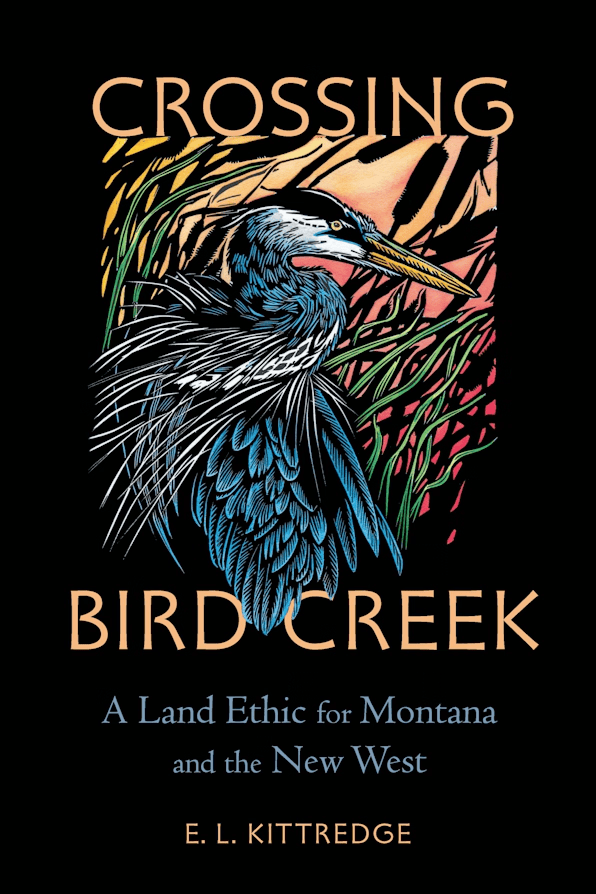
The Welsh have a word, Hiraeth, for a place we have lived in, settled into, felt safe in, but to which there is no return. In our world of flux, we long for that safe haven, even though it may never have existed.
Although the word home has been used since 900 AD in the earliest versions of English, that place lacks general definition or even fixed form. Author Thomas Wolfe warns us, “You can’t go home again.” Wallace Stegner described driving to see “the homeplace” and failing to go there, fearing that all traces of his life had disappeared. Deborah Tall calls how we try to save ourselves from our unquenched yearning a state of “protective amnesia.”
Like so many of us, I rarely considered deeply my physical context, those spaces that I might have claimed as part of my “home ground” and its culture. They abided, taken for granted, part of my background. And sometime, in the future, when the time was right, I would return to Montana and my family’s ranch.
That shifted in Milwaukee, WI, where I worked in Marquette University’s Foreign Student Program. Ironically, I, who had left my aging parents to deal with the family ranch on their own, worked to help students navigate their new surroundings as they dealt with leaving their homeland. They taught me much and awakened something.
On a summer visit to my parents and home, a friend urged me to read, “not later but now,” Wendell Berry’s book The Unsettling of America: Cultural and Agriculture. The book would engulf me. I read, then reread, even re-rereading what I had re-read. The mix of reality and clarity in Berry’s words turned my focus to how I saw and considered home and place.
Berry’s facts chilled — of an on-going diaspora, the largest outward migration in U.S. history. Rural populations continued to leave their land and cultures for urban life. He realized that what he valued was under attack and that he “was a member of a threatened minority.”
That tale of loss haunted. Would our place survive? Each visit home told of the loss of another mid-sized family ranch, of another name in the community gone, and with it a piece of the texture of the upper Great Plains.
But life’s tangles interfered. It would take nearly twenty years, several jobs, numerous moves and countless adventures to find a way home. More than those who came before me demanded attention. And the present raised its hand and shouted. The “Why” and “how” dangled and nagged. Confusing and unclear.
Perhaps it was a clearly worded message voiced at the bottom of a rock wall in Arizona. Or maybe it was that there I heard more clearly the word “Home.” Three of my fellow rock-climbers and I sat after a taxing climb, basking in what we had accomplished.
In a conversation pause, I said, “I suppose I need to get headed home before the weather changes.”
One person said he wanted to rest longer, a second one started checking equipment, but a third said, “Oh, I don’t think she’s talking about getting back to her house here. She’s returning to Montana.” He was correct.
However, the next day I didn’t pack my belongings and fly north. As in most lives, years of logistics and dramas remained. And the path that I chose was not well-marked. But I hungered for the light of Bird Creek’s longitude and latitude. For the sights and textures, the feel of simply being in the place.
Becoming takes time and work. The generations past are part of the push forward. The present pushes us in the moment. And sometimes, creativity makes an entrance and guides us in unexpected directions.
The job available when I returned was with a historical society with room to grow—for both the organization and me. That ballooned into a widening curiosity for the why and how those of us who are highly rural not only depend on our land but have learned and thrived from it.
Deep into my doctoral work of finding the answer to why, I had just finished writing my thesis statement, and the academic committee had okayed my dissertation proposal. Relief flowed, and out of pure joy for what I felt for the land and its cultures, I began to write.
After several pages, I realized that what I had written fit with what I would be researching in Montana’s most sparsely settled counties. I said to the late night air, “I’ll send a copy to my committee chair. He’ll enjoy this.” I never expected his response.
Midnight had just chimed, and the phone rang. It was my Chair, advising me to immediately pause in my rush down the rabbit-hole of a new subject, that I needed to finish my dissertation and have a degree in hand. “This is not the only book you’ll write. Get this one done. Then move on.”
I listened to that advice, and received my degree, but I continued to “fiddle” with the essays. The segments seemed like puzzle pieces that grew more related. But I dismissed any idea of a book of essays because in that era, only well-known writers had essays published. My essays would need to abide.
Time passed; things happened. I continued writing for work, and the essays sat on the shelf.
Then a wider world intervened with 2015 to 2020 making me feel like a silenced Cassandra. I had to write. Something. Anything! So, I started a novel. I wrote…and wrote… and wrote to assuage the growing terror of what I felt coming. The feeling eased in 2020, but in October 2024 my husband died, and a month later, the elections made real the fear of the approaching storm.
I had written a novel to its end. My beloved husband had died; and my country was careening into a dark place. What to do? I called a good friend and we had lunch. She quickly advised, “Write about your cows!”
I thought I misunderstood. My cows? Really? What could I say about a Highland cow?
At home, I pulled the essays off the shelf. Maybe, with some revision, something lay in them, something speaking directly to the losses and a way out. Maybe people were ready to read about what I felt was disappearing. A way of seeing, of knowing, of being, and thriving.
After re-editing, I submitted the essays to Bison Books’ Acquiring Editor, who saw the message of an ethic for living and suggested the book’s subtitle. So, yes, serendipity exists.
And yes, I have loved walking in the early morning drizzle in Cornwall and facing into the cold wind pushing off the Atlantic. I have lost myself in imagining an ancient Phoenician world in Malta’s Valetta with its harbor tangled with vibrantly colored fishing boats.
But if you think Crossing Bird Creek grew out of poetic contemplation, inspired by sitting on the creek’s bank in evening’s quiet, with an occasional hoot of an owl in the early dusk, the book will disappoint you. Research and life experience bolster the underlying messages.
Yes, Crossing is a response to our chaotic times, but uneasy times require the best in us.
And yes, a heavy weight of responsibility for the land lies on us – those of the land as well as those urban born.
And yes, sorrow threads this book, the sorrows of death, of lessons not learned.
But there is something about the light on the land here that is different. It touches the trees and the grasses, playing on them, creating and accentuating shadows that move with the drama of just being. A moment, which then is gone.
But in Next Year Country, hope lives.

