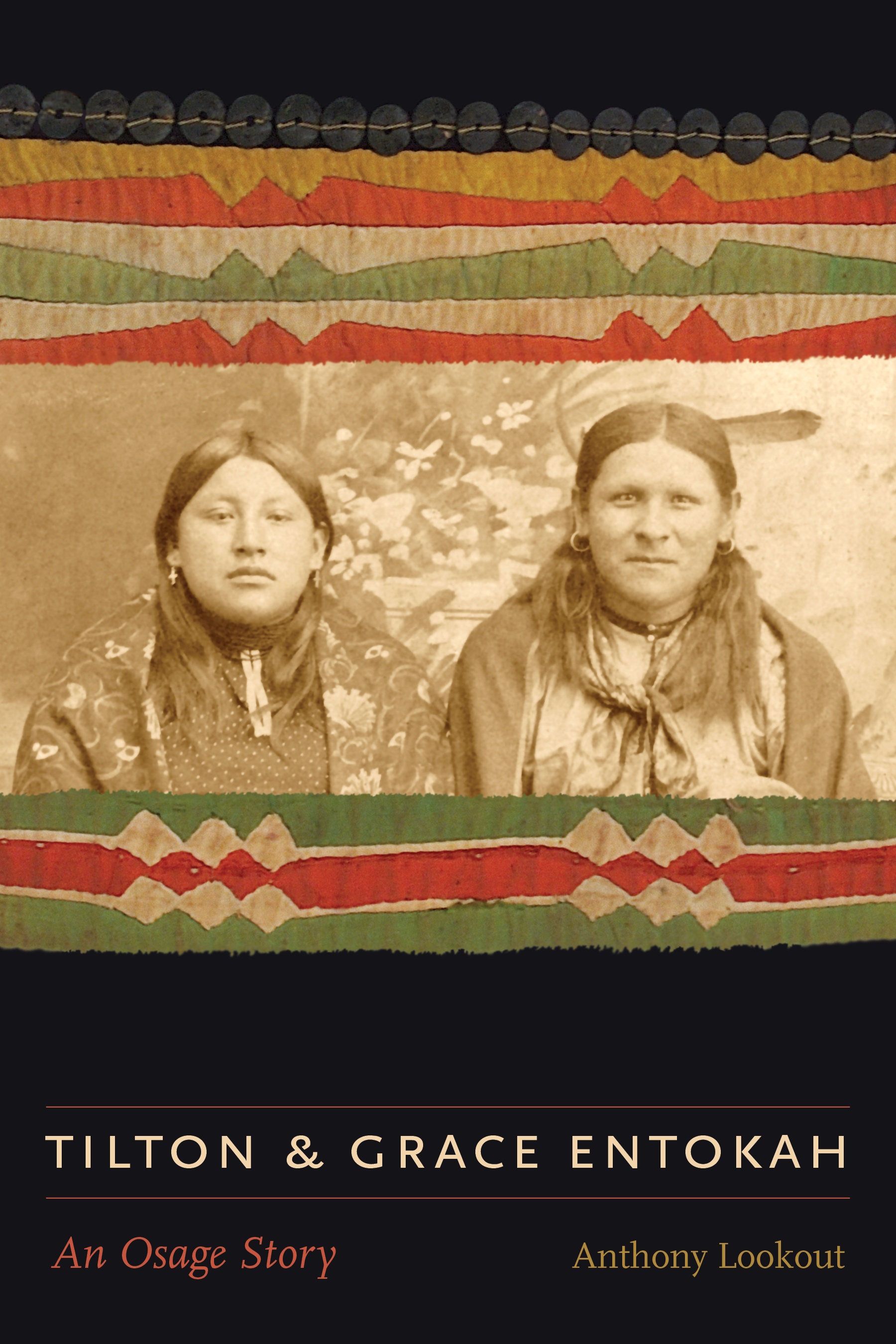
Anthony Lookout (1956–2026) was an Osage songwriter and musician from Tulsa, Oklahoma. His Osage name was Hunkathali, meaning “good eagle,” from the Hunka clan. He spent his life playing music as a multi-instrumentalist performing and recording songs and music videos and producing other local artists. Also an actor, he worked for two years with the Native American acting troupe Mahenwahdose. His posthumously released book Tilton and Grace Entokah: An Osage Story (Nebraska, 2026) was published in May.
Tilton and Grace Entokah: An Osage Story offers an episodic history of the Osage Nation of Oklahoma as told through the life narratives of Anthony Lookout’s great-grandparents Tilton and Grace Entokah. Anthony Lookout grew up hearing the stories of his relatives, including those of his great-grandfather Fred Lookout, who served as the principal chief of the Osage Nation in the early twentieth century. Anthony Lookout’s father, Morris Lookout, methodically recorded the oral traditions and tribal stories of Osage elders and relatives on reel-to-reel tapes from 1965 to 1971. The recordings preserved generations of Osage history, religious practices, and cultural traditions reaching back to the mid-nineteenth century. To write this story of his family and Osage history, Anthony Lookout did additional research in archival collections, newspapers, and magazines and interviewed elders.
Lookout covers the family history of the Entokahs, the Allotment Act of 1906, Oklahoma statehood, the depredations of mining and oil companies on Osage lands, the establishment of tribal government and courts, Principal Chief Fred Lookout’s journeys to Washington, DC, to meet top government leaders, as well as tribal stories of the infamous 1920s Osage murders and other key episodes in Osage history. Tilton and Grace Entokah is not only the story of the Entokahs but also an Osage history written from the collective memory of those on the Osage reservation.
1. Sitting Bull
Early one morning in the autumn of 1890, Tilton Entokah’s father woke him and told him to get their horses ready for a ride. Tilton was eleven years old and loved to go anywhere with his father.
“We are going to Sycamore Creek south of Gray Horse,” his father said.
They met up with about thirty Osage warriors and took a trail seldom used. Everyone traveled quietly, and Tilton soon found out why they didn’t want to be seen or heard. The Lakota leader, Sitting Bull, and his followers had set up camp at the creek. He was under constant surveillance by the U.S. Army but had managed to evade them.
Sitting Bull was there to persuade the Osages to take on the Ghost Dance. The Ghost Dance was a religious movement among many tribes from the southwestern nations to the north. Sitting Bull was considered a holy man who learned the dance from the Paiute messiah named Wovoka. The U.S. government was convinced the dance would lead to an uprising among the Indians.
One of the first things the Osages noticed were the battle-ready Lakotas. They were armed with rifles and had scouts placed on the hilltops in case any outsiders showed up. They had made a dance ground, with the men wearing their white ceremonial dance shirts and singing their songs in preparation. Soon, Sitting Bull appeared and greeted the Osages. He stood out from the other Lakotas. He had an aura about him. Sitting Bull showed the proper humility and respect toward the Osages as introductions were made. Everyone got off their horses and sat under some shade trees to hear what Sitting Bull was going to say.
He told them, “The dance will bring back the buffalo, drive away the white men, and life will be the way it used to be.” The Osages listened closely to everything the Lakota holy man had to say. After the charismatic Sitting Bull finished his speech, everyone went to the dance ground for a demonstration of the first day of dancing. About twenty dancers formed a circle and were singing and praying. They danced for hours and some of the dancers, who had been fasting, went into trances, waving their arms and rolling on the ground. All of this seemed foreign to the Osages compared to their own ceremonies and what was sacred to them. There wasn’t anything in the Ghost Dance that reflected the beliefs of the Osages’ structure of religion.
After the first session was over, the Osages had already made up their minds. Even before they came down to meet the Lakotas, they were aware that the Ghost Dance was becoming a major issue with the U.S. government, in that they were convinced it was going to lead to war.
As is customary, the Osage men got up one at a time to voice their opinion. When it was his turn, Tilton’s father, Entokahwahtianka, spoke to Sitting Bull.
“We Osage men are fearless warriors,” he said, “a courageous nation with strong Osage ways. Wahkonta takes care of us. Our Inlonshka Drum and what we’ve kept from our past keeps us alive today! I must say no to the Ghost Dance. It just isn’t Osage!”
The rest of the Osages stood to express themselves, telling Sitting Bull they also must decline taking on the dance. They wished him well by praying for him and blessing him with eagle feathers, a sign of respect and thanks.
Meanwhile, Tilton was fascinated with the Lakota warriors, imagining that he could take any of them in a good fight, when suddenly one of them rode up to Tilton and said, “Greetings, Osage warrior!”
Tilton looked around, thinking, Who, me? He was startled but quickly put on his warrior face.
The Lakota asked him, “What is this Inlonshka Drum your people talk about?”
Tilton said, “It’s our ceremony that Wahkonta gave us. We pray, sing, and dance for four days. The Drum guides us. It’s a way of life.”
The Lakota said, “It sounds good. I would like to come and dance with you someday.”
Tilton was surprised and answered, “You and your people are welcome anytime!”
“What is your name, my young friend?” the Lakota asked.
Tilton told him what his name was and then asked, “What is your name?”
“I am Standing Bear. Maybe I’ll return someday to dance and pray with your people.” Tilton realized he had made a friend, which made him feel good. He suddenly noticed his father was waiting for him.
“I’ve got to go back to Gray Horse now,” he told Standing Bear. “I hope to see you again.” Tilton got on his horse and joined his father to ride back home.
After a while they stopped, and Entokahwahtianka looked around at the rolling hills and prairies which were now their home. He then looked at Tilton and said, “We sure don’t need the Seventh Cavalry riding around here.” Tilton thought this comment was funny, but his father was serious. Dead serious. Four weeks later, Sitting Bull was assassinated at the Standing Rock reservation.

