Brian K. Burton is professor emeritus of management and retired associate vice president for academic affairs at Western Washington University. He is the author of Fredericksburg and Chancellorsville: A Battlefield Guide (Nebraska, 2026), The Peninsula and Seven Days: A Battlefield Guide (Nebraska, 2007), and Extraordinary Circumstances: The Seven Days Battles.
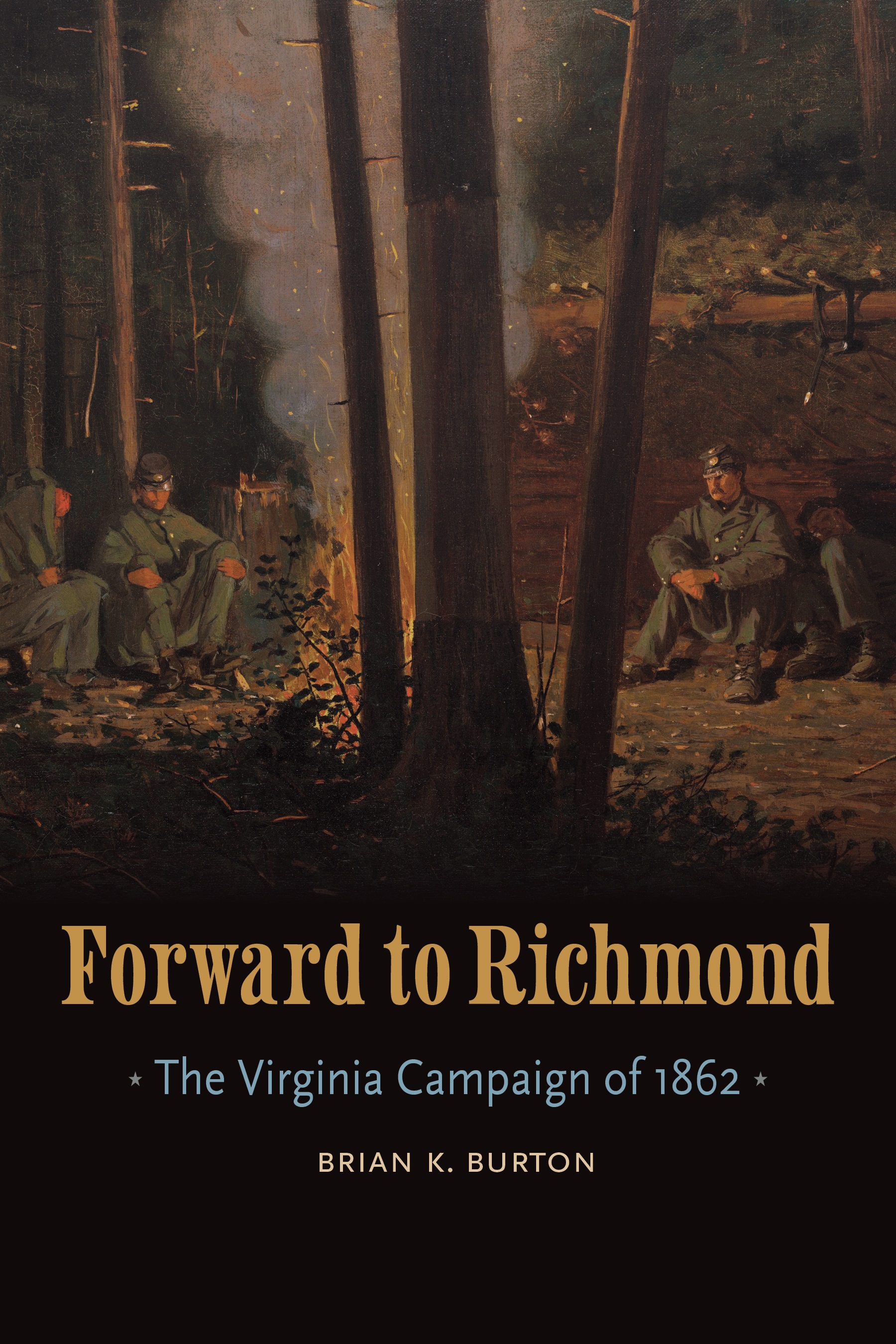
Covering all aspects of the war in Virginia in the first six months of 1862, Forward to Richmond treats the military actions in the Shenandoah Valley, the Piedmont, and the Peninsula as part of a theatre-wide campaign. Brian K. Burton goes beyond military events to also examine the political, social, and diplomatic interactions with military events, including the meetings of Union soldiers with Southern civilians and African Americans, ultimately leading to a turn away from conciliation and a beginning of a move toward support of emancipation.
1
The Campaign Opens
In the fall of 1861, three generals with experience operating in western Virginia received new assignments. Maj. Gen. Thomas J. “Stonewall” Jackson took command of the Confederacy’s Shenandoah District of the Department of Northern Virginia, reporting to Gen. Joseph E. Johnston. Jefferson Davis assigned a second Confederate, Gen. Robert E. Lee, to command a new department covering the coasts of South Carolina, Georgia, and eastern Florida. Abraham Lincoln named Union Maj. Gen. George B. McClellan the commanding general of the U.S. Army.
McClellan had been summoned after the Union defeat at Bull Run to take command of the demoralized army, which would become known as the Army of the Potomac. He quickly put in place a regimen of drill, review, and praise that built the soldiers’ morale and confidence. At the same time, however, McClellan was having problems working with the Union general- in- chief, Lt. Gen. Winfield Scott, the War of 1812 hero and Mexican War victor who because of age and infirmity was no longer able to lead an army in the field. McClellan wanted to concentrate Northern forces in Washington to ensure the capital’s safety, an idea Scott disliked so much that in August he submitted his resignation (which Lincoln rejected). Interestingly, McClellan’s overall plan shared some elements, especially a movement down the Mississippi River, with a plan Scott had formulated in April and May that became known as the Anaconda plan because it envisioned cutting the South off from supplies through a blockade. That plan, in its turn, came after Scott rejected a plan McClellan had written in early 1861. Both of McClellan’s plans included a large force moving on Richmond, which Scott’s plan was designed to avoid. The combination of McClellan’s ascendency, Scott’s infirmity, and the friction between the two men finally resulted in Lincoln’s acceptance of Scott’s resignation in the fall. On November 1 McClellan was named Scott’s successor.
Fresh out of West Point (graduating with Jackson in 1846), McClellan had served as a staff officer under Scott in the Mexican War and after several more years in the army became a successful railroad executive, gaining acquaintance with Lincoln (who represented railroads as part of his prewar law practice). McClellan proved to be forward thinking in several ways inside the U.S. Army, including developing joint operations with the navy and thinking beyond tactics to operational and strategic levels of warfare. His organizational skills were undeniable, and he likely would have been an excellent chief of staff. He legitimately gained, and returned, his men’s trust and affection. He had a tendency toward arrogance, however, and he (along with most military men of the time) disdained politicians. His rise in six months from a small command in an area of moderate strategic importance to general-in-chief of an army of hundreds of thousands of men would strain him, as it would anyone in the army (McDowell’s army of thirty-five thousand men had been the largest single field army in U.S. history). With a slower rate of advance, and an opportunity to learn about leading men in battle in smaller units, McClellan may have developed differently as a military leader.
However, that was not McClellan’s lot. And by the time he became general-in-chief, he had suffered his first setback. Elements of his army turned a reconnaissance on the south bank of the Potomac River at Ball’s Bluff into a raid and were attacked by Confederates. Reinforcements could not reach the Yankees in force because they lacked boats, and Col. Edward Baker (also a U.S. senator from California), leading the reinforcements, was killed. The Unionists retreated across the river in confusion, leading to more casualties.

