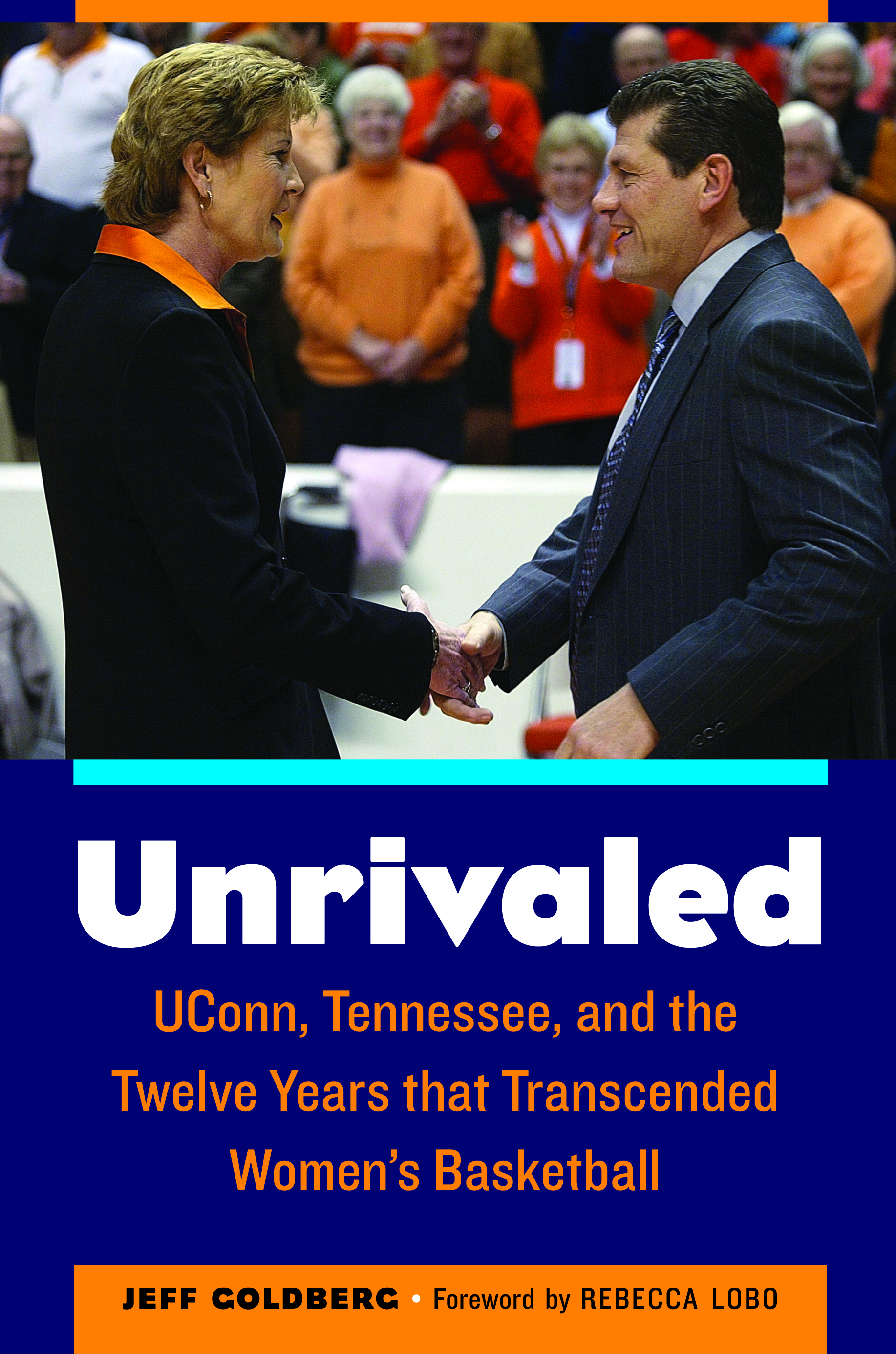
Jeff Goldberg was the UConn women’s basketball writer for the Hartford Courant from 2001 to 2006 and is the author of Bird at the Buzzer: UConn, Notre Dame, and a Women’s Basketball Classic (Nebraska, 2011) and Unrivaled: UConn, Tennessee, and the Twelve Years that Transcended Women’s Basketball (Nebraska, 2015).
I found myself recently making one of those observations that causes you feel every bit of your age, which at 57, can really pack a wallop.
This past March 6 represented the 25th anniversary of the 2001 Big East women’s basketball tournament final between Connecticut and Notre Dame. That game, won by UConn 78-76 on a last-second, coast-to-coast pull-up jumper by Sue Bird, became the basis for my 2011 book, Bird at the Buzzer, the first of two examinations of that era of UConn women’s basketball. The other, Unrivaled, chronicling the history of the iconic UConn-Tennessee rivalry, would follow in 2015.
What was more a shock to my system wasn’t the realization of the anniversary’s 25-year milestone marker. It was that, somehow, despite my full and total investment in that game and all that flowed from it, I had completely overlooked the anniversary as March 6, 2026, came and went.
And so it is, on a global scale, with the sport of women’s basketball. I am writing this piece because tomorrow, Aug. 21, AppleTV is dropping its three-part documentary on the history of the UConn women’s program, “The Dynasty: UConn Huskies.”
I was fortunate enough to be asked by director Matthew Hamachek in June 2025 if I would be interested in coming to New York (from my home in San Diego) to be interviewed for the project.
I had covered the UConn women’s team for my then-hometown newspaper, the Hartford Courant, from 2001-06, beginning with Bird’s senior season and including the final three seasons of Diana Taurasi’s brilliant college career. UConn won the first 70 games that I covered, amassing three straight national championships in the process.
Hamachek and his production team had read Bird at the Buzzer and Unrivaled as part of their exhausting research, and now they wanted the author and beat writer behind those books to share his stories and memories on camera.
The result—much like Hamachek’s earlier 10-part series on the New England Patriots’ dynasty under Bill Belichick, Tom Brady and Robert Kraft—tells the story of a unique and dominant chapter in American sports history. Between 1995-2025, UConn would win 12 national championships under the leadership of coach Geno Auriemma and the play of all-time women’s basketball legends Rebecca Lobo, Bird, Taurasi, Maya Moore, Breanna Stewart and Paige Bueckers.
And yet, this treatment, the platform of an all-encompassing documentary series, is itself unique in the world of women’s basketball.
As I and a fellow Courant writer walked out of UConn’s Gampel Pavilion late on the night of March 6, 2001, into the cold, snowy landscape of Storrs, Conn., I remarked to him that we had quite likely just witnessed the greatest women’s basketball game ever played.
A contest that featured eight future WNBA first-round picks, five future Olympic gold medalists and two Hall of Fame coaches. The tension of a developing heated rivalry between two iconic programs, the shock and sadness of a sudden, career-ending injury to a fierce UConn warrior. The elation from not one, but two buzzer-beating shots by Bird, their heir-apparent to the mantle of UConn superstar.
And yet, by 2009, when that observation germinated into the basis of my first book, the game, like so many other classic contests and stories in women’s basketball, had been relegated to the dustbin of history.
For as long as I have been associated with women’s basketball, which for all of us living in Connecticut became a thing in the undefeated season of 1995, the sport has operated with a singular, laser focus: The future.
Even today, with all its continuing growing pains and newfound controversies in the WNBA, the sport looks exclusively forward, still clawing and fighting for a permanent seat at the table alongside long-established men’s professional and collegiate sports entities.
The continuing fight for the next set of eyes on the TV screen and bodies in the seats leaves almost no time for the sport and its caretakers to take a deep breath and step back to look at all the history that has been created in its wake.
The NFL figured out how to turn its vast history into one of the greatest propaganda machines in world history. They call it NFL Films. The NBA and Major League Baseball have always celebrated its past as the games play out in the present.
But women’s basketball documentaries like AppleTV’s anthology are as rare as UConn’s 111-game winning streak from 2014-17. ESPN did a 30-for-30 on Tennessee coach Pat Summitt over 10 years ago. And that’s been pretty much it.
Virtually nothing on pioneer players like Cheryl Miller or Nancy Lieberman. Before now, nothing on UConn’s rise, or its rivalry with Tennessee. Did you know Olympic sprinter Marion Jones won a national championship in 1994 with North Carolina? Did you know that UConn and Tennessee were not the first programs to go undefeated? (Texas, 1986). Do you remember the Rutgers controversy that cost Don Imus his career?
The stories—and the players and coaches who made them—are as fascinating as they are endless.
When Auriemma was recruiting Taurasi in 1999, her Argentina-born parents wanted the Chino, California resident to stay home and attend UCLA, a local, but irrelevant women’s basketball program. It appeared a 50-50 call. Toward the end, Auriemma told her: “You are going to do amazing things in college. It would be a shame if no one saw them.”
I am honored to be a part of “The Dynasty: UConn Huskies” just as I continue to be humbled that I was able to publish my two books with the University of Nebraska Press. But I hope, perhaps finally with this documentary, that the history of women’s basketball can finally be brought back to life. The sport has done so many amazing things in its past. It’s a shame no one sees them.