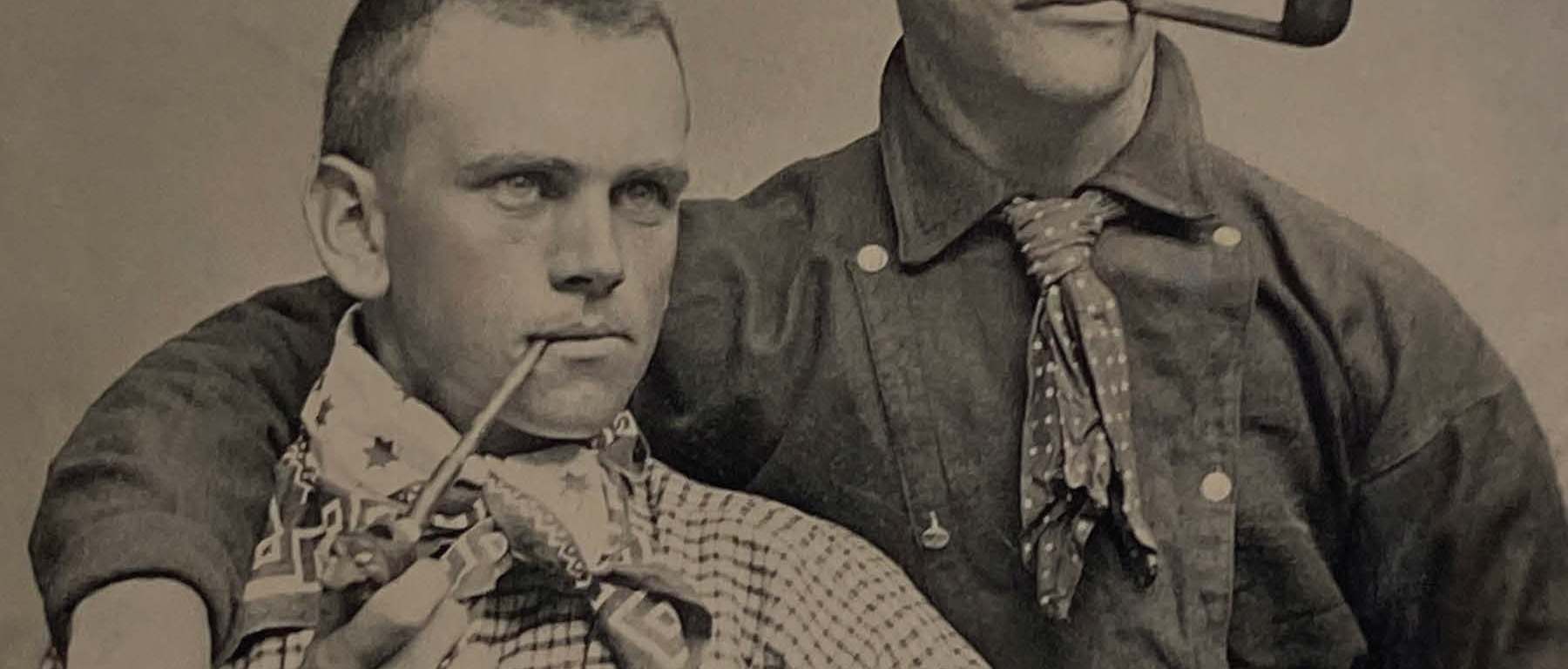
Book Birthdays celebrate one year of a book’s life in reviews, social media posts, and more. This month we’re saying Happy First Book Birthday to Frontier Comrades: From the Fur Trade to the Ford Car (Bison Books, 2025) by Jim Wilke.
About the Book:
Frontier Comrades examines six accounts of lesbian, gay, bisexual, and transgender lives on the frontier of the American West. Each account interprets this history through experiences that take place in different parts of the West, moving chronologically from the fur trade era to the dawn of the automobile age.
The maelstrom of opportunities and conflicts that made up the West affected lesbian, gay, bisexual, and transgender westerners in intrinsically personal ways. The accounts in Frontier Comrades provide an intimate yet expansive view of the American West.
A Word from the Author:
While writing Frontier Comrades, six accounts of lesbian, gay, bisexual and transgender lives in the American frontier, a reader wondered why I was including the gunfight at the O.K. Corral in a chapter describing the life of William Breakenridge, a gay lawman in Tombstone, Arizona Territory in the nineteenth century. Why mention that, they wondered. Everyone already knows about it.
Fortunately my editor was all for keeping it. This is because gay life in a western frontier was shaped and defined as much by horsemanship and survival as by modern theories of alterity or resilience, and that while the study of gay people in history has the ability to engage nearly every discipline, much remains unexplored.
Horsemanship, for example, may seem inconsequential to gay identity, yet the famous California stage driver Charlie Parkhurst considered himself a skilled horseman as much as transgender man. His old associates, fully aware of his transgender life, likewise described his character best through an anecdote about his driving.
For Parkhurst, the two were intertwined: he was necessarily as much aware of one as the other. Horsemanship and staging also introduced him to survivors of the Donner Party, John Frémont’s ranch at Mariposa and the San Joaquin Valley, teeming with wildlife and tule marshes, much as John Muir would see it a decade later.
William Breakenridge was also a horseman, driving freight wagons across the West whenever he wasn’t working as surveyor, volunteer soldier or lawman. His ability to make up and lead wagon trains — a skill he was notably proud of — ultimately led him to Arizona Territory, where he assumed a lawman’s badge and encountered a conflict of personalities that would later define his life’s experience, along with a gunfight that would serve as its measure.
As a lawman, Breakenridge threaded the fine line between forces of law and outlaw much as he negotiated his world as a gay man, on a border between authority and liberty that historians have documented among many middle class gay men in the nineteenth century. Remarkably, his description by people who knew him indicates that everyone knew Breakenridge was a gay man and accepted him as such.
Nothing is arbitrary or useless: stagecoaches and Tombstone matter, as much for their own sake as contributors to themes within the field of lesbian, gay, bisexual and transgender history. Their lives are as interwoven into buffalo hunts and land booms as any number of modern themes of identity or alterity. They were westerners, above all else.
Reviews:

“Wilke provides a rich and fully realized historical background and context for each of the book’s stories, showing how the people highlighted were an integral part of the fabric of the West rather than anomalies or outliers.”—Marc Beaudin, Big Sky Journal
“Wilke has written a fascinating, informative, and entertaining history of LGBT folks in the American west. “—Hank Trout
“Still it’s an illuminating survey of the past’s hidden queer lives.”—Publisher’s Weekly

