
Adam O. Davis is the author of Index of Haunted Houses, winner of the Kathryn A. Morton Poetry Prize. He is a recipient of the 2022 Poetry International Prize and the 2016 George Bogin Memorial Award from the Poetry Society of America. His work has appeared in AGNI, the Believer, the Kenyon Review, the Paris Review, ZYZZYVA, and in The Best American Poetry. Davis is cocreator and host of the podcast Poetry Goes to the Movies, and of its digital collection for the Poetry Foundation. His book Pyrrhic Symphony is now available.
In April 2020, the world was falling apart and full of wonder. Death was everywhere and, suddenly, so were birds—a three-foot-tall heron strutting among the fig trees across the street from my house, green clouds of feral parrots squawking without regard for the hour because there was no such thing as an hour anymore. Time, freed from the ebb and flow of the weekday 9-to-5, grew slippery—every day felt like a Friday, unless it was a Tuesday or Sunday—and nature was taking advantage of the global industrial lull to remind humanity of what it could be without humanity. During those early uncertain months, there was nowhere to go but home, so home was where I and my young daughters stayed while their mother worked in the hospital—me teaching remotely, them listening to Roald Dahl audiobooks. But when I had breaks in my schedule, I’d take them on drives where we could witness the world that seemed to have receded drastically from us.
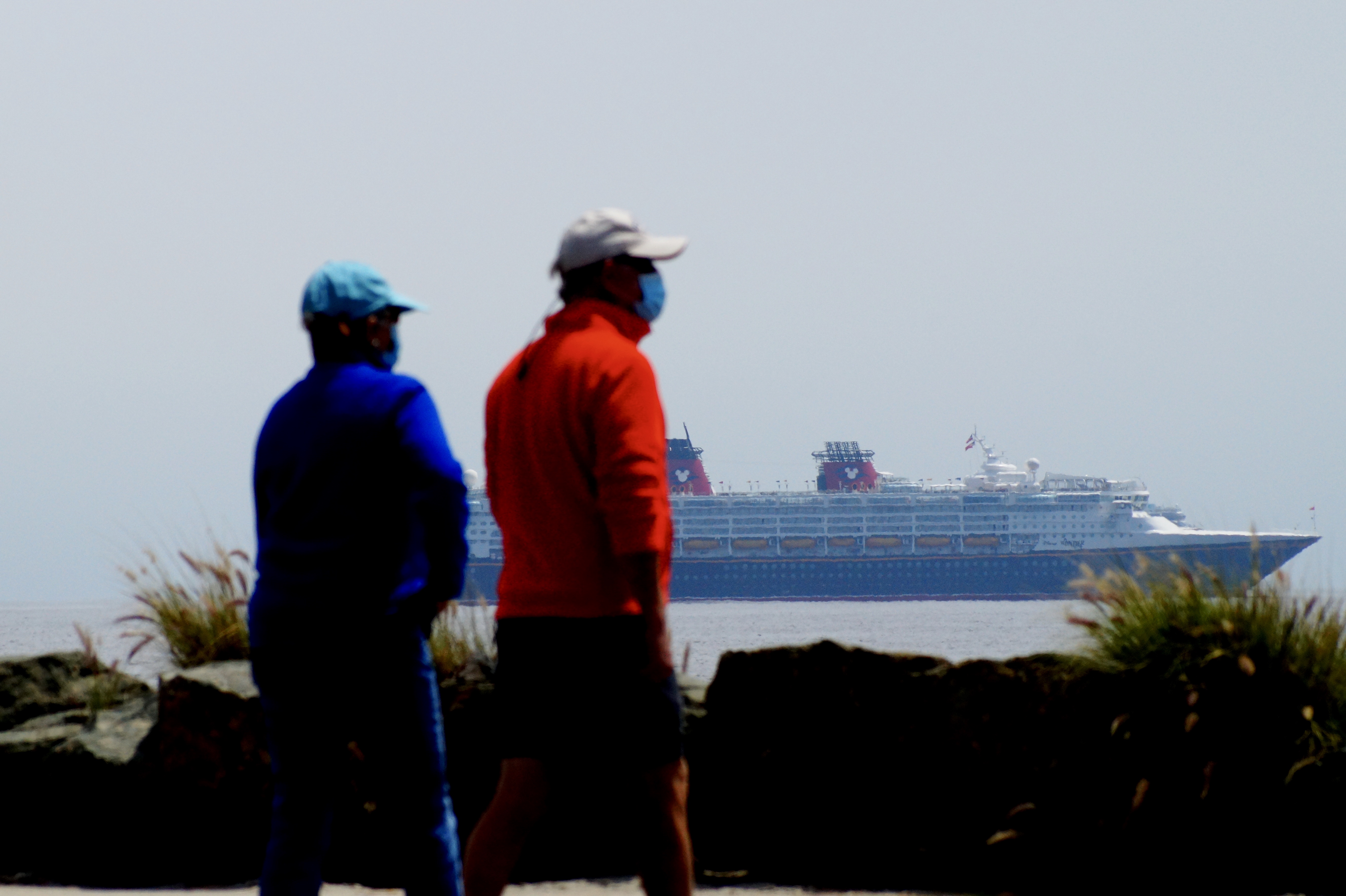
One day, we drove to Coronado where cruise ships sat anchored a mile offshore, slowly spinning in
the current. I’d brought my camera and telephoto lens. Looking through the viewfinder, zoomed all the way in, I noticed there were people wandering the deck of the closest ship—not passengers (they’d all been evacuated by their respective cruise lines) but employees. Their loneliness struck me immediately: so close to land and yet so far from rescue, abandoned upon a giant floating shopping mall whose pleasures weren’t for them and whose purpose had completely disappeared. In a sense, that cruise ship was a microcosm of the world we were all living in then, each of us a Crusoe confined to the islands of our apartments or homes, if we were fortunate enough to have one. I snapped the photo just as a masked couple powerwalked by. That was the moment that inspired the first movement of Pyrrhic Symphony’s title poem (and, as it happens, it’s the first of five photographs that appear in the book): “On the horizon, cruise ships//still crewed, their white dream of hospitality gone/silent as the sun.” That central image soon inspired others, all of them tethered by the same uncanny mixture of boredom and terror that the pandemic provided, illustrating how “fear pull[ed] through me//like a needle drawn by a magnet” because of the many ways in which everyday life had been transformed into a series of unexpected visitations and technical orchestrations—how, ultimately, it had become hard to tell whether we were spiders or flies in the web of commerce we’d woven.
When I had time to myself, I’d ride my bike down deserted boulevards, bandana over my nose like an old west desperado. Pedaling without care for cars—San Diego’s infamous traffic then as dead as the dodo—I reconnected not only with a long-lost sense of youthful suburban freedom but the future the apocalyptic films and news reports of my youth had prepared me for. Growing up in the 80s and 90s, the threat of nuclear war and the reality of AIDS had trained a generation to expect catastrophe, to question government efforts to contain it, and to believe, foolishly, that we might be the one person to survive it, some Hestonesque figure still swinging among the ruins. But, like those cruise ship employees, what good is it to still be swinging when everything else is in shambles? This was the realization that surprised me most when writing “Pyrrhic Symphony”—the return of a core memory from when I was four or five where I watched a house burn down, so awestruck by the spectacle that I didn’t think of who might have lived there or how, hopefully, they escaped. You could chalk this up to the myopia of childhood, but there was something else at play.
Toward the end of my book, in a poem entitled “Stations of the Crossed”, I explore a similar experience pulled from history: the documented delight of the schoolchildren who first encountered the pumice-encrusted skeletons of the people who had, until its eruption, lived in Krakatoa. Divorced from the reality of the disaster, all they had was the surprise of that arrival to guide their response, but when the spectacle of the disaster becomes its only context, what then? This was the question that haunted me when writing Pyrrhic Symphony, but also as I watched our political, environmental, and relational norms crumble. Yet it was also the question that ultimately inspired me to explore how memory put into action can serve as a moral counterweight to the nihilism of a culture seemingly in love with its destruction, and how language, like nature (and hopefully humanity), can flourish in spite of everything that conspires against it.

