Daniel H. Usner is Holland N. McTyeire Professor Emeritus of History at Vanderbilt University. He is the author of Native American Women and the Burdens of Southern History and Weaving Alliances with Other Women: Chitimacha Indian Work in the New South, among other books. In 2024 Usner was awarded the Lifetime Achievement Award from the American Society of Ethnohistory. Usner’s latest book, From Bayou Teche to Fifth Avenue was published last month.
From Bayou Teche to Fifth Avenue is in part the consequence of a life-long interest in “things” which began at my father’s auto repair shop and gas station six decades ago. There I frequently inventoried everything in stock from spark plugs and oil cans to batteries and tires and participated daily in their purchase from suppliers and sale to customers. I like to think that those years spent at my dad’s business helped shape my early interest as a historian in the small-scale exchange of things between Indigenous and colonial peoples in the Lower Mississippi Valley. As my work moved chronologically from the eighteenth into the nineteenth and early twentieth centuries, I then began to learn how Native Americans in that region and elsewhere came to rely even more on the production and sale of cultural objects not only for income but for representation of their identity and sovereignty as well. And it quickly became apparent that I also needed to confront the vexing ways in which non-Native observers and consumers perceived and portrayed Indigenous marketing of things like baskets, ceramics, and beadwork.
Even with all that background experience of studying the cross-cultural exchange of material objects, however, I was hardly prepared for the surprising direction my research would rather suddenly take. The Chitimacha Tribe of Louisiana was one among several groups that I had intended to include in an overview study of Gulf South Indigenous communities, but thanks to a wooden box discovered inside an old house on Avery Island, Louisiana, that nation’s history from the 1890s through the 1940s became the primary focus of a decade and a half of research and writing. Inside that box, made available to me by McIlhenny Company archivist Shane Bernard, I found a cache of documents that included nearly one hundred letters written by Christine Paul, a Chitimacha weaver, mostly to Mary McIlhenny Bradford, a daughter of the Tabasco Pepper Sauce company’s founder and a passionate patron of Chitimacha basketry. That rare access to the agency and voice of an Indigenous woman during what was a perilous period in her nation’s history, along with her collaborative relationship with Bradford, set me on winding paths that would take me back and forth from the Chitimacha homeland on Bayou Teche to many different and distant places.
My priority was always to feature what happened inside and around the Chitimacha community during the first half of the twentieth century. As soon as that wooden box crammed with documents came to my attention, I let the Chitimacha Tribe of Louisiana’s cultural director know what had been found. Kimberly Walden quickly proceeded to scan the manuscripts for her nation’s archive and patiently remained an invaluable advisor throughout the progress of my work. Painfully confronting dispossession and racial violence without federal protection but also creatively pursuing ways to persevere, the Chitimacha story is emblematic of what many other Indigenous communities endured in the Jim Crow South.
Those documents preserved by Mary McIlhenny Bradford, however, also enticed me to travel to archives and museums far away from Bayou Teche. Mary Bradford and her sister Sara McIlhenny corresponded with many individuals and organizations engaging in that period’s craving for Native American baskets. Letters and printed material contained in the box detail movement of thousands of baskets that left the hands of their Chitimacha weavers, then passed through the hands of Mary Bradford and Sara McIlhenny, and finally fell into the possession of dealers, museums, and private collectors across the United States. Consequently, I decided not only to track as much as possible the circulation of specific baskets to places they landed but also to search for extant correspondence from the McIlhenny sisters to persons who wrote to them. This endeavor took me into museum archives and collections—spaces where none of my previous work had taken me—which yielded remarkable results. There I found a significant number of letters handwritten by Bradford and McIlhenny and received by ethnographers and curators at institutions in Boston, New York, Philadelphia, Washington D.C., and elsewhere.
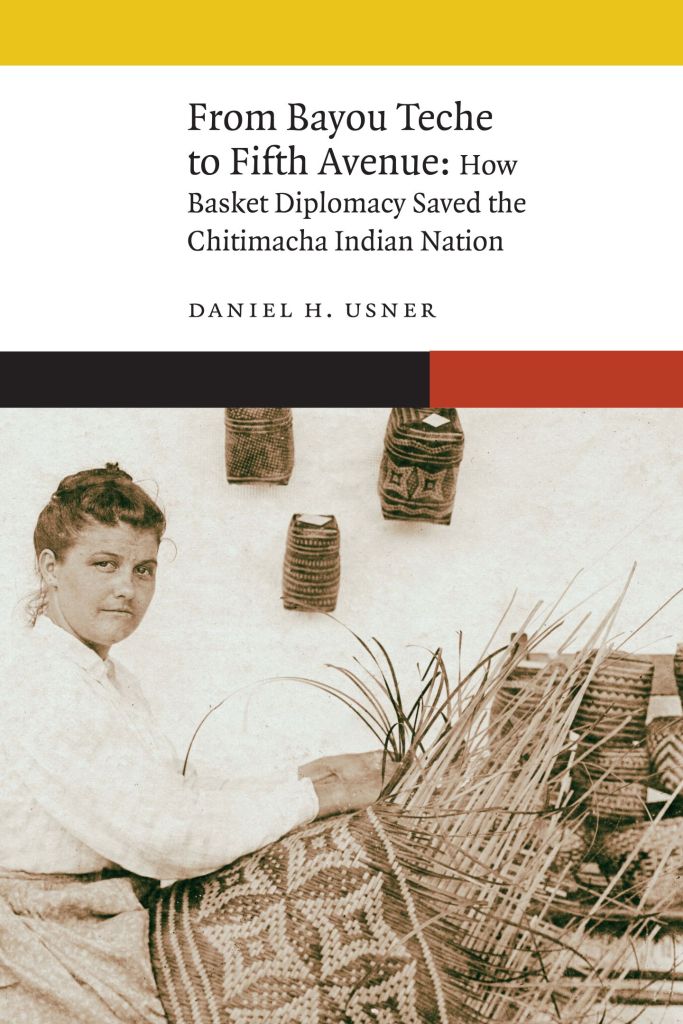
Although it was gratifying to connect letters with baskets held in museum cabinets and on shelves, the experience also heightened my awareness of what removal of cultural objects from their origins to such destinations meant back then and mean now. Along with learning why and how Chitimacha women made so many baskets, I needed to grasp what anthropologists, arts and crafts collectors, educators, and artists thought about them. Making and selling rivercane baskets, as I argue in From Bayou Teche to Fifth Avenue, proved to be a strategic way to preserve territory and sovereignty as well as a necessary source of income. But once they left the skillful hands of those Chitimacha women who created them, the baskets were assigned by patrons, purveyors, and collectors an array of purposes and meanings far removed from the weavers’ world—purposes largely fixed on an imagined pastness of things made by “vanishing Indians.” Rather ironically, though, the weavers were making and selling those things for the sake of their people’s future—only one example of how Indigenous people for centuries have turned tools of colonization into ones of resistance and negotiated colonial circuits and spaces on Native terms. Today, given serious concern for careless treatment of Indigenous objects by non-Native collectors and institutions, that ongoing effort of resistance and negotiation includes reconnecting with those objects and expecting greater respect for Indigenous views and voices in how their culture is represented. Tracking the circulation of things like letters and baskets as attempted in my work, I hope, might offer a modest contribution to that process.

