Happy University Press Week! Help us celebrate university presses November 10-14. Since 2012, members of the Association of University Presses have participated in an annual celebration of University Presses.
This year’s theme for UP Week is “Team UP,” to celebrate the ways that university presses and their authors Team UP with a vast network of reviewers, booksellers, freelancers, translators, librarians, teachers, and students to advance knowledge and understanding.
The #UPweek blog tour today asks “WHY does your press #TeamUP?” Posts on today’s topic, exploring why it’s important for presses and the publishing community to support the open exchange of ideas and expertise along with curtailing misinformation and censorship, come from Temple University Press, University of Illinois Press, Bucknell University Press, Leuven University Press, University of Alabama Press, John Hopkins University Press, Bristol University Press, Mercer University Press, Clemson University Press, SUNY Press, and Edinburgh University Press.
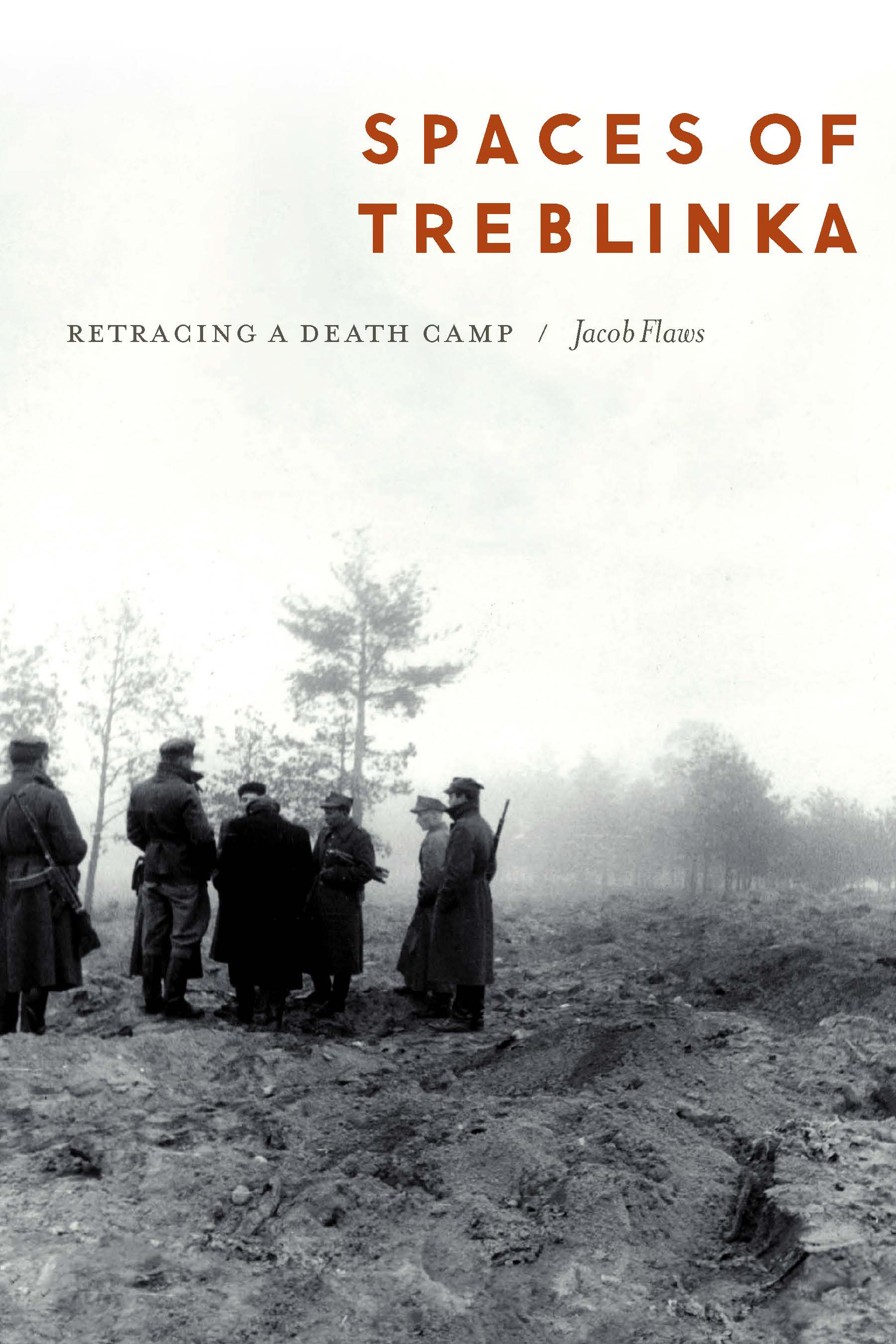
For our contribution, Jacob Flaws, author of Spaces of Treblinka: Retracing a Death Camp, will discuss the importance of accessible scholarly work in our current media ecosystem.
The Holocaust was an event fundamentally defined by nuance. What happened on the ground locally in towns, villages, railway stations, houses, backyards, and in the most intimate of interpersonal interactions determined much about who lived, who died, who perpetrated crimes, who benefitted from violence, and who saved lives. While ideologies and large-scale forces matter in determining the course of history, the events that compose that story transpire in millions of disparate transactions.
My recent book Spaces of Treblinka (Nebraska, 2024), repositions our perspective towards the fundamental, human elements that constituted the horrific Nazi death camp. The questions I ask are seemingly obvious ones: How did the camp smell to neighbors in the region? What did the smoke plumes rising into the sky from thousands of burning bodies look like from 5 kilometers away? Why did a person jumping from a death train choose to knock on the door of that house instead of this one? The answers are revealing in determining how many small decisions snowball into a cascading series of contingencies that come to define earth-shattering events like genocide.
Scholarship like this is more important now than it ever has been. In a world of algorithms and skewed sources, we are prone to be sucked into broad narratives that overgeneralize history as some predetermined path that occurred in some type of self-contained sequence. Rarely is this true, though. Humans are much more likely to behave in remarkably similar ways irrespective of generational differences, as nuanced explorations of the past show us time and again.
Recently, I participated in an r/AskHistorians forum on Reddit where users could ask me any question they wanted as it related to my book and my expertise. The interactive exchange of ideas and free-flowing conversation that ensued renewed my hope in society’s ability to have meaningful dialogues about challenging topics. Central to creating such a conducive atmosphere is starting with mutual respect for the other person. Just as the questioner approached our interaction as an opportunity to engage with a subject matter expert, so too I approached it with eager anticipation of a thoughtful conversation with a fellow lover-of-learning.
Finding that common connective tissue that unites us in our innate human curiosity allowed for an experience that deeply impacted me. Approaching the table as equally-interested humans capable of rational thought allowed for the shedding of preconceived judgments that often get in the way of our world’s echo chambers and selective censorship. The exchange I had that day was respectful, encouraging, constructive, and meaningful. And it made me reflect not only on our current, perhaps precarious moment, but also on the one I study.
Why did one neighbor help a death camp escapee when others did not? Why did the entire world not go mad with the fevers of totalitarian ideologies and hateful fantasies of racially-engineered utopias? What saved mankind from total destruction at the end of a war that saw the creation of the very means to do just that?
I don’t think I oversimply things to say it was seeing the common humanity in the other; recognizing that what we share vastly outmatches that which we don’t. What emerged from the violence of aerial bombardment, nuclear weapons, genocide, and inhumanity that defined World War II was that democratic ideals founded upon not only possessing diverse viewpoints, but freely and openly sharing those ideas represented one of the most cherished bulwarks against the wanton, indiscriminate destruction wrought by authoritarian nightmares.
Pulling this lesson from the Second World War or the death camp at Treblinka seems fairly straightforward. But pulling it from the simple pleasure of sharing a conversation based on a mutual love of learning reiterates its importance not just for our macro-level existence as a society, but as one that sustains us in our common pursuits in the nuanced, everyday realities and interactions that comprise it.
Jacob Flaws is an assistant professor of history at Kean University.

