Randolph Lewis is a professor of American studies at the University of Texas at Austin. He is the author of “Navajo Talking Picture”: Cinema on Native Ground (Nebraska, 2012), Alanis Obomsawin: The Vision of a Native Filmmaker (Nebraska, 2006), and Under Surveillance: Being Watched in Modern America. His new book Bummerland: Ruin and Restoration in Trump’s New America (Bison Books, 2026) was published in March.
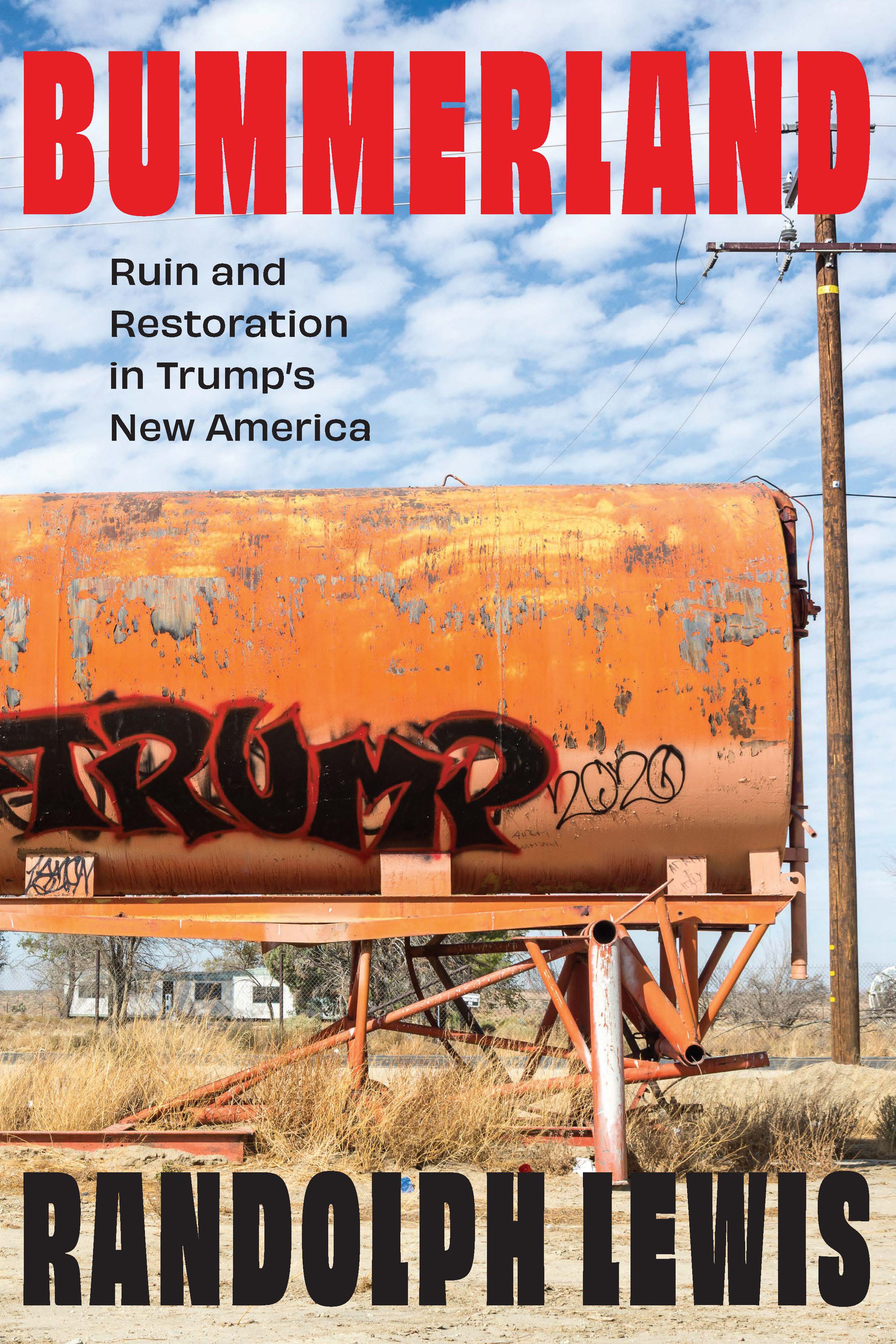
With radical candor and sardonic wit, Randolph Lewis offers an autopsy of the recent past, looking for glimmers of hope and redemption among the detritus strewn about by neo–Gilded Age billionaires, Big Tech, and political extremes during the first Trump administration and the pandemic era. American life took a weird turn in June 2015, when an aging reality star descended a golden escalator to announce his bid for the White House. From there, Lewis watched from his longtime home in the Lone Star State as the country slipped into an endless fever dream churning with chaos, uncertainty, and fear.
Wanting to decipher how things went sideways in such a hurry, Lewis drove all over the Sunbelt and beyond, trying to make sense of what was happening. In this passionate critique of the anxious new world we inhabit, Lewis offers sketches of where we’ve ended up, why it feels so wrong, and how we might find our way out of Bummerland.
Introduction
American life took a weird turn in June 2015, when an aging reality star descended a golden escalator in a Manhattan high rise to announce his improbable bid for the White House. From that moment forward, it felt like the country began to slip into an endless fever dream churning with chaos, uncertainty, and fear. Wanting to capture something about how things went sideways in a hurry, I drove all over the Sunbelt trying to understand what was happening. I went on sojourns to an apocalyptic slab of the Mojave Desert, the paradoxical land around Colorado Springs, the seductively deranged city known as Las Vegas, the expat communities of Central Mexico, the racial hot spots of the Deep South, and even the fjords of Norway, from which, surreally, I watched the unfolding news of the school shooting in Uvalde, Texas, and decided I would head there. Other people would cover the major stories of Trump and Biden’s America for years to come, but as an American studies professor for almost three decades, I wanted to write in a different register, one that was darkly comic, mournful, meditative, and personal. Hoping to offer a different kind of portrait of American life in the 2020s, I tracked a complex trajectory of cultural burnout mixed with a profound yearning for something better than a Neo–Gilded Age of fear, hustle, and hype.
What emerged is a book about Apple Inc., apocalypse culture, the American West, backwoods murder, the musician Bill Callahan, civil rights tourism, consumerism, depression, Elon Musk, expat life, fascism, Idiocracy, infertility, January 6, jewel thieves in my backyard, Joy Division, Las Vegas, the Lone Star state, lowered expectations, postmodernism, sex robot brothels, suburban blues, surrealist comedy, tent cities of the homeless, toxic masculinity, the Trump family, and trauma. All these angles allow me to sketch out something important about the era when America lurched uncertainly into the 2020s with its democratic norms barely intact and its systems straining. In his recent book on James Baldwin, the scholar Eddie S. Glaude followed the extraordinary writer’s footsteps to France, looked back over his shoulder, and thought about his own life at home as a Black man in the Trump years. He then expressed something that I think many people have felt in recent years: “For me the daily grind consumes. I cannot escape the news. I am drowning in it, and in all the nastiness of a country that seems, or feels, like it’s going underwater.” Or as The Economist put it during the pandemic, “The shared world is increasingly intolerable.” Or to quote a Slate headline from election night 2024: “Americans Just Voted to Burn It All to the Ground.”
It’s not all grim. Early in the pandemic, the novelist Marilynne Robinson wrote a powerful essay describing how the crisis had revealed the flimsiness of a system that had long seemed rock-solid. It contains this oddly hopeful passage: “Over the decades we have consented, passively for the most part, to a kind of change that has made this country a disappointment to itself, an imaginary prison with real prisoners in it. Now those imaginary walls have fallen if we choose to notice. We can consider what kind of habitation, what kind of home we want this country to be.” Even if she penned these words well before the Supreme Court stripped away long-cherished rights, long before The Guardian opined in 2023 that “serial liar George Santos is the politician Americans deserve,” and long before venture capitalist fauxbilly J. D. Vance served up nasty propaganda about Haitian immigrants eating puppies in the final weeks before the 2024 election, I remain hopeful that we might find some kind of salvation in recognizing our systemic failures and rethinking our national identity. Perhaps everything is terrible, as one snarky website puts it, but even more reason to imagine that something sweeter is possible. We deserve better than what we’ve endured in the chaotic wake of the forty-fifth/forty-seventh president, who has taken the worst elements of American capitalism, nationalism, and celebrity worship and elevated them into a rancorous political ideology of hate and neglect.
Bummerland explores how things are curdling under the surface and why the country often feels more like a woodchipper for the soul than a safe place to call home. This is the subject of essays that range mostly across the U.S. West, with a special emphasis on the mysteries of the Lone Star state, where I have lived much of my life, watching this strange red giant called Texas from the relative safety of its funky blue capital of Austin. On and off since the mid-1980s, this super-hyped Sunbelt metropolis has been my home base for exploring an unsettling new world of dead ends: young people who will never afford a home, never pay off their student loans, never have job security. Forty-somethings who will never have a pension and worry about “memory care” insurance policies in case they suffer dementia in their final years. Older people who can never retire (the average American retired with less than $90,000 in savings in 2024 while estimating that they would need $1.46 million to “retire comfortably”; even worse, 25 percent of them hit sixty-five without any savings at all). Health care that is so costly and heartless that the internet explodes with laughter when a CEO is assassinated on the streets of Manhattan. Social media and streaming platforms that often leave us disconnected while providing the illusion of connection. Cities that are designed for cars instead of community, making them “easy to get to, but not worth arriving at.”
Frankly, it sucks. Like a lot of people, I am often wiped out from the stress, uncertainty, and despair of living in such chaotic times. Suffering from a raft of health problems that I describe in an essay called “Healing Inc.,” I barely squeaked through lockdown life under Trump and its muddled aftermath, not to mention his disheartening political resurrection in 2024—and yet I still carry a utopian spark that these years haven’t extinguished. I know things could be different if we could reimagine the cruel structures—national, economic, social, ideological—in which we are stuck.

